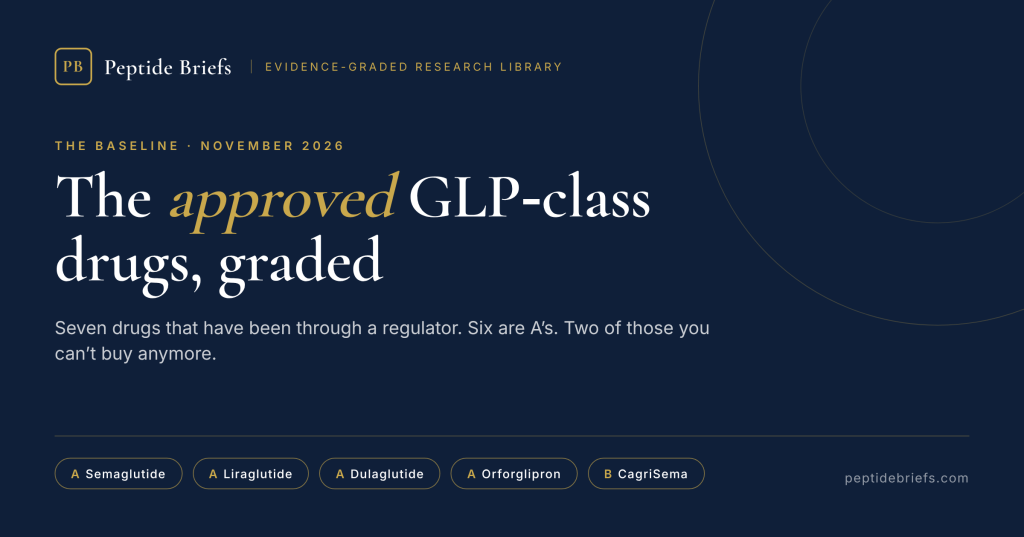
Six A’s, two you can’t buy, one that isn’t a peptide. What the grade tells you, and what it doesn’t.
Peptide Briefs · · Troy Snyder, Ed.D., MBA
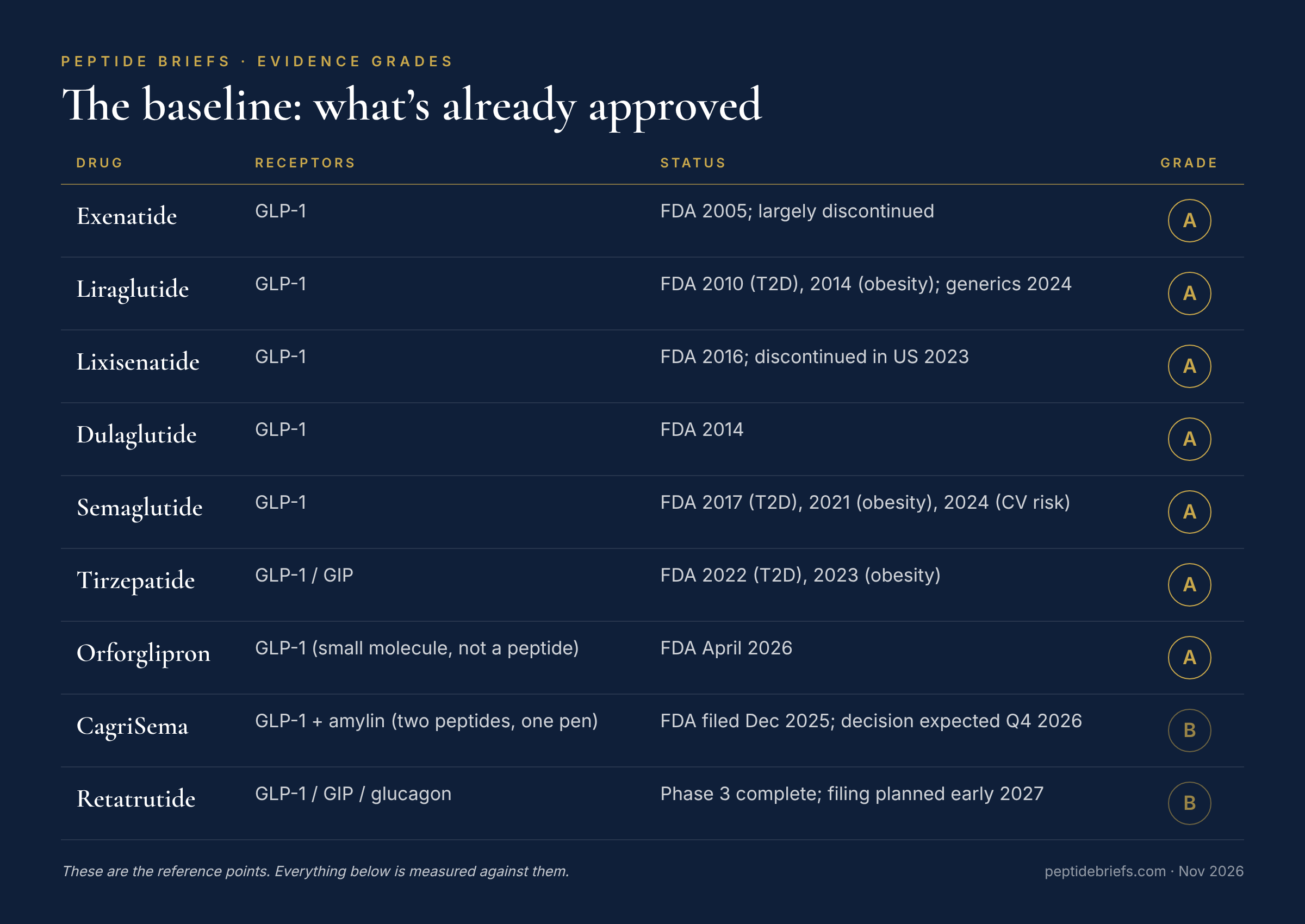
The field guide covered the pipeline. This is the other half of the map: the GLP-class drugs that have already been through a regulator, plus the one combination sitting on the FDA’s desk right now. Seven compounds, each graded the same way the rest of the library is graded. A means peer-reviewed pivotal trials plus a completed regulatory safety review; B means peer-reviewed phase 3 or strong phase 2 without a regulator’s sign-off.
Six of the seven are A’s, and that is the point of writing them up. An A is not a recommendation and it is not a claim that the drug is the best in its class. Exenatide is an A and has been pulled from the US market. Lixisenatide is an A and was discontinued because nobody wanted it. The grade says the evidence is complete and reviewed. What you do with that is a different question.
Each section below is short on purpose. These are the best-documented drugs in the entire library, and the full trial records run to hundreds of papers each. I’ve pulled the pivotal trial, the cardiovascular outcomes trial where one exists, the approval history, and the caveat that matters most. Full compound pages will follow for the ones people actually search for.
Semaglutide
Evidence grade: A · Also known as Ozempic, Wegovy, Rybelsus; GLP-1 S on some vendor menus.
What it is. A once-weekly GLP-1 receptor agonist, 31 amino acids, with a C18 fatty diacid on lysine 26 that binds albumin and gives it a half-life of about a week. The oral form uses an absorption enhancer (SNAC) and a much higher dose to get across the stomach wall.
Why it’s an A. The STEP program (STEP 1, NEJM 2021: 14.9% weight loss at 68 weeks versus 2.4% placebo in 1,961 adults) and the SUSTAIN program for diabetes are peer-reviewed. SELECT (NEJM 2023; 17,604 adults with cardiovascular disease and no diabetes) showed a 20% reduction in major adverse cardiovascular events, the first time an obesity drug did that. FLOW (NEJM 2024) showed kidney protection in type 2 diabetes. The FDA has reviewed all of it: Ozempic for diabetes (December 2017), Rybelsus oral for diabetes (September 2019), Wegovy for obesity (June 2021), cardiovascular risk reduction (March 2024), MASH (August 2025), and the oral Wegovy 25 mg pill (December 22, 2025, based on OASIS 4: 16.6% at 64 weeks).
Caveat. The gastrointestinal burden is real (74% of STEP 1 participants versus 48% on placebo) and weight returns when treatment stops: the STEP 1 extension showed two-thirds of lost weight regained within a year off drug. Loss of lean mass is a live research question. Semaglutide is also the most counterfeited drug in this class; the FDA stated in June 2026 that sales of unapproved semaglutide products to consumers are illegal, and research-use-only labeling does not change that.
Key references. Wilding JPH et al., STEP 1, N Engl J Med 2021;384:989 (PMID 33567185). Lincoff AM et al., SELECT, N Engl J Med 2023;389:2221 (PMID 37952131). Marso SP et al., SUSTAIN-6, N Engl J Med 2016;375:1834 (PMID 27633186). Wharton S et al., OASIS 4, N Engl J Med 2025 (PMID 40934115).
Tirzepatide
Already has its own page: Tirzepatide (A). Listed here for completeness of the baseline.
Liraglutide
Evidence grade: A · Also known as Victoza, Saxenda; generic liraglutide.
What it is. A once-daily GLP-1 receptor agonist with a C16 fatty acid on lysine 26, half-life about 13 hours. The direct ancestor of semaglutide: same strategy, shorter tail.
Why it’s an A. SCALE Obesity and Prediabetes (NEJM 2015; 3,731 adults) showed 8.0% weight loss at 56 weeks on 3.0 mg versus 2.6% placebo. LEADER (NEJM 2016; 9,340 adults with type 2 diabetes) showed a 13% reduction in major cardiovascular events and a 22% reduction in cardiovascular death, which made liraglutide the first GLP-1 with a cardiovascular indication (2017). FDA approvals: Victoza for diabetes (January 2010), Saxenda for obesity (December 2014), pediatric diabetes (2019), pediatric obesity (2020). Generic Victoza was approved in December 2024 (Teva, Hikma) and generic Saxenda in August 2025 (Teva), the first generic GLP-1 for weight management.
Caveat. Daily injection, and the weight loss is roughly half of semaglutide’s in head-to-head data (STEP 8: 15.8% versus 6.4%). A 2024 analysis flagged bone-density declines in Saxenda-treated patients. It matters now mostly because it is the cheapest approved GLP-1 in the US and the one most likely to be substituted for an off-label or compounded product.
Key references. Pi-Sunyer X et al., SCALE, N Engl J Med 2015;373:11 (PMID 26132939). Marso SP et al., LEADER, N Engl J Med 2016;375:311 (PMID 27295427). Rubino DM et al., STEP 8, JAMA 2022;327:138.
Dulaglutide
Evidence grade: A · Also known as Trulicity.
What it is. Two GLP-1 analogue chains fused to a modified human IgG4 Fc fragment, which is why it is dosed weekly and why it is technically a fusion protein rather than a lipidated peptide.
Why it’s an A. The AWARD program established glycemic efficacy; FDA approval for type 2 diabetes came in September 2014. REWIND (Lancet 2019; 9,901 adults, median 5.4 years, the longest GLP-1 outcomes trial) showed a 12% reduction in major cardiovascular events in a population that was mostly primary prevention, which earned a cardiovascular indication in February 2020 covering both people with and without established heart disease. Weight loss is modest: about 1.5 kg in REWIND, 4 to 5 kg at the higher 3.0 and 4.5 mg doses in AWARD-11.
Caveat. It is a diabetes drug, not an obesity drug, and has never been submitted for weight management. Anyone marketing it as a weight-loss peptide is working from the wrong trial record. Not available as a generic.
Key references. Gerstein HC et al., REWIND, Lancet 2019;394:121 (PMID 31189511). Frias JP et al., AWARD-11, Diabetes Care 2021;44:765.
Exenatide
Evidence grade: A · Also known as Byetta, Bydureon, Bydureon BCise; exendin-4.
What it is. The original. A 39-amino-acid peptide first isolated from Gila monster venom, about 53% identical to human GLP-1 and resistant to DPP-4 breakdown, with a half-life of about 2.4 hours. Byetta was twice-daily; Bydureon wrapped it in microspheres for weekly dosing.
Why it’s an A. FDA approval in April 2005 made it the first GLP-1 receptor agonist on the market. The AMIGO trials established glycemic control; Bydureon (weekly) followed in 2012. EXSCEL (NEJM 2017; 14,752 adults) showed cardiovascular safety (non-inferiority) but not benefit, with a hazard ratio of 0.91 that just missed significance.
Caveat. This is an A for a drug you can barely buy. AstraZeneca discontinued Byetta and Bydureon BCise in the US in October 2024 as a business decision; Amneal’s generic exenatide (Byetta equivalent) was approved in November 2024 and is the only form still sold. Weight loss was never the point: 2 to 3 kg in the diabetes trials. It belongs in the library because the entire class descends from it and because it still turns up on research vendor menus at prices that make no sense for a drug with an approved generic.
Key references. Holman RR et al., EXSCEL, N Engl J Med 2017;377:1228 (PMID 28910237). DeFronzo RA et al., AMIGO, Diabetes Care 2005;28:1092.
Lixisenatide
Evidence grade: A · Also known as Adlyxin (US), Lyxumia (EU); the lixisenatide half of Soliqua.
What it is. A once-daily exendin-4 derivative with a C-terminal polylysine tail, 44 amino acids, short-acting. Its distinguishing feature was a strong effect on post-meal glucose through gastric emptying, with less effect on fasting glucose.
Why it’s an A. GetGoal program for glycemic control; FDA approval July 2016. ELIXA (NEJM 2015; 6,068 adults after an acute coronary event) showed cardiovascular safety but no benefit, hazard ratio 1.02.
Caveat. Sanofi discontinued standalone Adlyxin in the US effective January 1, 2023, citing competition and poor sales; it survives only inside Soliqua (with insulin glargine). Weight effect was minimal, around 1 kg. Grade A, commercially dead. If a vendor is listing it, ask what possible research question it answers that liraglutide does not.
Key references. Pfeffer MA et al., ELIXA, N Engl J Med 2015;373:2247 (PMID 26630143).
Orforglipron
Evidence grade: A · Also known as Foundayo. Not a peptide.
What it is. A once-daily oral small molecule that activates the GLP-1 receptor. Discovered by Chugai, licensed to Lilly in 2018. Because it is not a peptide it has no absorption problem, no food or water restrictions, and cannot be made by peptide synthesis; it belongs in this library only because readers will see it next to the peptides everywhere else.
Why it’s an A. ATTAIN-1 (NEJM 2025; 3,127 adults without diabetes, 72 weeks) showed 12.4% weight loss at the top dose if everyone adhered, 11.1% on the treatment-regimen estimand, versus 2.1% placebo. ATTAIN-2 covered type 2 diabetes. The FDA approved it for chronic weight management on April 1, 2026, 50 days after filing under the national priority voucher program; diabetes is a separate pending submission. UK authorization followed in 2026.
Caveat. It loses to every injectable on the scale: roughly half of tirzepatide’s effect and below oral Wegovy’s 16.6%. Nausea ran 29 to 36% versus 10% on placebo, and the approved dose ladder (0.8 to 17.2 mg) differs from the trial’s titration without a published explanation. No cardiovascular outcomes data yet. Boxed thyroid warning like the rest of the class.
Key references. Wharton S et al., ATTAIN-1, N Engl J Med 2025;393:1796 (doi 10.1056/NEJMoa2511774). FDA approval announcement, April 1, 2026.
CagriSema
Evidence grade: B · Cagrilintide 2.4 mg plus semaglutide 2.4 mg, once weekly, one pen.
What it is. A fixed-dose combination of an amylin analogue and a GLP-1 analogue, two separate peptides co-formulated. Each half has its own page or will shortly: cagrilintide (B) is live; semaglutide is above.
Why it’s a B and not an A. The pivotal trials are peer-reviewed: REDEFINE 1 (NEJM 2025; n = 3,417) showed 20.4% weight loss at 68 weeks, 22.7% if everyone adhered, versus 3.0% placebo; REDEFINE 2 (NEJM 2025; type 2 diabetes) showed 13.7%. But no regulator has finished a review. Novo Nordisk filed with the FDA on December 18, 2025 and has guided to a decision in the fourth quarter of 2026. REDEFINE 4, the open-label head-to-head against tirzepatide 15 mg, missed its non-inferiority endpoint in February 2026 (20.2% versus 23.6% at 84 weeks). The cardiovascular outcomes trial (REDEFINE 3) is ongoing.
Caveat. Four in five participants had gastrointestinal side effects. Only 57% of the REDEFINE 1 CagriSema group reached the top dose under a flexible protocol, which the sponsor cites as context for the tirzepatide miss and critics read the other way. A higher-dose version (2.4/7.2 mg) starts phase 3 in the second half of 2026. This grade changes the day the FDA rules; watch Grade Changes.
Key references. Garvey WT et al., REDEFINE 1, N Engl J Med 2025 (doi 10.1056/NEJMoa2502081). Davies MJ et al., REDEFINE 2, N Engl J Med 2025 (doi 10.1056/NEJMoa2502082). Novo Nordisk, REDEFINE 4 announcement, February 23, 2026.
What the baseline tells you
Three things stand out when the approved drugs are lined up this way.
First, the A grade is about evidence, not usefulness. Two of the six A’s are discontinued, one was never a weight-loss drug, and one isn’t a peptide. If you are reading this library to decide which compound is interesting, the grade is the floor, not the answer.
Second, the cardiovascular outcomes trials are the real dividing line inside the A’s. Liraglutide, semaglutide and dulaglutide showed benefit. Exenatide and lixisenatide showed safety only. That difference, more than the weight numbers, is why the first three dominate prescribing.
Third, every pipeline compound in the field guide is measured against this table. UBT251’s 19.7% at 24 weeks is impressive because tirzepatide’s 72-week number is about 21%. Survodutide’s 13% is underwhelming because semaglutide’s is 15%. The baseline is what makes the pipeline numbers mean anything.
Peptide Briefs is an independent reference and does not sell anything. Its owners co-own a research-peptide vendor; that is disclosed on every page. Nothing here is medical advice or a dosing recommendation.


Leave a Reply