• WHAT ACTUALLY HAPPENS TO A PEPTIDE BEFORE IT REACHES THE VIAL

    WHAT ACTUALLY HAPPENS TO A PEPTIDE BEFORE IT REACHES THE VIAL

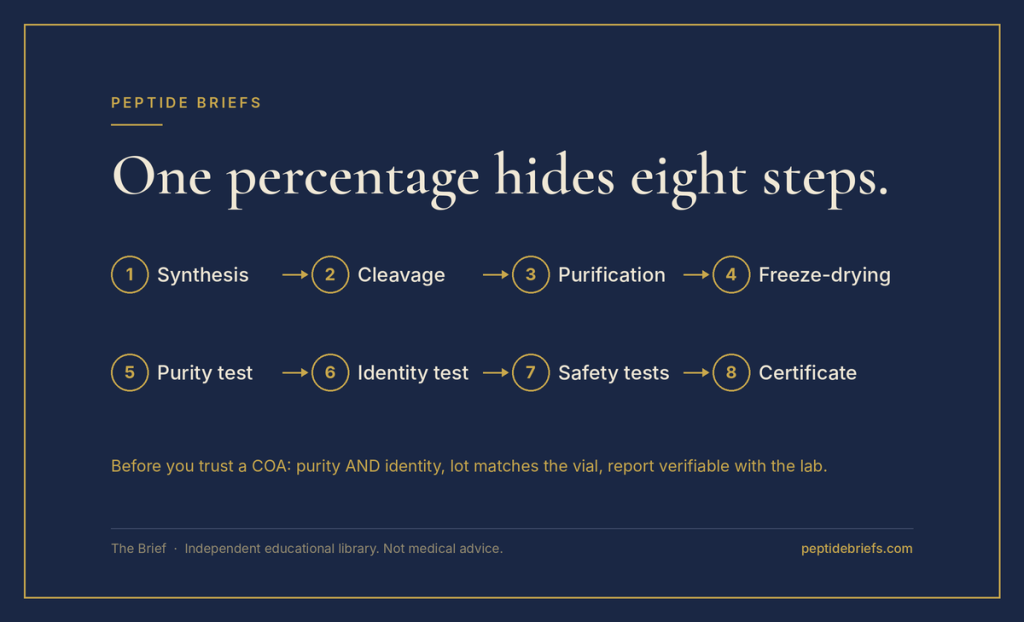
    Eight steps, and where each one can go wrong.

    A label says “99% pure.” It doesn’t say what happened before that number. Here is the path of one lot from chemistry to certificate, with the question to ask at each step.

    This is about manufacturing and testing. It is research-use-only information, not guidance for use in people.

    A note on where this comes from. I spent two years living in China, where I observed the peptide industry up close: I met vendors and manufacturers and visited their labs. I’m not a chemist, and this post doesn’t pretend to be a lab manual. It’s what I learned about how a lot moves from synthesis to certificate, and about which questions separate a real certificate from a PDF.

    SYNTHESIS
    Amino acids are joined one at a time on a resin bead. No step is perfect.
    Make Simple: at 99% efficiency per step, a 30-amino-acid peptide comes out roughly three-quarters full-length. The rest is near-miss sequences.
    Ask: how was the batch made, and how was the crude product cleaned up?

    CLEAVAGE
    The chain is chemically cut from the resin. What comes off is a mixture: the target, truncated pieces, deleted sequences, leftover reagents.

    PURIFICATION
    Preparative HPLC separates the target from the junk. Which fractions get kept is a judgment call, and it sets the final purity.

    FREEZE-DRYING
    The purified peptide is freeze-dried into powder. That powder is not 100% peptide. It also holds water and counterions such as TFA or acetate.
    Make Simple: “net peptide content” tells you how much of the powder is actually peptide.
    Ask: is net peptide content reported?

    PURITY TEST
    Analytical HPLC reports the share of the signal that belongs to the main peak.
    Make Simple: purity tells you how clean. It does not tell you what it is.

    IDENTITY TEST
    Mass spectrometry checks the molecular weight. Without it, a clean peak could still be the wrong molecule.
    Ask: is identity confirmed, and by what method?

    SAFETY TESTS
    Endotoxin and microbial testing are separate from purity. A certificate that lists only HPLC doesn’t cover them.

    THE CERTIFICATE
    A COA is a claim about one lot.
    Check: the lot number matches the vial. The report number can be verified with the lab itself, not just a PDF. The methods are listed. An independent lab ran it. The lab’s accreditation status is stated honestly.THE JOURNEY IN ONE LINE
    Synthesis → cleavage → purification → freeze-drying → purity → identity → safety → certificate

    THE BIG TAKEAWAY
    A single percentage hides seven other steps. Before you trust a COA, ask:

    1. Does it show purity AND identity?
    2. Is net peptide content reported?
    3. Were endotoxin and microbial tests run?
    4. Does the lot match the vial?
    5. Can the report number be verified with the lab?

    Which of these do you see missing most often?

    This post describes general peptide manufacturing and analytical practice. It makes no claim about any specific product or supplier.

    Also published on Substack.

  • Retatrutide: what the trials tested, and why a court is counting amino acids

    A viral cost estimate, a federal appeal, and what is still unknown

    Evidence grade: B (unchanged). Reviewed October 2026.

    Retatrutide was hard to miss this week. One widely shared post worked out what it would cost to give it to every American with obesity. Another reported that Eli Lilly is in court with the FDA over how many amino acids it contains. Both are worth a closer look, because each rests on a number that is easy to get wrong.

    The viral math

    The cost estimate assumed two things: a price of $1 per milligram, and 3 mg a week as a dose that works for most people.

    The dose. No trial has tested 3 mg as a maintenance dose. The Phase 2 obesity trial tested 1, 4, 8 and 12 mg. The pivotal Phase 3 trial, TRIUMPH-1, tested 4, 9 and 12 mg, with 2 mg used only as a starting step. At 80 weeks, average weight loss was 19.0% on 4 mg, 25.9% on 9 mg and 28.3% on 12 mg. What 3 mg does over a year or more is not something the published evidence can tell you.

    The price. Retatrutide is not approved in any country, so it has no list price. Lilly says it is legally available only to people in its clinical trials. A figure of $1 per milligram describes grey-market material that no regulator has examined. In August, Lilly announced six lawsuits against sellers of “research-use” retatrutide and said it had referred more than 200 others to authorities. A price for an unverified vial tells you nothing about what the medicine will cost.

    The larger argument, that treating obesity could pay for itself, may or may not be right. It needs real doses and real prices before anyone can check it.

    The court case

    Under FDA rules, a “protein” is an amino acid chain with a defined sequence that is greater than 40 amino acids long. Proteins are regulated as biologics. Shorter peptides are regulated as drugs.

    Retatrutide sits on that line. Its backbone has 39 amino acids. Attached to it is a side chain that Lilly says contains two more, which makes 41. The FDA says only alpha amino acids count and that one of the side chain’s two is not an alpha amino acid. By the FDA’s count the total is 40, which is not greater than 40.

    The classification matters for two reasons:

    • Exclusivity. Biologics get 12 years of protection from competition. New drugs get 5.
    • Compounding. Compounding pharmacies cannot make biologics. A biologic label would close the door that let pharmacies make copies of semaglutide and tirzepatide during shortages.

    Where it stands

    DateWhat happened
    March 18, 2024FDA designates retatrutide a drug, not a biologic
    September 3, 2024Lilly sues in federal court in Indiana
    September 30, 2025The court sides with FDA on the meaning of “protein,” and sends a second question, whether retatrutide is “analogous” to one, back to the agency
    February 2026Lilly appeals to the Seventh Circuit
    September 24, 2026The appeal is argued

    We found no report of a decision as of October 12.

    Whichever way the court rules, it is a decision about legal category. It adds nothing to what is known about whether retatrutide works or is safe.

    What is still unknown

    • The pivotal trial is not yet in a journal. TRIUMPH-1 was presented in full in June. As of this review we have not found a peer-reviewed publication.
    • No regulator has reviewed the safety data. Lilly has said it plans to file in early 2027. Two signals to watch are abnormal skin sensations, reported by 12.5% on the highest dose against 0.9% on placebo, and a rise in heart rate.
    • There is no head-to-head result against tirzepatide. That trial is still running.
    • TRIUMPH-2 was scheduled for full presentation at a European diabetes meeting on September 30. We have not yet reviewed it and will update the retatrutide page wScreenshot 2026-10-12 at 4.35.57 PM.pnghen we have.

    Why the grade has not changed

    Nothing this week was new evidence. The trials are the same ones we graded in September. An A needs a published pivotal trial and a regulator’s review, and retatrutide has neither yet.

    Jastreboff AM, et al. Triple-hormone-receptor agonist retatrutide for obesity: a phase 2 trial. N Engl J Med. 2023. Dose arms as summarized by Patient Care.

    AJMC: Retatrutide achieves up to 30.3% average weight loss in Phase 3 TRIUMPH-1 trial. Doses, results by arm, discontinuation rates.

    Reason: Can a new weight loss treatment escape the legal and regulatory thicket? September 10, 2026. The 40-amino-acid rule, each side’s count, exclusivity, Lilly’s six lawsuits.

    ProfPeptide: Lilly v. Kennedy, whether retatrutide is a drug or a biologic goes to the Seventh Circuit. Case timeline and dates.

    MDLinx: Inside retatrutide’s black market, Eli Lilly’s 6 new lawsuits, and a brewing FDA battle. August 18, 2026.

    Fidj Law: Drug or biologic? An Eli Lilly lawsuit could impact weight loss drug compounders.

    Lilly: new data at EASD 2026, including TRIUMPH-2 on September 30.

    The dysesthesia figures and the trial list come from the September retatrutide page on Peptide Briefs.

    Peptide Briefs is an independent reference on peptides as they appear in the scientific literature. Nothing here is medical advice or a recommendation to use any compound.

  • Behind the Science: How We Verify Every Batch

    “Trust us” isn’t a testing methodology. So here’s exactly what happens before any compound reaches you — not a summary, the actual panel.

    The testing panel

    Every batch goes through independent third-party testing at Purity Analytics, a Georgia-based lab, covering:

    • HPLC (High-Performance Liquid Chromatography) — measures purity, confirming what percentage of the vial is actually the compound it claims to be
    • Mass spectrometry — confirms molecular identity, verifying the compound is what it says it is, not just how pure it is
    • Heavy metals (ICP-MS) — screens for contamination from the manufacturing process
    • TAMC/TYMC — total aerobic microbial count and total yeast/mold count, catching biological contamination
    • Endotoxin testing (LAL) — screens for bacterial endotoxins, especially critical for injectable research compounds

    Why the signature matters more than the number

    A COA is only as trustworthy as its origin. Ours are cryptographically signed using PKCS#7/Sectigo digital signatures — the same underlying technology banks use to verify document authenticity. That means the document itself can prove it hasn’t been altered since the lab issued it, and you can verify that signature yourself in Adobe Acrobat, not just take our description of it on faith.

    Every COA is also independently checkable at verify.purityanalytics.com — you don’t need to trust our website’s claim that testing happened; you can go straight to the lab’s own verification system.

    The honest part

    This process isn’t unique to us, it’s what any legitimate research supplier should be doing. What we think is actually worth pointing out: it’s rare to see suppliers publish the full panel rather than a vague “tested for purity” claim. See our [Research Index] for the published literature these compounds are studied against, and check any batch’s COA yourself before you use it.

    This content is provided for research and informational purposes only. Agape Compounds products are not intended for human or animal consumption.