• What the Research Actually Shows About “Libido Peptides”

    What the Research Actually Shows About “Libido Peptides”

    Peptides and Sexual Function: Research, Claims and Gaps

    Original Posted on Substack | Nov 7, 2026

    Search for “peptides for libido” and you will find a crowded market of claims. Some come from clinical trials. Many come from vendor pages, forums and influencers, and they blur the line between an approved prescription drug, a small early study and an animal result. This piece separates them. It covers four compounds that come up most often: bremelanotide (PT-141), melanotan II, kisspeptin and oxytocin. It does not recommend using any of them, and it gives no dosing.

    Subscribe

    The short version

    • One of these has gone through large, controlled trials for a sexual-function indication and is approved: bremelanotide, for a specific group of women.
    • Melanotan II has a small, old human study and a record of safety warnings. It is not approved for any use.
    • Kisspeptin has produced interesting brain-imaging findings in a small group of healthy men. It has no clinical trial for sexual dysfunction behind it.
    • Oxytocin has a large literature on social behavior and a thin, mixed one on sexual function.
    • Active research is mostly new uses of bremelanotide, not new compounds.
    • A vendor page that blends these four into “peptides for sex” is describing four very different evidence bases as one.

    Bremelanotide (PT-141): the approved one, with narrow limits

    What it is: A melanocortin receptor agonist. The FDA approved it as Vyleesi on June 21, 2019, for premenopausal women with acquired, generalized hypoactive sexual desire disorder (HSDD), a condition defined by low desire that causes distress.

    Evidence: The approval rests on two identical 24-week, randomized, double-blind, placebo-controlled phase 3 trials in women aged 19 to 56 in the US and Canada, with an optional 52-week open-label extension. The FDA’s trial summary reports that desire scores improved by about 0.5 to 0.6 points on the scale used, compared with about 0.2 for placebo, and that distress scores fell by about 0.7 points, compared with about 0.4 for placebo. These are modest average changes, and they are what a regulator judged to be enough for approval in that population.

    What the trials also found: Nausea was reported by 40.0% of women on the drug versus 1.3% on placebo, flushing by 20.3% versus 0.3%, headache by 11.3% versus 1.9% and vomiting by 4.8% versus 0.2%. The label warns of a temporary rise in blood pressure and fall in heart rate after each dose, darkening of the gums and of skin on the face and breasts, and nausea that can be severe.

    What the evidence does not cover: All trial participants were women, and about 86% were White, so the FDA notes that results for other groups cannot be fully assessed. The approval is for one indication in one population. It does not establish benefit in men or in other situations, and it says nothing about unregulated products sold under the same name.

    Grade (suggested, adjust to your scale): A for the approved indication only.

    Melanotan II: an old small study and a record of warnings

    What it is: A synthetic melanocortin analogue originally studied for tanning. It is not approved by the FDA for any use.

    Evidence: The human sexual-function data come largely from a small double-blind, placebo-controlled crossover study published in 2000 (Wessells and colleagues, International Journal of Impotence Research). In 20 men with erectile dysfunction, 17 had erections without sexual stimulation, and increased desire was reported after 13 of 19 doses versus 4 of 21 placebo doses. Nausea and yawning were the most frequent side effects, and about 13% had severe nausea at the higher dose tested. The authors called for more investigation. That study is more than 25 years old, small, and short.

    Safety record: The Skin Cancer Foundation, in a July 2026 statement, discouraged the use of melanotan II and other unapproved tanning agents, citing published case reports of melanoma, rapid changes in moles, systemic toxicity and muscle damage. The Foundation says case reports cannot establish causation, and the full short- and long-term effects are unknown. The UK’s MHRA has said for years that melanotan products sold there are unlicensed and have not been tested for safety, quality or effectiveness.

    Grade (suggested): C or lower. A 2000 pilot study is not a basis for confidence, and the safety signals are real.

    Kisspeptin: intriguing biology, no clinical case yet

    What it is: A naturally occurring peptide that sits near the top of the reproductive hormone cascade.

    Evidence: A 2017 placebo-controlled crossover study in JCI Insight gave intravenous kisspeptin-54 to 29 healthy heterosexual men, aged about 25, while they underwent brain imaging and viewed sexual, couple-bonding, negative and neutral images. Kisspeptin increased activity in some brain regions involved in sexual and emotional processing, and the size of one reward-region response correlated with lower sexual aversion scores. It raised luteinizing hormone but did not change testosterone, oxytocin or cortisol.

    What it does not show: The authors list their own limits: a small sample of young heterosexual men, intravenous dosing that does not mimic natural pulsatile release, correlational links between brain activity and questionnaires, and significant effects in only some regions. The study measured brain responses, not sexual function or any clinical outcome. The authors suggest future research in reproductive disorders and in psychosexual problems, and they say so as a possibility, not a finding. A brain-imaging result in healthy volunteers is not evidence that a product will help anyone.

    Grade (suggested): C. Early human physiology.

    Oxytocin: a lot of research, little of it on sexual function

    What it is: A hormone and neuropeptide best known for roles in labor, lactation and social bonding.

    Evidence: A 2021 systematic review in Sexual Medicine (Cera and colleagues) looked at whether blood or saliva oxytocin levels track sexual arousal and orgasm. It included 13 studies, about 325 participants in total, published between 1969 and 2019, with varied designs. Most found oxytocin higher around orgasm or ejaculation, while the arousal findings were mixed. The authors call their hypotheses tentative and ask for standardized stimuli and objective measures of arousal.

    Important limit: That review excluded studies of intranasal oxytocin. It tells us how the body’s own oxytocin behaves, not whether a nasal spray improves sexual function, and I did not verify the results of intranasal treatment trials for this piece. Higher oxytocin during sex does not mean taking oxytocin improves sex.

    Grade (suggested): C for any sexual-function claim.

    What is being studied now

    Nothing new has emerged as a late-stage peptide drug for sexual function that I could find. The current activity is mostly new uses and mechanism work for bremelanotide, plus early research on other peptides.

    • Bremelanotide for men, combined with an erectile dysfunction pill. In June 2024, Palatin announced an open-label phase 2 study of bremelanotide co-administered with a PDE5 inhibitor, planned for about 50 men whose erectile dysfunction did not respond adequately to a PDE5 inhibitor alone. The company said topline data were expected by the end of 2024. I found no reported results, so whether the study finished, and what it found, is unknown. This is company information, not a published result.
    • How bremelanotide may work in women. A 2022 Journal of Clinical Investigation study used brain imaging in 31 premenopausal women with low desire. More women reported increased desire within 24 hours after the drug than after placebo (21 versus 8), and the authors suggest the drug may reduce self-consciousness during sexual stimulation. It was funded by the drug’s manufacturer, tested single doses, and studied only premenopausal heterosexual women, so it is a mechanism study, not new proof of benefit.
    • Another bremelanotide trial. A phase 3 bridging trial in premenopausal women with HSDD is registered on ClinicalTrials.gov (NCT04943068). We could not retrieve its details, so we cannot say who is running it, where, or its status.
    • Kisspeptin and oxytocin. We found no newer human trials for sexual function beyond the work described above. Absence of a result in our search is not proof none exist; check ClinicalTrials.gov before citing.

    The pattern is worth noticing: the compounds with the most credible activity are ones already studied in controlled trials, and the research-chemical “next generation” products promoted online usually have no trial behind them at all.

    Common claims, and what the evidence supports

    Claim you may seeWhat the evidence shows
    “PT-141 is FDA approved.”True for one indication in premenopausal women with HSDD. It does not cover other uses or other people.
    “Clinically proven to boost desire.”The approved drug showed a small average improvement over placebo in one population, with frequent nausea and flushing.
    “Melanotan II treats ED.”A 20-man study from 2000 showed erections. It is old and small, and safety concerns are documented.
    “Kisspeptin improves libido.”A brain-imaging study in 29 healthy men. No clinical outcome.
    “Oxytocin boosts arousal.”Body oxytocin rises around orgasm in several studies. That does not show a supplement works.
    “Pharmaceutical-grade, tested for purity.”A claim about a product, not about the compound. Ask for a certificate tied to the lot, and see our coverage of why a single purity number can mislead.

    Where the research-chemical market fits

    The gap between the approved drug and the products sold online is the main point. Vyleesi comes from a manufacturer that ran controlled trials and submitted to FDA review. A vial sold as “PT-141” or “melanotan” online has no such record. Its identity, purity and sterility are whatever the seller and a testing lab say. As covered in our recent Top 10, third-party testing results on the same product can differ widely between labs, and a large preprint found wide variability across vendors. Research-use-only labeling does not change the clinical evidence. A recent Peptides Weekly review summarizes US rules as treating intended use as what matters, with research-use-only wording not overriding evidence of marketing for human use; check FDA’s own guidance before relying on that.

    What to take from this

    • Ask which compound a claim is about, and what kind of evidence sits behind it: an approved-drug trial, a small early study, a brain scan or an animal result.
    • Check the population. Evidence in premenopausal women does not carry over to men, and a study in healthy men does not carry over to anyone with a condition.
    • Treat side-effect data as part of the evidence, not an afterthought. In the bremelanotide trials, nausea affected roughly four in ten women on the drug.
    • Treat sexual-health concerns as medical questions for a licensed clinician. This article is not medical advice, a recommendation to use any compound, or a guide to sourcing one.

    Evidence note: Bremelanotide data come from the FDA’s trial summary, not the full label. The melanotan II trial, the kisspeptin study and the oxytocin review were read through summaries and abstracts as available, not as full papers. I did not verify the compounding status of any of these four in the US, so check the FDA’s current lists before citing it. Safety statements about melanotan II come from case reports and advocacy or regulator warnings, which show concern but not cause.

    Sources:

  • “GLP” Field Guide Part 2: The Approved “GLP”-Class Drugs, Graded

    “GLP” Field Guide Part 2: The Approved “GLP”-Class Drugs, Graded

    Six A’s, two you can’t buy, one that isn’t a peptide. What the grade tells you, and what it doesn’t.

    Peptide Briefs · · Troy Snyder, Ed.D., MBA

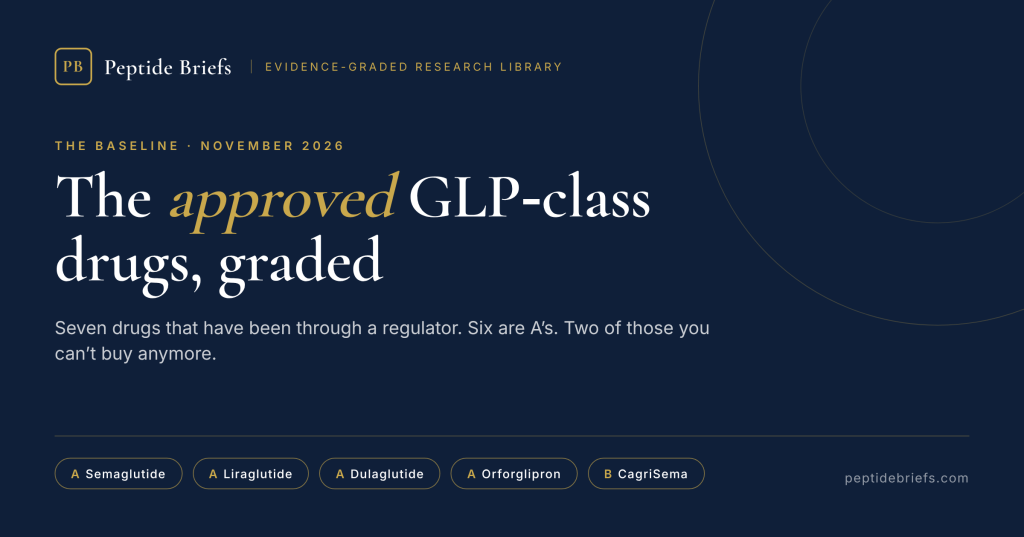
    The field guide covered the pipeline. This is the other half of the map: the GLP-class drugs that have already been through a regulator, plus the one combination sitting on the FDA’s desk right now. Seven compounds, each graded the same way the rest of the library is graded. A means peer-reviewed pivotal trials plus a completed regulatory safety review; B means peer-reviewed phase 3 or strong phase 2 without a regulator’s sign-off.

    Six of the seven are A’s, and that is the point of writing them up. An A is not a recommendation and it is not a claim that the drug is the best in its class. Exenatide is an A and has been pulled from the US market. Lixisenatide is an A and was discontinued because nobody wanted it. The grade says the evidence is complete and reviewed. What you do with that is a different question.

    Each section below is short on purpose. These are the best-documented drugs in the entire library, and the full trial records run to hundreds of papers each. I’ve pulled the pivotal trial, the cardiovascular outcomes trial where one exists, the approval history, and the caveat that matters most. Full compound pages will follow for the ones people actually search for.


    Semaglutide

    Evidence grade: A · Also known as Ozempic, Wegovy, Rybelsus; GLP-1 S on some vendor menus.

    What it is. A once-weekly GLP-1 receptor agonist, 31 amino acids, with a C18 fatty diacid on lysine 26 that binds albumin and gives it a half-life of about a week. The oral form uses an absorption enhancer (SNAC) and a much higher dose to get across the stomach wall.

    Why it’s an A. The STEP program (STEP 1, NEJM 2021: 14.9% weight loss at 68 weeks versus 2.4% placebo in 1,961 adults) and the SUSTAIN program for diabetes are peer-reviewed. SELECT (NEJM 2023; 17,604 adults with cardiovascular disease and no diabetes) showed a 20% reduction in major adverse cardiovascular events, the first time an obesity drug did that. FLOW (NEJM 2024) showed kidney protection in type 2 diabetes. The FDA has reviewed all of it: Ozempic for diabetes (December 2017), Rybelsus oral for diabetes (September 2019), Wegovy for obesity (June 2021), cardiovascular risk reduction (March 2024), MASH (August 2025), and the oral Wegovy 25 mg pill (December 22, 2025, based on OASIS 4: 16.6% at 64 weeks).

    Caveat. The gastrointestinal burden is real (74% of STEP 1 participants versus 48% on placebo) and weight returns when treatment stops: the STEP 1 extension showed two-thirds of lost weight regained within a year off drug. Loss of lean mass is a live research question. Semaglutide is also the most counterfeited drug in this class; the FDA stated in June 2026 that sales of unapproved semaglutide products to consumers are illegal, and research-use-only labeling does not change that.

    Key references. Wilding JPH et al., STEP 1, N Engl J Med 2021;384:989 (PMID 33567185). Lincoff AM et al., SELECT, N Engl J Med 2023;389:2221 (PMID 37952131). Marso SP et al., SUSTAIN-6, N Engl J Med 2016;375:1834 (PMID 27633186). Wharton S et al., OASIS 4, N Engl J Med 2025 (PMID 40934115).

    Tirzepatide

    Already has its own page: Tirzepatide (A). Listed here for completeness of the baseline.

    Liraglutide

    Evidence grade: A · Also known as Victoza, Saxenda; generic liraglutide.

    What it is. A once-daily GLP-1 receptor agonist with a C16 fatty acid on lysine 26, half-life about 13 hours. The direct ancestor of semaglutide: same strategy, shorter tail.

    Why it’s an A. SCALE Obesity and Prediabetes (NEJM 2015; 3,731 adults) showed 8.0% weight loss at 56 weeks on 3.0 mg versus 2.6% placebo. LEADER (NEJM 2016; 9,340 adults with type 2 diabetes) showed a 13% reduction in major cardiovascular events and a 22% reduction in cardiovascular death, which made liraglutide the first GLP-1 with a cardiovascular indication (2017). FDA approvals: Victoza for diabetes (January 2010), Saxenda for obesity (December 2014), pediatric diabetes (2019), pediatric obesity (2020). Generic Victoza was approved in December 2024 (Teva, Hikma) and generic Saxenda in August 2025 (Teva), the first generic GLP-1 for weight management.

    Caveat. Daily injection, and the weight loss is roughly half of semaglutide’s in head-to-head data (STEP 8: 15.8% versus 6.4%). A 2024 analysis flagged bone-density declines in Saxenda-treated patients. It matters now mostly because it is the cheapest approved GLP-1 in the US and the one most likely to be substituted for an off-label or compounded product.

    Key references. Pi-Sunyer X et al., SCALE, N Engl J Med 2015;373:11 (PMID 26132939). Marso SP et al., LEADER, N Engl J Med 2016;375:311 (PMID 27295427). Rubino DM et al., STEP 8, JAMA 2022;327:138.

    Dulaglutide

    Evidence grade: A · Also known as Trulicity.

    What it is. Two GLP-1 analogue chains fused to a modified human IgG4 Fc fragment, which is why it is dosed weekly and why it is technically a fusion protein rather than a lipidated peptide.

    Why it’s an A. The AWARD program established glycemic efficacy; FDA approval for type 2 diabetes came in September 2014. REWIND (Lancet 2019; 9,901 adults, median 5.4 years, the longest GLP-1 outcomes trial) showed a 12% reduction in major cardiovascular events in a population that was mostly primary prevention, which earned a cardiovascular indication in February 2020 covering both people with and without established heart disease. Weight loss is modest: about 1.5 kg in REWIND, 4 to 5 kg at the higher 3.0 and 4.5 mg doses in AWARD-11.

    Caveat. It is a diabetes drug, not an obesity drug, and has never been submitted for weight management. Anyone marketing it as a weight-loss peptide is working from the wrong trial record. Not available as a generic.

    Key references. Gerstein HC et al., REWIND, Lancet 2019;394:121 (PMID 31189511). Frias JP et al., AWARD-11, Diabetes Care 2021;44:765.

    Exenatide

    Evidence grade: A · Also known as Byetta, Bydureon, Bydureon BCise; exendin-4.

    What it is. The original. A 39-amino-acid peptide first isolated from Gila monster venom, about 53% identical to human GLP-1 and resistant to DPP-4 breakdown, with a half-life of about 2.4 hours. Byetta was twice-daily; Bydureon wrapped it in microspheres for weekly dosing.

    Why it’s an A. FDA approval in April 2005 made it the first GLP-1 receptor agonist on the market. The AMIGO trials established glycemic control; Bydureon (weekly) followed in 2012. EXSCEL (NEJM 2017; 14,752 adults) showed cardiovascular safety (non-inferiority) but not benefit, with a hazard ratio of 0.91 that just missed significance.

    Caveat. This is an A for a drug you can barely buy. AstraZeneca discontinued Byetta and Bydureon BCise in the US in October 2024 as a business decision; Amneal’s generic exenatide (Byetta equivalent) was approved in November 2024 and is the only form still sold. Weight loss was never the point: 2 to 3 kg in the diabetes trials. It belongs in the library because the entire class descends from it and because it still turns up on research vendor menus at prices that make no sense for a drug with an approved generic.

    Key references. Holman RR et al., EXSCEL, N Engl J Med 2017;377:1228 (PMID 28910237). DeFronzo RA et al., AMIGO, Diabetes Care 2005;28:1092.

    Lixisenatide

    Evidence grade: A · Also known as Adlyxin (US), Lyxumia (EU); the lixisenatide half of Soliqua.

    What it is. A once-daily exendin-4 derivative with a C-terminal polylysine tail, 44 amino acids, short-acting. Its distinguishing feature was a strong effect on post-meal glucose through gastric emptying, with less effect on fasting glucose.

    Why it’s an A. GetGoal program for glycemic control; FDA approval July 2016. ELIXA (NEJM 2015; 6,068 adults after an acute coronary event) showed cardiovascular safety but no benefit, hazard ratio 1.02.

    Caveat. Sanofi discontinued standalone Adlyxin in the US effective January 1, 2023, citing competition and poor sales; it survives only inside Soliqua (with insulin glargine). Weight effect was minimal, around 1 kg. Grade A, commercially dead. If a vendor is listing it, ask what possible research question it answers that liraglutide does not.

    Key references. Pfeffer MA et al., ELIXA, N Engl J Med 2015;373:2247 (PMID 26630143).

    Orforglipron

    Evidence grade: A · Also known as Foundayo. Not a peptide.

    What it is. A once-daily oral small molecule that activates the GLP-1 receptor. Discovered by Chugai, licensed to Lilly in 2018. Because it is not a peptide it has no absorption problem, no food or water restrictions, and cannot be made by peptide synthesis; it belongs in this library only because readers will see it next to the peptides everywhere else.

    Why it’s an A. ATTAIN-1 (NEJM 2025; 3,127 adults without diabetes, 72 weeks) showed 12.4% weight loss at the top dose if everyone adhered, 11.1% on the treatment-regimen estimand, versus 2.1% placebo. ATTAIN-2 covered type 2 diabetes. The FDA approved it for chronic weight management on April 1, 2026, 50 days after filing under the national priority voucher program; diabetes is a separate pending submission. UK authorization followed in 2026.

    Caveat. It loses to every injectable on the scale: roughly half of tirzepatide’s effect and below oral Wegovy’s 16.6%. Nausea ran 29 to 36% versus 10% on placebo, and the approved dose ladder (0.8 to 17.2 mg) differs from the trial’s titration without a published explanation. No cardiovascular outcomes data yet. Boxed thyroid warning like the rest of the class.

    Key references. Wharton S et al., ATTAIN-1, N Engl J Med 2025;393:1796 (doi 10.1056/NEJMoa2511774). FDA approval announcement, April 1, 2026.

    CagriSema

    Evidence grade: B · Cagrilintide 2.4 mg plus semaglutide 2.4 mg, once weekly, one pen.

    What it is. A fixed-dose combination of an amylin analogue and a GLP-1 analogue, two separate peptides co-formulated. Each half has its own page or will shortly: cagrilintide (B) is live; semaglutide is above.

    Why it’s a B and not an A. The pivotal trials are peer-reviewed: REDEFINE 1 (NEJM 2025; n = 3,417) showed 20.4% weight loss at 68 weeks, 22.7% if everyone adhered, versus 3.0% placebo; REDEFINE 2 (NEJM 2025; type 2 diabetes) showed 13.7%. But no regulator has finished a review. Novo Nordisk filed with the FDA on December 18, 2025 and has guided to a decision in the fourth quarter of 2026. REDEFINE 4, the open-label head-to-head against tirzepatide 15 mg, missed its non-inferiority endpoint in February 2026 (20.2% versus 23.6% at 84 weeks). The cardiovascular outcomes trial (REDEFINE 3) is ongoing.

    Caveat. Four in five participants had gastrointestinal side effects. Only 57% of the REDEFINE 1 CagriSema group reached the top dose under a flexible protocol, which the sponsor cites as context for the tirzepatide miss and critics read the other way. A higher-dose version (2.4/7.2 mg) starts phase 3 in the second half of 2026. This grade changes the day the FDA rules; watch Grade Changes.

    Key references. Garvey WT et al., REDEFINE 1, N Engl J Med 2025 (doi 10.1056/NEJMoa2502081). Davies MJ et al., REDEFINE 2, N Engl J Med 2025 (doi 10.1056/NEJMoa2502082). Novo Nordisk, REDEFINE 4 announcement, February 23, 2026.


    What the baseline tells you

    Three things stand out when the approved drugs are lined up this way.

    First, the A grade is about evidence, not usefulness. Two of the six A’s are discontinued, one was never a weight-loss drug, and one isn’t a peptide. If you are reading this library to decide which compound is interesting, the grade is the floor, not the answer.

    Second, the cardiovascular outcomes trials are the real dividing line inside the A’s. Liraglutide, semaglutide and dulaglutide showed benefit. Exenatide and lixisenatide showed safety only. That difference, more than the weight numbers, is why the first three dominate prescribing.

    Third, every pipeline compound in the field guide is measured against this table. UBT251’s 19.7% at 24 weeks is impressive because tirzepatide’s 72-week number is about 21%. Survodutide’s 13% is underwhelming because semaglutide’s is 15%. The baseline is what makes the pipeline numbers mean anything.

    Peptide Briefs is an independent reference and does not sell anything. Its owners co-own a research-peptide vendor; that is disclosed on every page. Nothing here is medical advice or a dosing recommendation.

  • A Field Guide to the “GLP”-Class Pipeline

    A Field Guide to the “GLP”-Class Pipeline

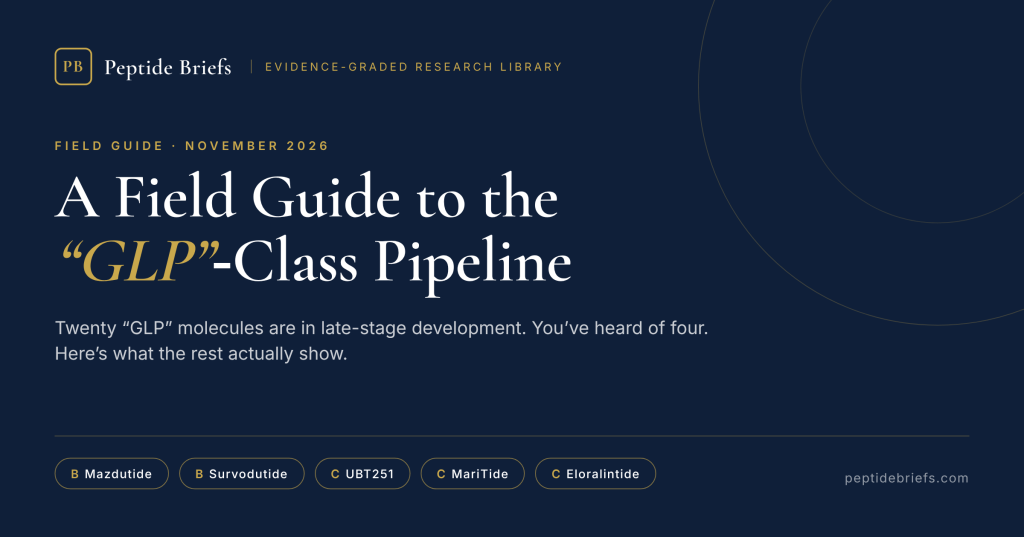
    Twenty molecules are in late-stage development. You’ve heard of four. Here’s what the rest actually show.

    Updated Nov 6, 2026: added CT-G32 (Celltrion), a preclinical four-target candidate.

    Peptide Briefs · · Troy Snyder, Ed.D., MBA

    If you follow this space on X, you could be forgiven for thinking there are four GLP-class molecules in the world: semaglutide, tirzepatide, retatrutide, and whatever a vendor is calling retatrutide this week. There are closer to twenty in late-stage development, several are already approved somewhere, and a few of them are starting to show up on research vendor menus under names most buyers have never seen in a paper.

    This is a field guide to the ones that don’t get talked about. For each I’ll tell you what it is, who makes it, what the human evidence actually shows, and how far it is from a regulator’s desk. I grade the same way the compound pages do: A needs peer-reviewed pivotal data plus a completed regulatory safety review; B is peer-reviewed phase 3 or strong phase 2 without a regulator’s sign-off; C is phase 2 or less; D is preclinical or sponsor press releases only. Where a drug is approved in China but not reviewed by the FDA or EMA, I say so, because a Chinese approval is a real regulatory review and also not the same thing as a US one.

    One framing note before the list. “GLP-1” has become shorthand for a whole family of gut-hormone drugs. Several of the molecules below don’t touch the GLP-1 receptor at all. They are here because they are being developed to do the same job and because they get lumped together on vendor sites.

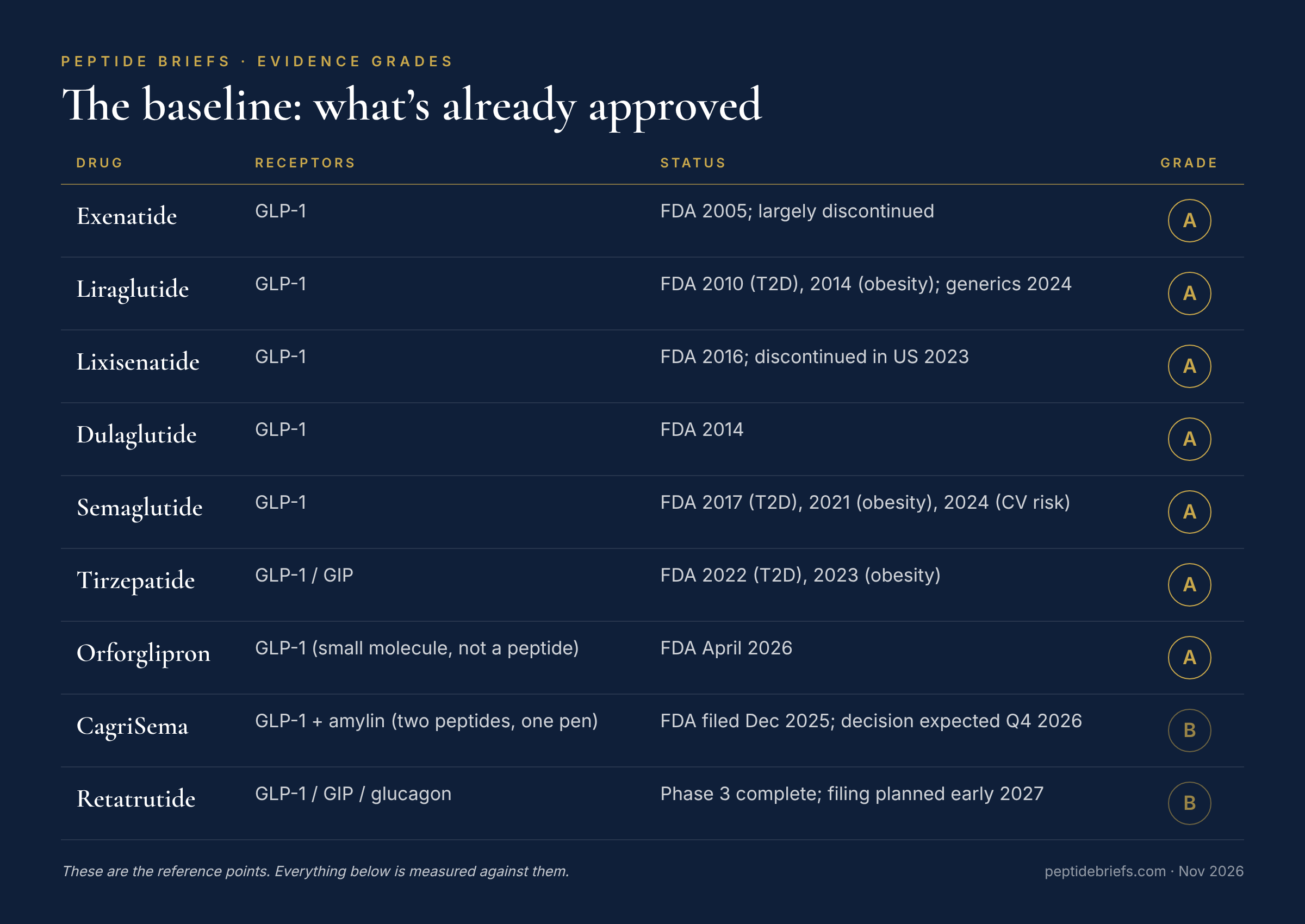
    The Baseline: What’s Already Approved

    DrugReceptorsStatusGrade
    ExenatideGLP-1FDA 2005; largely discontinuedA
    LiraglutideGLP-1FDA 2010 (T2D), 2014 (obesity); generics 2024A
    LixisenatideGLP-1FDA 2016; discontinued in US 2023A
    DulaglutideGLP-1FDA 2014A
    SemaglutideGLP-1FDA 2017 (T2D), 2021 (obesity), 2024 (CV risk)A
    TirzepatideGLP-1/GIPFDA 2022 (T2D), 2023 (obesity)A
    OrforglipronGLP-1 (small molecule, not a peptide)FDA April 2026A
    CagriSemaGLP-1 + amylin (two peptides, one pen)FDA filed Dec 2025, decision expected Q4 2026B
    RetatrutideGLP-1/GIP/glucagonPhase 3 complete, filing planned early 2027B

    The Chinese Pipeline

    China is now the second center of gravity for this drug class, and two of its molecules are approved there. If you have seen a “Chinese retatrutide” referenced online, it is almost certainly one of the first two below.

    UBT251 — the triple agonist Novo bought

    What it is: A once-weekly synthetic peptide that activates GLP-1, GIP and glucagon receptors, the same three targets as retatrutide. Developed by United Bio-Technology (Hengqin), a subsidiary of The United Laboratories (TUL), Zhuhai. In March 2025 Novo Nordisk licensed worldwide rights outside Greater China for $200 million upfront.

    Evidence: Two Chinese phase 2 trials, both reported by press release in 2026 and not yet peer-reviewed. In adults with overweight or obesity (baseline 92 kg, BMI 33), the 6 mg dose produced a mean weight loss of 19.7% at 24 weeks versus 2.0% on placebo. In type 2 diabetes (211 participants), HbA1c fell up to 2.16% versus 1.77% on semaglutide 1 mg, with weight loss up to 9.8% versus 4.8%. Novo is running a global phase 1b/2a in about 330 people, reading out in 2027, and TUL plans two Chinese phase 3s.

    Why people call it “the Chinese retatrutide”: Same mechanism, similar early numbers (retatrutide’s phase 2 showed 24% at 48 weeks; 19.7% at 24 weeks is on a comparable trajectory), and it is Novo’s answer to Lilly’s molecule. On half-life, I can find no published pharmacokinetic data for UBT251 that would support a claim that it lasts longer than retatrutide. Both are dosed weekly. If a vendor is telling you otherwise, ask them for the paper.

    Grade: C. Phase 2, press-release only, no peer review, no regulator.

    Mazdutide — approved in China, dual GLP-1/glucagon

    What it is: A once-weekly GLP-1 and glucagon receptor dual agonist, originally Lilly’s LY3305677, licensed to Innovent Biologics for China. Brand name Xinermei.

    Evidence: The GLORY-2 phase 3 in Chinese adults with obesity reported 16.7% mean weight loss at 9 mg over 60 weeks; the earlier GLORY-1 phase 3 was published in NEJM in 2024 and the program has since appeared in JAMA and Lancet Diabetes & Endocrinology. A US phase 2 reported up to 18.1% at 16 mg over 32 weeks.

    Regulatory: Approved by China’s NMPA for chronic weight management on June 27, 2025 and for type 2 diabetes on September 19, 2025. No FDA or EMA filing.

    Grade: B. Peer-reviewed phase 3 and a completed regulatory review, but not by the FDA or EMA. If you want to call this an A for China, I won’t argue hard. For a US reader it is a B.

    Ecnoglutide — the “biased” GLP-1

    What it is: A long-acting GLP-1 receptor agonist from Sciwind Biosciences (Hangzhou), engineered to preferentially signal through the cAMP pathway rather than β-arrestin, which in theory means less receptor desensitization. Brand names Xianyida (diabetes) and Xianweiying (weight). Pfizer holds China commercialization rights.

    Evidence: Phase 3 in China reported about 15.1% placebo-adjusted weight loss. The biased-agonism claim is mechanistically interesting and clinically unproven; nobody has shown in humans that it translates to better durability or tolerability than semaglutide.

    Regulatory: NMPA approved for type 2 diabetes (January 30, 2026) and for weight management (March 6, 2026). No US filing announced.

    Grade: B, same logic as mazdutide.

    Bofanglutide (GZR18) — the every-two-weeks GLP-1

    What it is: A long-acting GLP-1 receptor agonist from Gan & Lee Pharmaceuticals (Beijing), dosed once every two weeks. This is the one Chinese molecule where “longer half-life” is actually the selling point.

    Evidence: Phase 3 in China with an extension ongoing; Gan & Lee has signed licensing deals with JW Pharmaceutical (Korea, $81 million, April 2026) and Lupin (India). Published data are thinner than for mazdutide or ecnoglutide.

    Grade: C. It is a single GLP-1 agonist, not a triple, so anyone describing it as a longer-acting retatrutide is wrong on mechanism.

    HRS9531 — Hengrui’s dual agonist

    What it is: A GLP-1/GIP dual agonist (tirzepatide’s mechanism) from Jiangsu Hengrui, in phase 3 in China. Kailera Therapeutics licensed it for the rest of the world in 2024.

    Grade: C pending phase 3 publication.


    The Western pipeline you’ve probably skipped

    Survodutide — the one that read out and underwhelmed

    What it is: Boehringer Ingelheim and Zealand Pharma’s once-weekly GLP-1/glucagon dual agonist (BI 456906).

    Evidence: SYNCHRONIZE-1 (NEJM, June 2026; 76 weeks, 1,481 people without diabetes) reported 12.2% and 13.0% at 3.6 and 6.0 mg versus 5.4% placebo on the primary estimand, or up to 16.6% if everyone adhered. SYNCHRONIZE-2 (NEJM, October 2026, type 2 diabetes) reported 8.2% and 9.8% versus 3.9%. A pre-specified substudy showed 63% liver fat reduction and 34% visceral fat reduction, and the earlier phase 2b in MASH showed histological improvement in up to 83% of patients. The cardiovascular outcomes trial completed in June 2026 with results expected before year end.

    The honest read: This is semaglutide-range weight loss with a potentially better liver story. It is not a tirzepatide competitor on the scale.

    Grade: B. Peer-reviewed phase 3, no regulatory review yet.

    MariTide (maridebart cafraglutide) — the monthly one

    What it is: Amgen’s AMG 133, a GLP-1 receptor agonist peptide fused to an antibody that blocks the GIP receptor. Yes, blocks. Tirzepatide activates GIP; MariTide antagonizes it; both lose weight. Nobody has fully explained this. The antibody scaffold gives it a half-life around three weeks, so it is dosed monthly, and Amgen is testing every-eight-weeks maintenance.

    Evidence: Phase 2 (NEJM 2025) showed up to about 20% weight loss at 52 weeks in people without diabetes and about 17% with type 2 diabetes, with the striking feature that weight stayed off for months after the last dose. Phase 3 (MARITIME-1 and -2) is ongoing with an estimated primary completion in January 2027; as of October 2026 no phase 3 results have been reported. The phase 3 titration was slowed after high rates of nausea and vomiting in phase 2.

    Grade: C, and the most interesting C on this list. If anything here deserves the label “longer half-life than retatrutide,” it is this, and it is a peptide-antibody conjugate, not something a peptide synthesizer can make.

    Amycretin — GLP-1 and amylin in one molecule

    What it is: Novo’s single peptide that activates both the GLP-1 receptor and the amylin receptor, available as a weekly injection and a daily pill. Think CagriSema’s two mechanisms fused into one chain.

    Evidence: Phase 1b/2a injectable showed about 22% weight loss at 36 weeks; the oral form showed about 13% at 12 weeks. Phase 3 began in 2026.

    Grade: C. Early, but this is where Novo is putting its chips after the CagriSema head-to-head miss.

    Eloralintide — Lilly’s amylin-only answer

    What it is: A selective amylin receptor agonist (no calcitonin receptor activity, unlike cagrilintide), weekly injection.

    Evidence: Phase 2 showed up to 20% weight loss at 48 weeks as monotherapy, which is remarkable for an amylin drug on its own. The eloralintide-plus-tirzepatide combination (presented at EASD, September 30, 2026) showed up to 23.3% at 48 weeks in obesity with type 2 diabetes versus 14.8% for tirzepatide 15 mg alone. Phase 3 started late 2025.

    Grade: C, likely B within a year.

    Pemvidutide, VK2735, petrelintide, berobenatide

    Briefly: pemvidutide (Altimmune) is a GLP-1/glucagon dual in phase 2 with a MASH focus; VK2735 (Viking) is a GLP-1/GIP dual in phase 3 with both injectable and oral forms; petrelintide (Zealand, partnered with Roche) is another long-acting amylin analogue in phase 2; berobenatide (Pfizer, formerly Metsera’s MET-097i) is an ultra-long-acting GLP-1 dosed monthly, in phase 3, with 12.3% placebo-adjusted weight loss at 28 weeks in phase 2b. All C or D today.

    The Korea pipeline

    CT-G32 — Celltrion’s four-target candidate

    What it is: Celltrion’s injectable candidate that combines GLP-1, GIP, glucagon and amylin activity in one molecule. It’s the first announced design to add amylin to a retatrutide-style triple agonist.

    Evidence: Preclinical only. Celltrion reports that in obese animals at the same dose it produced greater weight loss than retatrutide, with proportionally less lean mass lost, and that primate data support once-weekly dosing. These are company-reported, non-peer-reviewed results, and no human data exist. An IND is expected in early 2027, per company statements.

    Grade: C. Preclinical and company-reported; too early to judge.

    What this means if you are reading vendor listings

    Three patterns to watch for.

    Names that aren’t names. “GLP-3,” “Triple G,” “Reta-L,” “long-acting GLP” are catalog labels, not molecules. Every compound on this page has a development code and, for most, an INN. A vendor who cannot tell you which one they are selling cannot have tested its identity.

    Half-life claims without pharmacokinetics. A peptide’s half-life comes from its lipid tail or antibody scaffold and is measured in a phase 1 trial. Retatrutide’s is about six days; semaglutide’s about seven; cagrilintide’s about seven to eight; MariTide’s about three weeks. Any claim of a “longer half-life” version of a weekly peptide should come with a published number. If the vendor’s answer is a different fatty acid chain, that is a different molecule with no human data at all.

    Approval that isn’t your approval. Mazdutide and ecnoglutide are approved drugs in China. That is a meaningful review. It is not an FDA review, and it does not change the legal status of research-grade material in the US, where the FDA stated in June 2026 that sales of unapproved GLP-class products to consumers are illegal and Lilly filed six lawsuits in August 2026 against sellers of retatrutide, including research-use-only vendors.

    The field is moving fast enough that half of this page will need updating within six months: CagriSema’s FDA decision is due this quarter, retatrutide’s filing is planned for early 2027, MariTide phase 3 reads out around the same time, and SYNCHRONIZE-CVOT is due before year end. I’ll post grade changes as they land.


    Sources

    • United Laboratories / Novo Nordisk, UBT251 phase 2 topline releases, February 24 and March 25, 2026
    • Innovent Biologics, mazdutide NMPA approvals (June 27 and September 19, 2025); Ji L et al., Once-weekly mazdutide in Chinese adults with obesity or overweight, NEJM 2024, doi:10.1056/NEJMoa2411528
    • Sciwind Biosciences, ecnoglutide NMPA approval announcements, January 30 and March 6, 2026
    • Boehringer Ingelheim, SYNCHRONIZE-1 topline (April 28, 2026) and ADA 2026 presentation; SYNCHRONIZE-1 and SYNCHRONIZE-2 in NEJM, June and October 2026
    • Amgen, MariTide phase 2 (NEJM 2025); ClinicalTrials.gov MARITIME-1 and MARITIME-2 records
    • Eli Lilly, eloralintide phase 2 and EASD 2026 presentation (September 30, 2026)
    • Novo Nordisk, REDEFINE 4 company announcement, February 23, 2026
    • FDA statement on unapproved incretin products, June 2026; Eli Lilly press release on retatrutide lawsuits, August 12, 2026
    • Celltrion. Press release on CT-G32 preclinical development, May 29, 2026 (company-authored). celltrion.com
    • Seoul Economic Daily. “Celltrion to Begin Trials of World’s First Quadruple-Acting Obesity Drug,” Nov 4, 2026. en.sedaily.comLeave a comment

    Peptide Briefs is an independent reference and does not sell anything. Its owners co-own a research-peptide vendor; that is disclosed on every page. Nothing here is medical advice.

  • 12 Websites Every Peptide Researcher Should Bookmark + 88 More Worth Knowing

    12 Websites Every Peptide Researcher Should Bookmark + 88 More Worth Knowing

    The tools I actually use to check claims, read the evidence and keep up with the rules.

    Originally Shared on Substack

    Most of us visit the same few websites every day. Meanwhile, some of the most useful tools on the internet sit unused. When I started reading about peptides, I learned fast that the quality of what you find depends on where you look. A good source takes a claim apart. A bad one just repeats it.

    Subscribe for free to receive new posts and support my work.

    Subscribe

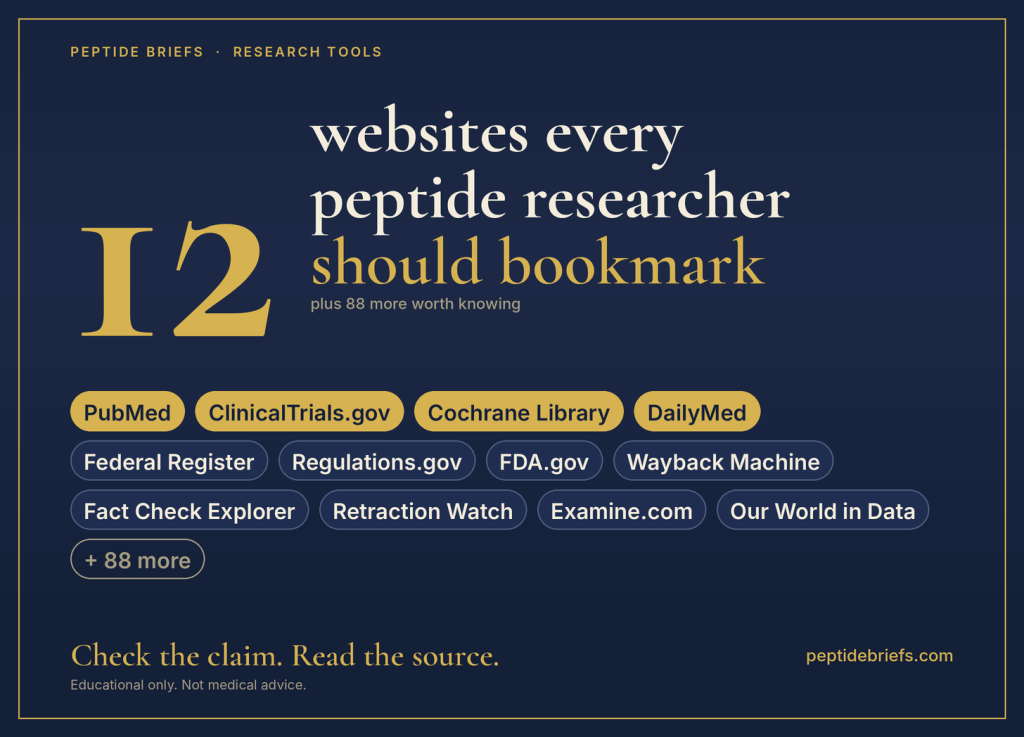
    Here are the 12 I would bookmark first, and why. The full list of 100 is below.

    The evidence

    1. PubMed. The main search engine for biomedical research. Search a compound name and look at what is actually published, then notice how much is animal or cell work.

    2. ClinicalTrials.gov. Shows which human trials are registered, running or finished. If a compound has no trials here, that tells you something.

    3. Cochrane Library. Systematic reviews that pool many studies. Slow and careful, which is the point.

    4. DailyMed. Official labels for approved drugs. Useful for seeing what regulators allow a drug to claim.

    The rules

    5. Federal Register. Where proposed and final policy appears. Good for reading the notice itself instead of a headline about it.

    6. Regulations.gov. Where public comments are filed. You can read what others have said and submit your own.

    7. FDA.gov and Drugs@FDA. What is approved, for what, and what has received warnings.

    The truth check

    8. Wayback Machine. See what a company claimed last month, or last year.

    9. Google Fact Check Explorer. Search a claim and see who has already examined it.

    10. Retraction Watch. Tracks retracted papers. A study can look strong right up until it is withdrawn.

    The quick references

    11. Examine.com. Plain language summaries of supplement and nutrition research.

    12. Our World in Data. Clear charts built from real datasets, handy when a post throws out a statistic.

    A note on what none of these do. Reading a paper is not a prescription, and finding a study is not proof something works for you. Several of these sites exist to help you see how thin the evidence can be. That is a feature.

    The full list of 100

    Research and evidence: PubMed, ClinicalTrials.gov, Cochrane Library, Google Scholar, Semantic Scholar, Europe PMC, DailyMed, Drugs@FDA, DrugBank, Retraction Watch

    Policy and regulation: Federal Register, Regulations.gov, FDA.gov, HHS.gov, Congress.gov, SEC EDGAR, USPTO, FTC.gov, Your State’s Secretary of State Page (Colorado for me), CBP.gov

    Verifying things: Wayback Machine, ICANN Lookup, VirusTotal, urlscan.io, Have I Been Pwned, Snopes, Google Fact Check Explorer, TinEye, Archive.today, OpenCorporates

    Web and SEO: Google Search Console, Google Analytics, Google Trends, Bing Webmaster Tools, PageSpeed Insights, Ahrefs Webmaster Tools, AnswerThePublic, SimilarWeb, Schema.org, W3C Validator

    Store and operations: WooCommerce docs, WordPress.org, Stripe, Klaviyo, Zapier, Cloudflare, Canva, QuickBooks, Shippo, Wise, Omnisend

    Writing and publishing: Substack, Hemingway Editor, Grammarly, Notion, Linktree, Beehiiv, Ghost, Typeform, Calendly, Loom

    Learning: Khan Academy, Coursera, edX, MIT OpenCourseWare, Wikipedia, Project Gutenberg, Library of Congress, Our World in Data, TED, Wolfram Alpha

    Health references: MedlinePlus, Mayo Clinic, CDC, NIH, WHO, Examine.com, Cleveland Clinic, USDA FoodData Central, Cronometer, NHS

    News and analysis: Reuters, AP News, Axios, STAT News, Endpoints News, Fierce Biotech, Time, Financial Times, ProPublica, BBC News

    My Other Everyday Sites: Weather.gov, Google Flights, Recreation.gov, Colorado Parks and Wildlife, onX Hunt, Rome2Rio, iNaturalist, Kelley Blue Book, CarGurus, Google Maps

    Pick five that solve a real problem for you and ignore the rest. You will remember those.

    Peptide Briefs is an independent educational library. Nothing here is medical advice.

    Disclosure: we co-own a research-peptide vendor. Peptide Briefs is written independently of it and does not link to it.

  • Funny, Strange and Scary Stories From Inside the Chinese Peptide Supply Chain

    Funny, Strange and Scary Stories From Inside the Chinese Peptide Supply Chain

    Origiannly Posted on Substack

    A reader asked for the stories behind my China article, so here are some. I went back through my own conversations with sellers there. I have left out names, companies, phone numbers, addresses, and prices. These stories describe my dealings with sellers in China and nothing else. They say nothing about any supplier in the United States.

    Subscribe

    Discovering My First Supplier: A Journey Through Reddit and Shenzhen Sea World

    Finding my very first supplier in China was an unexpected adventure that unfolded in the most unconventional way – on Reddit! It wasn’t through a factory visit or a bustling trade show; it was through connecting with a fascinating individual with a unique story.

    This particular supplier was living in Shenzhen and originally hailed from Nigeria. He specialized in peptides, which piqued my interest right away. However, I must admit that my initial reaction was laced with apprehension. Selling injectables over the internet can certainly raise red flags, and I had to confront the unfair stereotypes about online scams, particularly those related to Nigeria. The stereotype isn’t just a perception; it can cloud judgment. Instead of focusing on his nationality, I realized I needed to assess the situation more objectively.

    I looked for a way to reassure myself about his authenticity and found that he had shared photos of himself at a well-known spot in Shenzhen called Sea World—somewhere I recognized because I had been there myself! While this didn’t definitively prove his credibility or the quality of his products, it created a sense of connection. It turned him from a faceless stranger into someone who lived just an hour away by ferry, making the whole situation feel more tangible.

    This small but meaningful verification taught me an important lesson about the market. Peptides often pose sourcing challenges in China because they’re intended for export. Domestic sales are generally discouraged, which means that sometimes it’s easier for a foreigner on Reddit to find reputable suppliers than to locate a lab nearby. As I explored further, I discovered additional vendors on Meituan, a Chinese shopping app. This was a whole new experience—products were cleverly disguised as skincare, and titles contained deliberate misspellings, adding an element of intrigue.

    Looking back, it’s clear that my first supplier was more of a trader than a direct manufacturer. This is a crucial distinction I now emphasize to anyone entering this field. At that time, all I knew was that he felt authentic enough for me to want to meet him in a place I recognized.

    * Bacteriostatic water in China comes in ampoules. You then have to use a filter needle to make sure you don’t get glass fragments into the injectable liquid. I never got comfortable with it and brought my own.

    Navigating Sterile Standards and Visitor Restrictions

    Out of the blue, I received a message from a salesperson representing a factory that boldly claimed to be a leading peptide manufacturer. They promised 99% purity, certificates of analysis, no minimum order, and readily available stock. Exciting, right? I was eager to learn more, so I asked if I could visit their facility.

    The response was somewhat surprising: they only catered to VIP clients, and their factory maintained strict sterile production standards. I was invited to place a small trial order instead. Here’s my takeaway: they were too sterile for a visitor but open to selling to unknown strangers. I followed my learned principle: factories that welcome visits are typically genuine producers, while those that impose visitor restrictions can raise concerns. With that, I respectfully declined their offer.

    Let Me Consult My Boss Tomorrow

    I reached out to another factory, repeating my inquiry about visiting. The representative assured me she would check with her boss the following day. I inquired about their testing procedures, but the answer was vague—“third-party independent laboratory testing.” No specifics, just a general term.

    Later that day, the narrative shifted. Suddenly, they were open to visits, but only for clients placing large orders. Did I want to see factory videos first? While video tours are nice, they don’t equate to an actual visit. I’m looking for transparency, not a promotional trailer.

    The Three Bosses

    The most welcoming response came from a representative at a different company. She enthusiastically suggested that I inspect their site since I was nearby, even embracing my idea of organizing a tour group for sellers. However, before she could approve a visit for a friend, she inquired if he was American. Spoiler alert: he was. I’ll let you draw your own conclusions.

    A few days later, I received an update from her. After some “deliberation among our three bosses,” the directive changed. I was now required to place a sample order, send it for testing, and only then would they consider a site visit. If the product failed the test, I would be fully refunded; if it passed and I was willing to endorse their company, they would refund 30% of the testing fee.

    Take a moment to ponder that. What began as an invitation to visit morphed into a transaction, and that testing fee was essentially a discount tied to a potential testimonial. It felt wholly inappropriate to me. A lab test should genuinely reflect the quality of a product and shouldn’t be contingent on my willingness to provide a positive review.

    Communicating Clearly with a Language Barrier

    Navigating the language differences in this business can be quite a challenge. One seller listed a popular weight-management compound, but their product name included periods between syllables, which I suspected was a deliberate attempt to bypass keyword filters. When I inquired about product sizes, I was encouraged to send my request “in the straightest way possible”—a testament to the challenges of translation tools.

    Then came a memorable moment when I asked about a blend humorously referred to as “Wolverine” in online communities. The response informed me that only peptide injections were available. Clearly, the nickname had lost its charm in translation! I had to clarify, quite politely, that I wasn’t actually ordering a superhero.

    The Batch That Turned to Gel

    In my quest, one product from an early order didn’t behave as expected; it clumped together and transformed into a gel. I tried various solutions—acetic acid, bacteriostatic water, and even sought out glycerol. Unfortunately, I lost three vials in the process.

    The seller advised me to experiment with different types of water and asked for my feedback. When that didn’t yield the desired results, she offered either a replacement or a refund.

    This journey of discovery, intertwined with both challenges and triumphs, opened my eyes to the complexities of international trade and the importance of forging authentic relationships in the business world. It’s this process of learning and adaptation that fuels my enthusiasm for what lies ahead as I continue to explore and grow in this vibrant market!

    The Domestic Lists

    I said earlier that the industry is built around exports. That is true of the sellers who message foreigners. But it is not the whole picture.

    At some point a different kind of spreadsheet reached me: a price list for the domestic market. Same idea as the export menu, but with a twist. It had one column for a brand or street name and another column for the real name of what was inside.

    That extra column tells you a lot. Products were sold under nicknames and invented brands, and the “real name” column was there so buyers knew what the nickname meant. The list mixed peptides with other bodybuilding products, which tells me who the customer is: gym-goers, not skincare shoppers.

    One brand name on it borrowed the name of a well-known approved weight-management drug and added “pen type.” That is not a brand. That is a costume.

    Then there was the pricing. Early on, the domestic list charged noticeably more than the export menu. In one case, a single vial on the domestic list cost more than a whole box of ten on the export sheet. I do not know why. Different sellers, different margins, retail versus wholesale, or a premium for risk are all possible, and I cannot tell you which. Later on, the domestic list became much cheaper, especially factoring in shipping costs, than the export lists, like about 25% cheaper across the board, and shipping was less than $10.

    Two cautions. I do not know who produced this list, how current it was, or whether anyone could actually deliver at those prices. And a list is not a sale.

    But it settles one thing for me. The seller who told me this product is not legally available in China was right about the law. She was not saying nobody buys it there.

    Lab Visits

    This is actually the boring section of this article. I visited 3 labs while living in China. The ones I saw were professional, clean, and respectable. They had assembly lines that appeared sterile, and workers wore lab coats, gloves, and masks and actively monitored the lines. They also had labs with state-of-the-art-looking equipment to check products. I saw nothing that caused alarms, but again, they also had nothing to hide.

    I assume the ones that denied my visit were hiding their operations, if they were even labs and not just bulk-powered buyers and vial fillers.

    What I took away

    Ask to visit. A real producer usually says yes. Treat a no, a delay, or a new condition as information.

    Test the product, not the paperwork. “COA provided” is the cheapest sentence in this industry.

    A relationship is not verification. Months of friendly messages did not make a vial what its label said.

    Test every lot with an independent lab, and compare reports from more than one.

    This article describes my own experience with sellers in China. It is not medical advice, and none of the products discussed here are approved for the uses people claim online.

    Share

    Disclosure: I co-own a research-use-only peptide business. Peptide Briefs runs independently of it. This is not medical advice.

  • The FDA’s Six, Part 3: HHS Cleared the Six. Here Is What That Does and Does Not Mean

    The FDA’s Six, Part 3: HHS Cleared the Six. Here Is What That Does and Does Not Mean

    Originally publshed on Substack

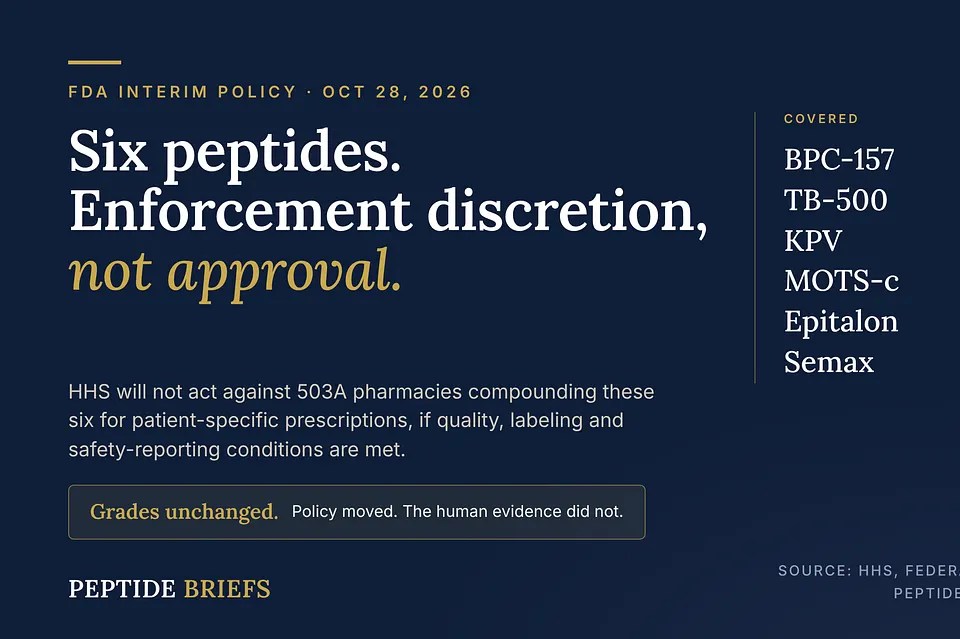
    Today the Department of Health and Human Services published an interim policy in the Federal Register covering six peptides: BPC-157, TB-500, KPV, MOTS-c, Epitalon and Semax. Under it, FDA says it will not take enforcement action against licensed 503A pharmacies and physicians who compound these peptides for individual patients, provided they meet conditions on ingredient quality, manufacturing standards, labeling, safety reporting and patient-specific prescriptions. Several clinicians are reporting an effective date of Friday, October 30.

    Subscribe

    This is the end of a road that started in September 2023, when FDA moved these compounds into Category 2 of its interim bulks policy, effectively blocking pharmacies from compounding them. In April 2026 they were removed from Category 2. In July an FDA advisory committee voted narrowly, 8 to 6 on most of them, to recommend adding all six to the 503A bulks list, over the objection of the agency’s own scientific reviewers. On October 14 HHS sent this interim policy to the White House. It cleared review on October 27 and was published today.

    What it is

    Enforcement discretion. FDA is telling compounding pharmacies it will not pursue them for making these six, as long as the conditions are met. That gives clinics and telehealth providers a workable federal basis to prescribe them for the first time in three years.

    What it is not

    Approval. HHS said explicitly that the policy does not constitute FDA approval of the peptides or of any compounded product made from them. Compounded drugs are not reviewed for safety, efficacy or quality before they reach patients. HHS also said it may reconsider the policy if safety signals or product-quality problems emerge, which is a reminder that this can be withdrawn as easily as it was granted.

    It also does not bind the states. State boards of pharmacy regulate compounding on the ground, and at least one industry figure has already said some states may not follow the federal move.

    And it does not touch research-use products. A vial sold as research-use-only is outside a compounding policy entirely. Nothing in today’s announcement changes the legal status of that market in either direction.

    What the evidence says

    Here is the part that matters most to this library. FDA’s reviewers found no human safety studies for KPV, TB-500, MOTS-c or Epitalon, and found the BPC-157 trials too small and too short to establish safety or efficacy for any proposed use. An independent systematic review published this month in Acta Orthopaedica Belgica searched every major database through June for human BPC-157 data and came to a similar conclusion.

    So the grades here do not move. BPC-157 stays at C. TB-500 stays at C. The others hold where they are. A policy decision about who may dispense a compound is not evidence about whether it works, and this library grades evidence.

    What to watch

    The policy text itself, which should show exactly which conditions pharmacies must meet and whether specific indications are named. Any state board responses. The citizen petition filed last week asking FDA to block compounding of these peptides. And, further out, whether FDA ever starts the formal rulemaking that would put any of the six on the bulks list permanently. The advisory committee’s recommendation was non-binding, and as of today no proposed rule exists.

    Disclosure: I co-own a research-peptide vendor. That is disclosed on every page of this publication and does not affect how compounds are graded here.

    Sources
    Reuters, Oct 28, 2026: US health department to allow temporary sale of some unapproved peptides
    AJMC, Jul 31, 2026: FDA Panel Backs 6 Peptides for Compounding
    Holland & Knight, Oct 2026: Peptides at a Crossroads
    reginfo.gov, RIN 0910-ZD94, Interim Access Policy for Compounding Using Certain Peptides

  • A sterility recall, a regulatory signal, and two claims that outran their sources

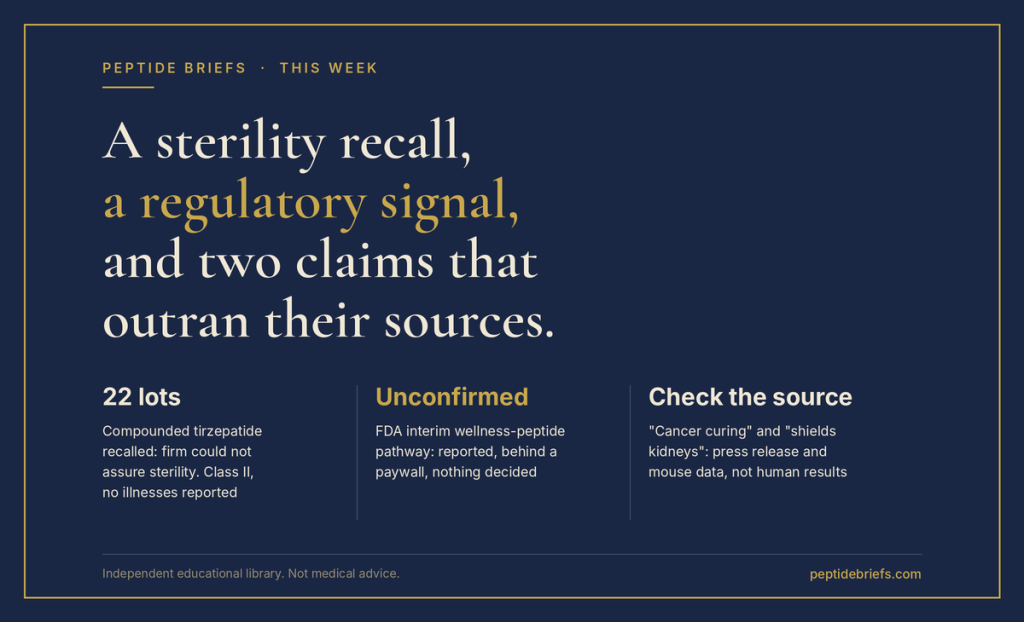
    A sterility recall, a regulatory signal, and two claims that outran their sources

    What I could confirm this week in peptide news, and what I couldn’t.

    Originally posted on Substack

    There was a lot of noise in the peptide feed this week. Here is the short version: what I could confirm from a source, what I couldn’t, and what to watch.

    Subscribe

    1. Two compounded GLP-1 recalls over sterility

    Apothecary Pharma. Apothecary Pharma LLC, a 503B outsourcing facility in Cary, North Carolina, recalled 22 lots of compounded tirzepatide (18 mg/mL, 4 mL multi-dose vials) and one lot of an NAD+ injection. The reason given: the firm “cannot assure the product is sterile.”

    What that does and doesn’t mean:

    • It is voluntary and firm-initiated, and FDA classified it Class II.
    • No illnesses are reported in the coverage I read.
    • “Can’t assure sterility” is a documentation finding. It is not a finding that contamination was detected.
    • FDA issued a warning letter to the firm after a May 2025 inspection that cited insanitary conditions in sterile drug production. The coverage does not say whether the recall is connected to those findings, so I won’t connect them either.

    Carolina Infusion. A widely shared post also described a second recall, by Carolina Infusion, LLC of Ridgeland, South Carolina. FDA’s Enforcement Report lists it. One record I reviewed covers compounded semaglutide 3 mg/mL syringes, Class II, with the reason given as lack of assurance of sterility “related to formulation using bacteriostatic water” and “related to processing equipment used in compounded product.” That wording points at the manufacturing process, not at a contamination finding. The beyond-use dates on the lots in that record have all passed. I only reviewed one record, so I’m not stating how many products or lots the recall covers.

    Takeaway: for any injectable, the paperwork is part of the product. If a manufacturer can’t document the process, that is the story, whether or not anyone got sick.

    1. FDA may be weighing an interim path for “wellness” peptide compounding

    The Capitol Forum reported on October 21 that FDA is seeking an interim pathway that would allow compounding of certain unapproved wellness peptides before final rulemaking. The article is paywalled, so I only have the headline and a short summary. I don’t know the scope, which peptides, or any dates.

    So: a signal, not a decision. Nothing has changed in what is allowed today. If details become public, I’ll cover them properly.

    1. Enforcement is moving past the “research use only” label

    Eli Lilly filed suit in August against six U.S. companies over unauthorized retatrutide, and says it referred information on more than 200 individuals and entities to authorities. It is also asking payment processors, platforms and shippers to stop unauthorized sales. A law-firm summary of the cases notes that FDA treated one seller’s retatrutide as an unapproved new drug in March, despite research-use-only wording, relying on the company’s website and the claims it made.

    The pattern worth noticing is that intended use is judged from conduct, not from the label. Marketing, social posts, and how a seller talks to customers all count. That applies to every seller and every influencer in this space, and it is a good reason to be skeptical of anyone who says “it’s labeled RUO, so anything goes.”

    Retatrutide itself is still investigational. Per the same summary, FDA says it cannot be compounded.

    1. Two claims that outran their sources

    SenoMune-0257. A viral post called it a “cancer curing peptide” that “completed pre-clinical studies successfully.” The only coverage I found is a trade-press article built on a company press release from Immorta Bio. It describes a nine-amino-acid, AI-designed peptide intended to train immune cells to remove senescent cells, framed around diseases of aging. It does not call it a cancer treatment, it gives no data on models or results, and human evaluation is described as anticipated before year-end, not started.

    A MOTS-c kidney study. Another post said MOTS-c “could be the peptide that shields kidneys from diabetes,” citing a mouse and cell-culture paper. I could not find that paper, so I can’t confirm the details. Even if it holds up exactly as described, mice and lab cells point to where to look. They don’t show what happens in people.

    A quick filter for any viral peptide post:

    1. Mice, cells, or humans?
    2. Correlation or intervention?
    3. Is there a DOI? If the poster can’t link it, treat it as a rumor.

    What I’m watching

    • Any FDA detail on an interim wellness-peptide pathway.
    • The retatrutide court case over classification and jurisdiction.
    • A DOI for the MOTS-c kidney paper.

    This is a news summary and not medical, legal or purchasing advice.

    Sources

    • Managed Healthcare Executive, October 21, 2026: Apothecary Pharma recall of compounded tirzepatide and NAD+ vials over sterility concerns (managedhealthcareexecutive.com)
    • FDA Enforcement Report, Carolina Infusion, LLC (accessdata.fda.gov)
    • The Capitol Forum, Health Care Weekly, October 21, 2026 (thecapitolforum.com), paywalled
    • Vedder Price, “Lilly’s Retatrutide Lawsuits Spotlight Expanding Enforcement Risk for the Peptide and GLP-1 Industry” (vedder.com)
    • RuntimeWire, “Immorta Bio completes preclinical studies for AI-designed senolytic peptide” (runtimewire.com)

    Disclosure: I co-own Agape Compounds, a research-use-only peptide company. Peptide Briefs is written independently of it.

  • The FDA’s Six, Part Two: a peptide policy is sitting at the White House. Here’s what it would and wouldn’t change.

    The FDA’s Six, Part Two: a peptide policy is sitting at the White House. Here’s what it would and wouldn’t change.

    Find Part One Here

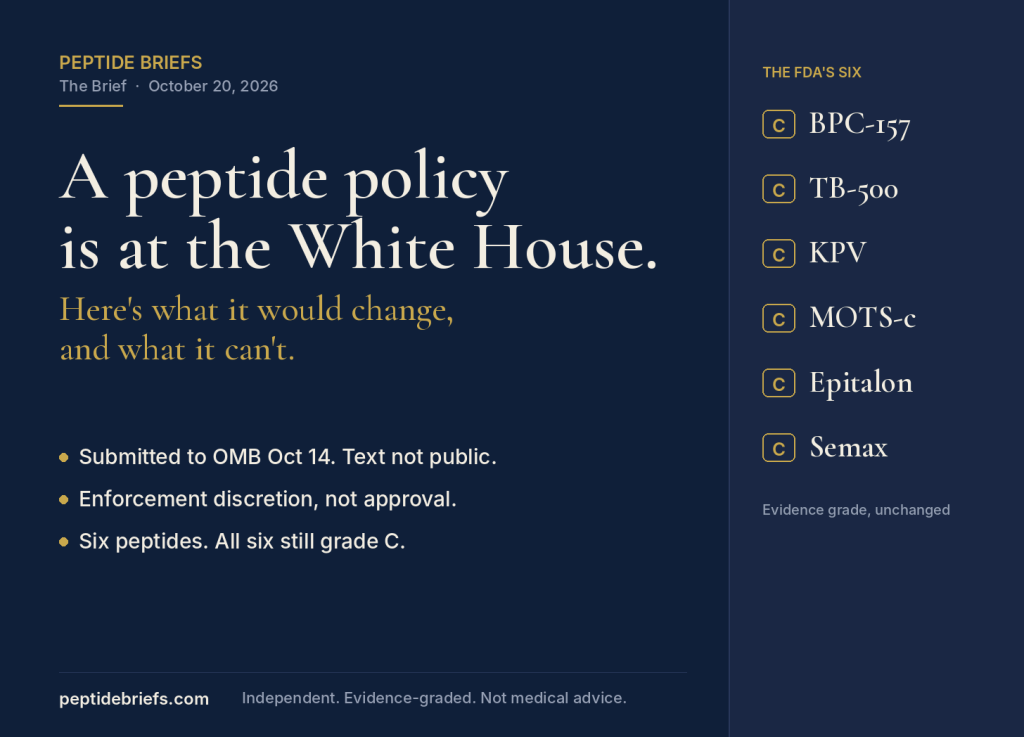
    On October 14, HHS and the FDA sent a document called “Interim Access Policy for Compounding Using Certain Peptides” to the White House Office of Management and Budget for review. It is listed as pending. Reuters reported the submission the next day, and within 48 hours several headlines had the FDA “fast-tracking” peptides.

    It isn’t. Here is what actually happened, what the document most likely says, and what it cannot do.

    Where this came from:

    In September we covered what the human evidence shows for the six peptides an FDA advisory committee voted toward the compounding list in July: BPC-157, KPV, TB-500, MOTS-c, Epitalon and Semax. Short version: all six sit at C on our scale. Cell and animal data, little or no controlled human data, and in several cases no published human trial at all.

    The votes were close and they went against the agency’s own scientists. FDA staff had recommended against all seven peptides under review on June 29, citing poorly characterized substances, limited human data and immune-reaction risk. BPC-157, KPV and TB-500 each passed 8 to 6 with one abstention. Emideltide (DSIP) failed 6 to 7. Roughly half the reconstituted committee was reported to have ties to peptide clinics or businesses.

    A committee vote does not put anything on the 503A bulks list. That takes a proposed rule, a comment period and a final rule. The last time FDA did this for a batch of ten substances, the proposed rule came in 2016 and the final rule in 2019.

    What the October 14 document most likely is

    Nobody outside government has read it. But the title says “interim” and “access,” and the FDA already runs an interim policy for nominated bulk substances. Under that policy, a substance in Category 1 can be compounded by a state-licensed 503A pharmacy while the agency keeps evaluating it, because the FDA says it does not intend to enforce against that use. Category 2 substances, where BPC-157 and friends sat from 2023 until April of this year, get no such discretion.

    So the most likely shape is this: the six move into Category 1, with conditions. A prescriber writes a prescription for one patient. A licensed pharmacy compounds it from bulk material that meets whatever sourcing and testing standards the policy names. The FDA agrees not to pursue that pharmacy for it, for now.

    What it would not do

    1. It would not approve anything. Enforcement discretion is the agency saying what it will not prosecute. The peptides would remain unapproved drugs with the same evidence base they have today.
    2. It would not be permanent. A guidance document can be narrowed or withdrawn without a comment period. The compounded semaglutide and tirzepatide discretion periods ended the same way.
    3. It would not cover products sold as research chemicals, dietary supplements or through 503B outsourcing facilities. The channel it opens is prescription-only, through a pharmacy.
    4. It would not bind state pharmacy or medical boards, which can still say no.
    5. It could be limited by route. Some committee members tied their yes votes to specific routes of administration, and the policy could follow them.

    That third point deserves a second look, because it is the one the headlines skip.

    The other half of the story

    While the access story got the attention, enforcement went the other way. On August 24 the FDA sent five warning letters to online peptide vendors. The agency’s reasoning is worth knowing exactly: a “research use only” label did not outweigh evidence the products were intended for people, and the evidence it pointed to was bacteriostatic water sold for mixing and dosing calculators offered alongside the vials.

    On September 18 a warning letter went to a compounder whose GLP-1 products with added B12 or niacinamide were, in the FDA’s view, essentially copies of approved drugs. The same letter questioned prescriptions generated from preselected menu options on telehealth platforms. And in August the developer of retatrutide filed six lawsuits against sellers and reported more than 200 referrals to regulators.

    Read those two threads together. The administration is building a narrow, licensed, prescription path for six C-grade peptides, and at the same time the agency is telling the gray market that the label on the vial is not a defense if the rest of the website says otherwise.

    What happens next

    Date

    What

    Now

    OMB review of the interim policy; no deadline, no public text

    Before end of Feb 2027

    Second advisory committee meeting on GHK-Cu, LL-37, Dihexa, Melanotan II and PEG-MGF; date not set

    2027

    A proposed rule for the bulks list, if FDA accepts the July votes

    Late 2027 to 2028

    A final rule, on the 2016-to-2019 precedent

    Jan 2029

    Whatever survives the 2028 election

    If the policy comes out, the things to read first are the conditions: which lab standards the bulk material has to meet, whether the FDA-registered facility and certificate-of-analysis language applies, and whether any route is excluded. Those conditions will say more about where this is going than the headline.

    What it means for the grades

    Nothing. A grade here is a statement about evidence, and no evidence changed this month. Access and evidence are different questions, and a policy that opens the first does not answer the second. If a controlled human trial of any of the six publishes, you will read about it here, and the grade will move then.

    The six pages, for reference: BPC-157, TB-500, KPV, MOTS-c, Epitalon, Semax.

    Disclosure: I co-own a research-peptide vendor. That is stated on every page here, and this library does not link to it.

    Peptide Briefs is an independent reference. Nothing here is medical advice or a recommendation to use any compound.

    Also published on Substack

  • WHAT ACTUALLY HAPPENS TO A PEPTIDE BEFORE IT REACHES THE VIAL

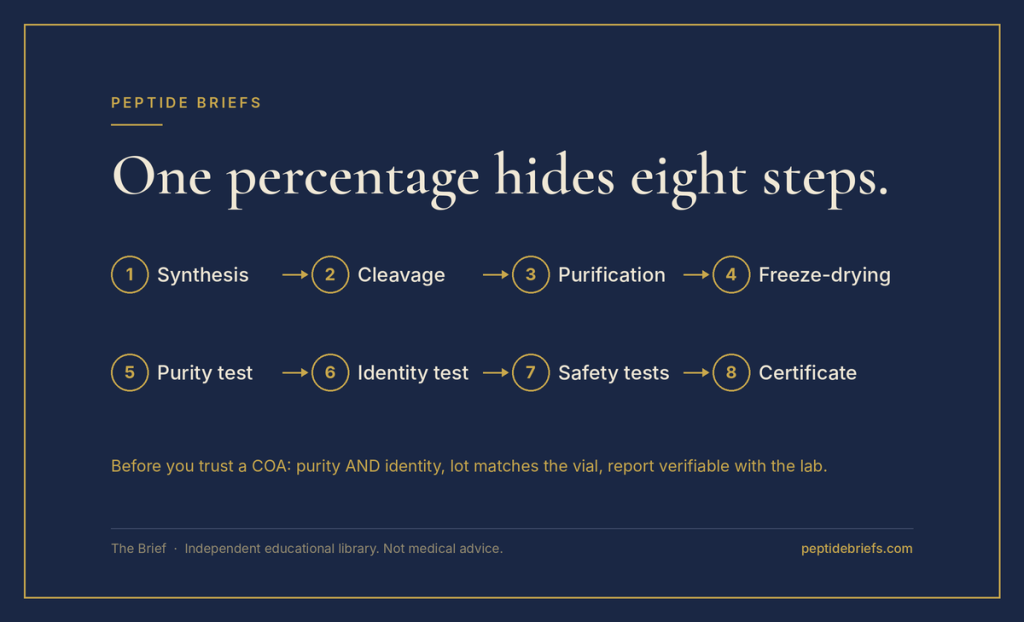
    WHAT ACTUALLY HAPPENS TO A PEPTIDE BEFORE IT REACHES THE VIAL

    Eight steps, and where each one can go wrong.

    A label says “99% pure.” It doesn’t say what happened before that number. Here is the path of one lot from chemistry to certificate, with the question to ask at each step.

    This is about manufacturing and testing. It is research-use-only information, not guidance for use in people.

    A note on where this comes from. I spent two years living in China, where I observed the peptide industry up close: I met vendors and manufacturers and visited their labs. I’m not a chemist, and this post doesn’t pretend to be a lab manual. It’s what I learned about how a lot moves from synthesis to certificate, and about which questions separate a real certificate from a PDF.

    SYNTHESIS
    Amino acids are joined one at a time on a resin bead. No step is perfect.
    Make Simple: at 99% efficiency per step, a 30-amino-acid peptide comes out roughly three-quarters full-length. The rest is near-miss sequences.
    Ask: how was the batch made, and how was the crude product cleaned up?

    CLEAVAGE
    The chain is chemically cut from the resin. What comes off is a mixture: the target, truncated pieces, deleted sequences, leftover reagents.

    PURIFICATION
    Preparative HPLC separates the target from the junk. Which fractions get kept is a judgment call, and it sets the final purity.

    FREEZE-DRYING
    The purified peptide is freeze-dried into powder. That powder is not 100% peptide. It also holds water and counterions such as TFA or acetate.
    Make Simple: “net peptide content” tells you how much of the powder is actually peptide.
    Ask: is net peptide content reported?

    PURITY TEST
    Analytical HPLC reports the share of the signal that belongs to the main peak.
    Make Simple: purity tells you how clean. It does not tell you what it is.

    IDENTITY TEST
    Mass spectrometry checks the molecular weight. Without it, a clean peak could still be the wrong molecule.
    Ask: is identity confirmed, and by what method?

    SAFETY TESTS
    Endotoxin and microbial testing are separate from purity. A certificate that lists only HPLC doesn’t cover them.

    THE CERTIFICATE
    A COA is a claim about one lot.
    Check: the lot number matches the vial. The report number can be verified with the lab itself, not just a PDF. The methods are listed. An independent lab ran it. The lab’s accreditation status is stated honestly.THE JOURNEY IN ONE LINE
    Synthesis → cleavage → purification → freeze-drying → purity → identity → safety → certificate

    THE BIG TAKEAWAY
    A single percentage hides seven other steps. Before you trust a COA, ask:

    1. Does it show purity AND identity?
    2. Is net peptide content reported?
    3. Were endotoxin and microbial tests run?
    4. Does the lot match the vial?
    5. Can the report number be verified with the lab?

    Which of these do you see missing most often?

    This post describes general peptide manufacturing and analytical practice. It makes no claim about any specific product or supplier.

    Also published on Substack.

  • Retatrutide: what the trials tested, and why a court is counting amino acids

    A viral cost estimate, a federal appeal, and what is still unknown

    Evidence grade: B (unchanged). Reviewed October 2026.

    Retatrutide was hard to miss this week. One widely shared post worked out what it would cost to give it to every American with obesity. Another reported that Eli Lilly is in court with the FDA over how many amino acids it contains. Both are worth a closer look, because each rests on a number that is easy to get wrong.

    The viral math

    The cost estimate assumed two things: a price of $1 per milligram, and 3 mg a week as a dose that works for most people.

    The dose. No trial has tested 3 mg as a maintenance dose. The Phase 2 obesity trial tested 1, 4, 8 and 12 mg. The pivotal Phase 3 trial, TRIUMPH-1, tested 4, 9 and 12 mg, with 2 mg used only as a starting step. At 80 weeks, average weight loss was 19.0% on 4 mg, 25.9% on 9 mg and 28.3% on 12 mg. What 3 mg does over a year or more is not something the published evidence can tell you.

    The price. Retatrutide is not approved in any country, so it has no list price. Lilly says it is legally available only to people in its clinical trials. A figure of $1 per milligram describes grey-market material that no regulator has examined. In August, Lilly announced six lawsuits against sellers of “research-use” retatrutide and said it had referred more than 200 others to authorities. A price for an unverified vial tells you nothing about what the medicine will cost.

    The larger argument, that treating obesity could pay for itself, may or may not be right. It needs real doses and real prices before anyone can check it.

    The court case

    Under FDA rules, a “protein” is an amino acid chain with a defined sequence that is greater than 40 amino acids long. Proteins are regulated as biologics. Shorter peptides are regulated as drugs.

    Retatrutide sits on that line. Its backbone has 39 amino acids. Attached to it is a side chain that Lilly says contains two more, which makes 41. The FDA says only alpha amino acids count and that one of the side chain’s two is not an alpha amino acid. By the FDA’s count the total is 40, which is not greater than 40.

    The classification matters for two reasons:

    • Exclusivity. Biologics get 12 years of protection from competition. New drugs get 5.
    • Compounding. Compounding pharmacies cannot make biologics. A biologic label would close the door that let pharmacies make copies of semaglutide and tirzepatide during shortages.

    Where it stands

    DateWhat happened
    March 18, 2024FDA designates retatrutide a drug, not a biologic
    September 3, 2024Lilly sues in federal court in Indiana
    September 30, 2025The court sides with FDA on the meaning of “protein,” and sends a second question, whether retatrutide is “analogous” to one, back to the agency
    February 2026Lilly appeals to the Seventh Circuit
    September 24, 2026The appeal is argued

    We found no report of a decision as of October 12.

    Whichever way the court rules, it is a decision about legal category. It adds nothing to what is known about whether retatrutide works or is safe.

    What is still unknown

    • The pivotal trial is not yet in a journal. TRIUMPH-1 was presented in full in June. As of this review we have not found a peer-reviewed publication.
    • No regulator has reviewed the safety data. Lilly has said it plans to file in early 2027. Two signals to watch are abnormal skin sensations, reported by 12.5% on the highest dose against 0.9% on placebo, and a rise in heart rate.
    • There is no head-to-head result against tirzepatide. That trial is still running.
    • TRIUMPH-2 was scheduled for full presentation at a European diabetes meeting on September 30. We have not yet reviewed it and will update the retatrutide page wScreenshot 2026-10-12 at 4.35.57 PM.pnghen we have.

    Why the grade has not changed

    Nothing this week was new evidence. The trials are the same ones we graded in September. An A needs a published pivotal trial and a regulator’s review, and retatrutide has neither yet.

    Jastreboff AM, et al. Triple-hormone-receptor agonist retatrutide for obesity: a phase 2 trial. N Engl J Med. 2023. Dose arms as summarized by Patient Care.

    AJMC: Retatrutide achieves up to 30.3% average weight loss in Phase 3 TRIUMPH-1 trial. Doses, results by arm, discontinuation rates.

    Reason: Can a new weight loss treatment escape the legal and regulatory thicket? September 10, 2026. The 40-amino-acid rule, each side’s count, exclusivity, Lilly’s six lawsuits.

    ProfPeptide: Lilly v. Kennedy, whether retatrutide is a drug or a biologic goes to the Seventh Circuit. Case timeline and dates.

    MDLinx: Inside retatrutide’s black market, Eli Lilly’s 6 new lawsuits, and a brewing FDA battle. August 18, 2026.

    Fidj Law: Drug or biologic? An Eli Lilly lawsuit could impact weight loss drug compounders.

    Lilly: new data at EASD 2026, including TRIUMPH-2 on September 30.

    The dysesthesia figures and the trial list come from the September retatrutide page on Peptide Briefs.

    Peptide Briefs is an independent reference on peptides as they appear in the scientific literature. Nothing here is medical advice or a recommendation to use any compound.