
• “GLP” Field Guide Part 2: The Approved “GLP”-Class Drugs, Graded

    “GLP” Field Guide Part 2: The Approved “GLP”-Class Drugs, Graded

    Six A’s, two you can’t buy, one that isn’t a peptide. What the grade tells you, and what it doesn’t.

    Peptide Briefs · · Troy Snyder, Ed.D., MBA

    The field guide covered the pipeline. This is the other half of the map: the GLP-class drugs that have already been through a regulator, plus the one combination sitting on the FDA’s desk right now. Seven compounds, each graded the same way the rest of the library is graded. A means peer-reviewed pivotal trials plus a completed regulatory safety review; B means peer-reviewed phase 3 or strong phase 2 without a regulator’s sign-off.

    Six of the seven are A’s, and that is the point of writing them up. An A is not a recommendation and it is not a claim that the drug is the best in its class. Exenatide is an A and has been pulled from the US market. Lixisenatide is an A and was discontinued because nobody wanted it. The grade says the evidence is complete and reviewed. What you do with that is a different question.

    Each section below is short on purpose. These are the best-documented drugs in the entire library, and the full trial records run to hundreds of papers each. I’ve pulled the pivotal trial, the cardiovascular outcomes trial where one exists, the approval history, and the caveat that matters most. Full compound pages will follow for the ones people actually search for.

    Semaglutide

    Evidence grade: A · Also known as Ozempic, Wegovy, Rybelsus; GLP-1 S on some vendor menus.

    What it is. A once-weekly GLP-1 receptor agonist, 31 amino acids, with a C18 fatty diacid on lysine 26 that binds albumin and gives it a half-life of about a week. The oral form uses an absorption enhancer (SNAC) and a much higher dose to get across the stomach wall.

    Why it’s an A. The STEP program (STEP 1, NEJM 2021: 14.9% weight loss at 68 weeks versus 2.4% placebo in 1,961 adults) and the SUSTAIN program for diabetes are peer-reviewed. SELECT (NEJM 2023; 17,604 adults with cardiovascular disease and no diabetes) showed a 20% reduction in major adverse cardiovascular events, the first time an obesity drug did that. FLOW (NEJM 2024) showed kidney protection in type 2 diabetes. The FDA has reviewed all of it: Ozempic for diabetes (December 2017), Rybelsus oral for diabetes (September 2019), Wegovy for obesity (June 2021), cardiovascular risk reduction (March 2024), MASH (August 2025), and the oral Wegovy 25 mg pill (December 22, 2025, based on OASIS 4: 16.6% at 64 weeks).

    Caveat. The gastrointestinal burden is real (74% of STEP 1 participants versus 48% on placebo) and weight returns when treatment stops: the STEP 1 extension showed two-thirds of lost weight regained within a year off drug. Loss of lean mass is a live research question. Semaglutide is also the most counterfeited drug in this class; the FDA stated in June 2026 that sales of unapproved semaglutide products to consumers are illegal, and research-use-only labeling does not change that.

    Key references. Wilding JPH et al., STEP 1, N Engl J Med 2021;384:989 (PMID 33567185). Lincoff AM et al., SELECT, N Engl J Med 2023;389:2221 (PMID 37952131). Marso SP et al., SUSTAIN-6, N Engl J Med 2016;375:1834 (PMID 27633186). Wharton S et al., OASIS 4, N Engl J Med 2025 (PMID 40934115).

    Tirzepatide

    Already has its own page: Tirzepatide (A). Listed here for completeness of the baseline.

    Liraglutide

    Evidence grade: A · Also known as Victoza, Saxenda; generic liraglutide.

    What it is. A once-daily GLP-1 receptor agonist with a C16 fatty acid on lysine 26, half-life about 13 hours. The direct ancestor of semaglutide: same strategy, shorter tail.

    Why it’s an A. SCALE Obesity and Prediabetes (NEJM 2015; 3,731 adults) showed 8.0% weight loss at 56 weeks on 3.0 mg versus 2.6% placebo. LEADER (NEJM 2016; 9,340 adults with type 2 diabetes) showed a 13% reduction in major cardiovascular events and a 22% reduction in cardiovascular death, which made liraglutide the first GLP-1 with a cardiovascular indication (2017). FDA approvals: Victoza for diabetes (January 2010), Saxenda for obesity (December 2014), pediatric diabetes (2019), pediatric obesity (2020). Generic Victoza was approved in December 2024 (Teva, Hikma) and generic Saxenda in August 2025 (Teva), the first generic GLP-1 for weight management.

    Caveat. Daily injection, and the weight loss is roughly half of semaglutide’s in head-to-head data (STEP 8: 15.8% versus 6.4%). A 2024 analysis flagged bone-density declines in Saxenda-treated patients. It matters now mostly because it is the cheapest approved GLP-1 in the US and the one most likely to be substituted for an off-label or compounded product.

    Key references. Pi-Sunyer X et al., SCALE, N Engl J Med 2015;373:11 (PMID 26132939). Marso SP et al., LEADER, N Engl J Med 2016;375:311 (PMID 27295427). Rubino DM et al., STEP 8, JAMA 2022;327:138.

    Dulaglutide

    Evidence grade: A · Also known as Trulicity.

    What it is. Two GLP-1 analogue chains fused to a modified human IgG4 Fc fragment, which is why it is dosed weekly and why it is technically a fusion protein rather than a lipidated peptide.

    Why it’s an A. The AWARD program established glycemic efficacy; FDA approval for type 2 diabetes came in September 2014. REWIND (Lancet 2019; 9,901 adults, median 5.4 years, the longest GLP-1 outcomes trial) showed a 12% reduction in major cardiovascular events in a population that was mostly primary prevention, which earned a cardiovascular indication in February 2020 covering both people with and without established heart disease. Weight loss is modest: about 1.5 kg in REWIND, 4 to 5 kg at the higher 3.0 and 4.5 mg doses in AWARD-11.

    Caveat. It is a diabetes drug, not an obesity drug, and has never been submitted for weight management. Anyone marketing it as a weight-loss peptide is working from the wrong trial record. Not available as a generic.

    Key references. Gerstein HC et al., REWIND, Lancet 2019;394:121 (PMID 31189511). Frias JP et al., AWARD-11, Diabetes Care 2021;44:765.

    Exenatide

    Evidence grade: A · Also known as Byetta, Bydureon, Bydureon BCise; exendin-4.

    What it is. The original. A 39-amino-acid peptide first isolated from Gila monster venom, about 53% identical to human GLP-1 and resistant to DPP-4 breakdown, with a half-life of about 2.4 hours. Byetta was twice-daily; Bydureon wrapped it in microspheres for weekly dosing.

    Why it’s an A. FDA approval in April 2005 made it the first GLP-1 receptor agonist on the market. The AMIGO trials established glycemic control; Bydureon (weekly) followed in 2012. EXSCEL (NEJM 2017; 14,752 adults) showed cardiovascular safety (non-inferiority) but not benefit, with a hazard ratio of 0.91 that just missed significance.

    Caveat. This is an A for a drug you can barely buy. AstraZeneca discontinued Byetta and Bydureon BCise in the US in October 2024 as a business decision; Amneal’s generic exenatide (Byetta equivalent) was approved in November 2024 and is the only form still sold. Weight loss was never the point: 2 to 3 kg in the diabetes trials. It belongs in the library because the entire class descends from it and because it still turns up on research vendor menus at prices that make no sense for a drug with an approved generic.

    Key references. Holman RR et al., EXSCEL, N Engl J Med 2017;377:1228 (PMID 28910237). DeFronzo RA et al., AMIGO, Diabetes Care 2005;28:1092.

    Lixisenatide

    Evidence grade: A · Also known as Adlyxin (US), Lyxumia (EU); the lixisenatide half of Soliqua.

    What it is. A once-daily exendin-4 derivative with a C-terminal polylysine tail, 44 amino acids, short-acting. Its distinguishing feature was a strong effect on post-meal glucose through gastric emptying, with less effect on fasting glucose.

    Why it’s an A. GetGoal program for glycemic control; FDA approval July 2016. ELIXA (NEJM 2015; 6,068 adults after an acute coronary event) showed cardiovascular safety but no benefit, hazard ratio 1.02.

    Caveat. Sanofi discontinued standalone Adlyxin in the US effective January 1, 2023, citing competition and poor sales; it survives only inside Soliqua (with insulin glargine). Weight effect was minimal, around 1 kg. Grade A, commercially dead. If a vendor is listing it, ask what possible research question it answers that liraglutide does not.

    Key references. Pfeffer MA et al., ELIXA, N Engl J Med 2015;373:2247 (PMID 26630143).

    Orforglipron

    Evidence grade: A · Also known as Foundayo. Not a peptide.

    What it is. A once-daily oral small molecule that activates the GLP-1 receptor. Discovered by Chugai, licensed to Lilly in 2018. Because it is not a peptide it has no absorption problem, no food or water restrictions, and cannot be made by peptide synthesis; it belongs in this library only because readers will see it next to the peptides everywhere else.

    Why it’s an A. ATTAIN-1 (NEJM 2025; 3,127 adults without diabetes, 72 weeks) showed 12.4% weight loss at the top dose if everyone adhered, 11.1% on the treatment-regimen estimand, versus 2.1% placebo. ATTAIN-2 covered type 2 diabetes. The FDA approved it for chronic weight management on April 1, 2026, 50 days after filing under the national priority voucher program; diabetes is a separate pending submission. UK authorization followed in 2026.

    Caveat. It loses to every injectable on the scale: roughly half of tirzepatide’s effect and below oral Wegovy’s 16.6%. Nausea ran 29 to 36% versus 10% on placebo, and the approved dose ladder (0.8 to 17.2 mg) differs from the trial’s titration without a published explanation. No cardiovascular outcomes data yet. Boxed thyroid warning like the rest of the class.

    Key references. Wharton S et al., ATTAIN-1, N Engl J Med 2025;393:1796 (doi 10.1056/NEJMoa2511774). FDA approval announcement, April 1, 2026.

    CagriSema

    Evidence grade: B · Cagrilintide 2.4 mg plus semaglutide 2.4 mg, once weekly, one pen.

    What it is. A fixed-dose combination of an amylin analogue and a GLP-1 analogue, two separate peptides co-formulated. Each half has its own page or will shortly: cagrilintide (B) is live; semaglutide is above.

    Why it’s a B and not an A. The pivotal trials are peer-reviewed: REDEFINE 1 (NEJM 2025; n = 3,417) showed 20.4% weight loss at 68 weeks, 22.7% if everyone adhered, versus 3.0% placebo; REDEFINE 2 (NEJM 2025; type 2 diabetes) showed 13.7%. But no regulator has finished a review. Novo Nordisk filed with the FDA on December 18, 2025 and has guided to a decision in the fourth quarter of 2026. REDEFINE 4, the open-label head-to-head against tirzepatide 15 mg, missed its non-inferiority endpoint in February 2026 (20.2% versus 23.6% at 84 weeks). The cardiovascular outcomes trial (REDEFINE 3) is ongoing.

    Caveat. Four in five participants had gastrointestinal side effects. Only 57% of the REDEFINE 1 CagriSema group reached the top dose under a flexible protocol, which the sponsor cites as context for the tirzepatide miss and critics read the other way. A higher-dose version (2.4/7.2 mg) starts phase 3 in the second half of 2026. This grade changes the day the FDA rules; watch Grade Changes.

    Key references. Garvey WT et al., REDEFINE 1, N Engl J Med 2025 (doi 10.1056/NEJMoa2502081). Davies MJ et al., REDEFINE 2, N Engl J Med 2025 (doi 10.1056/NEJMoa2502082). Novo Nordisk, REDEFINE 4 announcement, February 23, 2026.


    What the baseline tells you

    Three things stand out when the approved drugs are lined up this way.

    First, the A grade is about evidence, not usefulness. Two of the six A’s are discontinued, one was never a weight-loss drug, and one isn’t a peptide. If you are reading this library to decide which compound is interesting, the grade is the floor, not the answer.

    Second, the cardiovascular outcomes trials are the real dividing line inside the A’s. Liraglutide, semaglutide and dulaglutide showed benefit. Exenatide and lixisenatide showed safety only. That difference, more than the weight numbers, is why the first three dominate prescribing.

    Third, every pipeline compound in the field guide is measured against this table. UBT251’s 19.7% at 24 weeks is impressive because tirzepatide’s 72-week number is about 21%. Survodutide’s 13% is underwhelming because semaglutide’s is 15%. The baseline is what makes the pipeline numbers mean anything.

    Peptide Briefs is an independent reference and does not sell anything. Its owners co-own a research-peptide vendor; that is disclosed on every page. Nothing here is medical advice or a dosing recommendation.

  • A Field Guide to the “GLP”-Class Pipeline

    A Field Guide to the “GLP”-Class Pipeline

    Twenty molecules are in late-stage development. You’ve heard of four. Here’s what the rest actually show.

    Updated Nov 6, 2026: added CT-G32 (Celltrion), a preclinical four-target candidate.

    Peptide Briefs · · Troy Snyder, Ed.D., MBA

    If you follow this space on X, you could be forgiven for thinking there are four GLP-class molecules in the world: semaglutide, tirzepatide, retatrutide, and whatever a vendor is calling retatrutide this week. There are closer to twenty in late-stage development, several are already approved somewhere, and a few of them are starting to show up on research vendor menus under names most buyers have never seen in a paper.

    This is a field guide to the ones that don’t get talked about. For each I’ll tell you what it is, who makes it, what the human evidence actually shows, and how far it is from a regulator’s desk. I grade the same way the compound pages do: A needs peer-reviewed pivotal data plus a completed regulatory safety review; B is peer-reviewed phase 3 or strong phase 2 without a regulator’s sign-off; C is phase 2 or less; D is preclinical or sponsor press releases only. Where a drug is approved in China but not reviewed by the FDA or EMA, I say so, because a Chinese approval is a real regulatory review and also not the same thing as a US one.

    One framing note before the list. “GLP-1” has become shorthand for a whole family of gut-hormone drugs. Several of the molecules below don’t touch the GLP-1 receptor at all. They are here because they are being developed to do the same job and because they get lumped together on vendor sites.

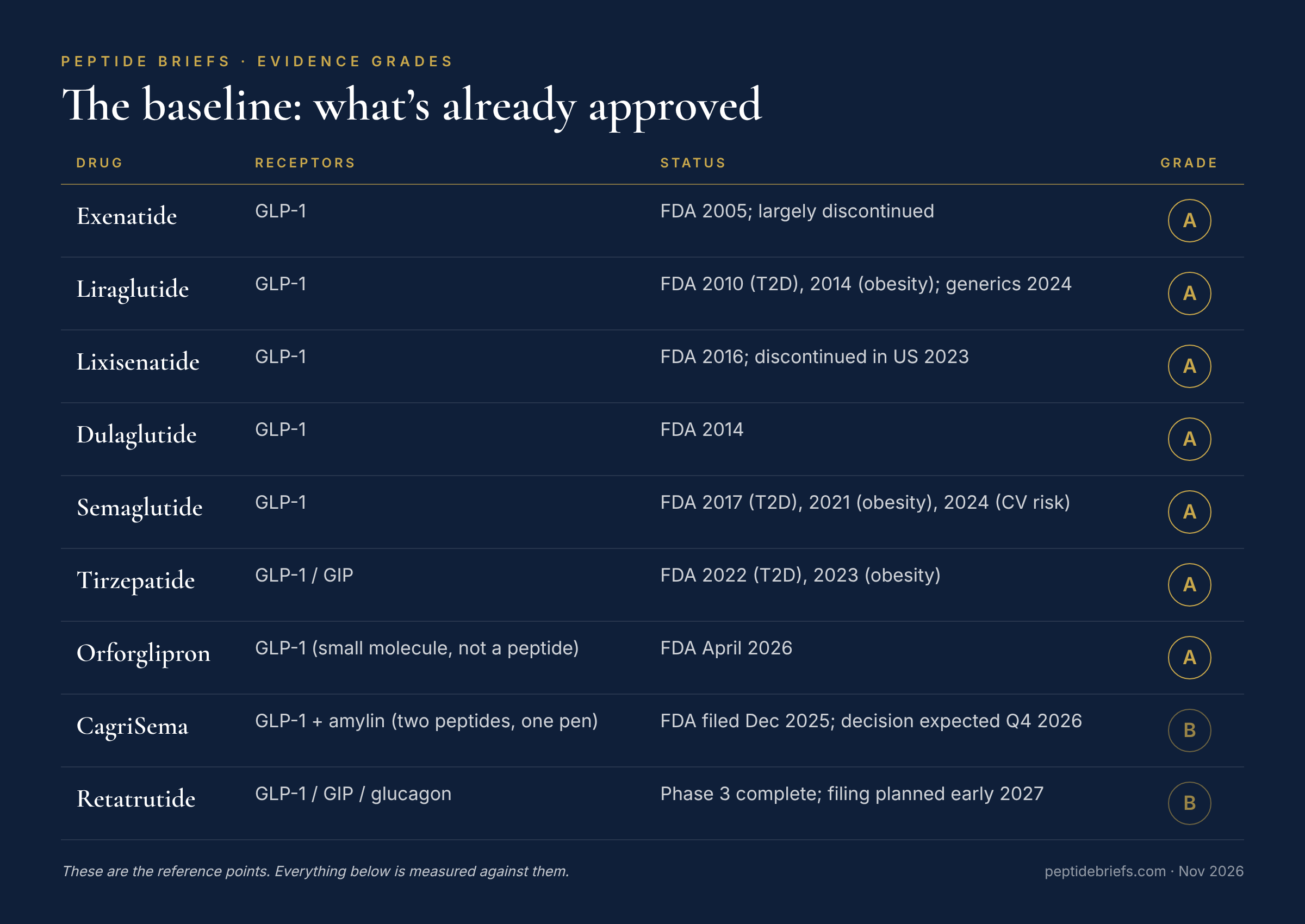
    The Baseline: What’s Already Approved

    DrugReceptorsStatusGrade
    ExenatideGLP-1FDA 2005; largely discontinuedA
    LiraglutideGLP-1FDA 2010 (T2D), 2014 (obesity); generics 2024A
    LixisenatideGLP-1FDA 2016; discontinued in US 2023A
    DulaglutideGLP-1FDA 2014A
    SemaglutideGLP-1FDA 2017 (T2D), 2021 (obesity), 2024 (CV risk)A
    TirzepatideGLP-1/GIPFDA 2022 (T2D), 2023 (obesity)A
    OrforglipronGLP-1 (small molecule, not a peptide)FDA April 2026A
    CagriSemaGLP-1 + amylin (two peptides, one pen)FDA filed Dec 2025, decision expected Q4 2026B
    RetatrutideGLP-1/GIP/glucagonPhase 3 complete, filing planned early 2027B

    The Chinese Pipeline

    China is now the second center of gravity for this drug class, and two of its molecules are approved there. If you have seen a “Chinese retatrutide” referenced online, it is almost certainly one of the first two below.

    UBT251 — the triple agonist Novo bought

    What it is: A once-weekly synthetic peptide that activates GLP-1, GIP and glucagon receptors, the same three targets as retatrutide. Developed by United Bio-Technology (Hengqin), a subsidiary of The United Laboratories (TUL), Zhuhai. In March 2025 Novo Nordisk licensed worldwide rights outside Greater China for $200 million upfront.

    Evidence: Two Chinese phase 2 trials, both reported by press release in 2026 and not yet peer-reviewed. In adults with overweight or obesity (baseline 92 kg, BMI 33), the 6 mg dose produced a mean weight loss of 19.7% at 24 weeks versus 2.0% on placebo. In type 2 diabetes (211 participants), HbA1c fell up to 2.16% versus 1.77% on semaglutide 1 mg, with weight loss up to 9.8% versus 4.8%. Novo is running a global phase 1b/2a in about 330 people, reading out in 2027, and TUL plans two Chinese phase 3s.

    Why people call it “the Chinese retatrutide”: Same mechanism, similar early numbers (retatrutide’s phase 2 showed 24% at 48 weeks; 19.7% at 24 weeks is on a comparable trajectory), and it is Novo’s answer to Lilly’s molecule. On half-life, I can find no published pharmacokinetic data for UBT251 that would support a claim that it lasts longer than retatrutide. Both are dosed weekly. If a vendor is telling you otherwise, ask them for the paper.

    Grade: C. Phase 2, press-release only, no peer review, no regulator.

    Mazdutide — approved in China, dual GLP-1/glucagon

    What it is: A once-weekly GLP-1 and glucagon receptor dual agonist, originally Lilly’s LY3305677, licensed to Innovent Biologics for China. Brand name Xinermei.

    Evidence: The GLORY-2 phase 3 in Chinese adults with obesity reported 16.7% mean weight loss at 9 mg over 60 weeks; the earlier GLORY-1 phase 3 was published in NEJM in 2024 and the program has since appeared in JAMA and Lancet Diabetes & Endocrinology. A US phase 2 reported up to 18.1% at 16 mg over 32 weeks.

    Regulatory: Approved by China’s NMPA for chronic weight management on June 27, 2025 and for type 2 diabetes on September 19, 2025. No FDA or EMA filing.

    Grade: B. Peer-reviewed phase 3 and a completed regulatory review, but not by the FDA or EMA. If you want to call this an A for China, I won’t argue hard. For a US reader it is a B.

    Ecnoglutide — the “biased” GLP-1

    What it is: A long-acting GLP-1 receptor agonist from Sciwind Biosciences (Hangzhou), engineered to preferentially signal through the cAMP pathway rather than β-arrestin, which in theory means less receptor desensitization. Brand names Xianyida (diabetes) and Xianweiying (weight). Pfizer holds China commercialization rights.

    Evidence: Phase 3 in China reported about 15.1% placebo-adjusted weight loss. The biased-agonism claim is mechanistically interesting and clinically unproven; nobody has shown in humans that it translates to better durability or tolerability than semaglutide.

    Regulatory: NMPA approved for type 2 diabetes (January 30, 2026) and for weight management (March 6, 2026). No US filing announced.

    Grade: B, same logic as mazdutide.

    Bofanglutide (GZR18) — the every-two-weeks GLP-1

    What it is: A long-acting GLP-1 receptor agonist from Gan & Lee Pharmaceuticals (Beijing), dosed once every two weeks. This is the one Chinese molecule where “longer half-life” is actually the selling point.

    Evidence: Phase 3 in China with an extension ongoing; Gan & Lee has signed licensing deals with JW Pharmaceutical (Korea, $81 million, April 2026) and Lupin (India). Published data are thinner than for mazdutide or ecnoglutide.

    Grade: C. It is a single GLP-1 agonist, not a triple, so anyone describing it as a longer-acting retatrutide is wrong on mechanism.

    HRS9531 — Hengrui’s dual agonist

    What it is: A GLP-1/GIP dual agonist (tirzepatide’s mechanism) from Jiangsu Hengrui, in phase 3 in China. Kailera Therapeutics licensed it for the rest of the world in 2024.

    Grade: C pending phase 3 publication.


    The Western pipeline you’ve probably skipped

    Survodutide — the one that read out and underwhelmed

    What it is: Boehringer Ingelheim and Zealand Pharma’s once-weekly GLP-1/glucagon dual agonist (BI 456906).

    Evidence: SYNCHRONIZE-1 (NEJM, June 2026; 76 weeks, 1,481 people without diabetes) reported 12.2% and 13.0% at 3.6 and 6.0 mg versus 5.4% placebo on the primary estimand, or up to 16.6% if everyone adhered. SYNCHRONIZE-2 (NEJM, October 2026, type 2 diabetes) reported 8.2% and 9.8% versus 3.9%. A pre-specified substudy showed 63% liver fat reduction and 34% visceral fat reduction, and the earlier phase 2b in MASH showed histological improvement in up to 83% of patients. The cardiovascular outcomes trial completed in June 2026 with results expected before year end.

    The honest read: This is semaglutide-range weight loss with a potentially better liver story. It is not a tirzepatide competitor on the scale.

    Grade: B. Peer-reviewed phase 3, no regulatory review yet.

    MariTide (maridebart cafraglutide) — the monthly one

    What it is: Amgen’s AMG 133, a GLP-1 receptor agonist peptide fused to an antibody that blocks the GIP receptor. Yes, blocks. Tirzepatide activates GIP; MariTide antagonizes it; both lose weight. Nobody has fully explained this. The antibody scaffold gives it a half-life around three weeks, so it is dosed monthly, and Amgen is testing every-eight-weeks maintenance.

    Evidence: Phase 2 (NEJM 2025) showed up to about 20% weight loss at 52 weeks in people without diabetes and about 17% with type 2 diabetes, with the striking feature that weight stayed off for months after the last dose. Phase 3 (MARITIME-1 and -2) is ongoing with an estimated primary completion in January 2027; as of October 2026 no phase 3 results have been reported. The phase 3 titration was slowed after high rates of nausea and vomiting in phase 2.

    Grade: C, and the most interesting C on this list. If anything here deserves the label “longer half-life than retatrutide,” it is this, and it is a peptide-antibody conjugate, not something a peptide synthesizer can make.

    Amycretin — GLP-1 and amylin in one molecule

    What it is: Novo’s single peptide that activates both the GLP-1 receptor and the amylin receptor, available as a weekly injection and a daily pill. Think CagriSema’s two mechanisms fused into one chain.

    Evidence: Phase 1b/2a injectable showed about 22% weight loss at 36 weeks; the oral form showed about 13% at 12 weeks. Phase 3 began in 2026.

    Grade: C. Early, but this is where Novo is putting its chips after the CagriSema head-to-head miss.

    Eloralintide — Lilly’s amylin-only answer

    What it is: A selective amylin receptor agonist (no calcitonin receptor activity, unlike cagrilintide), weekly injection.

    Evidence: Phase 2 showed up to 20% weight loss at 48 weeks as monotherapy, which is remarkable for an amylin drug on its own. The eloralintide-plus-tirzepatide combination (presented at EASD, September 30, 2026) showed up to 23.3% at 48 weeks in obesity with type 2 diabetes versus 14.8% for tirzepatide 15 mg alone. Phase 3 started late 2025.

    Grade: C, likely B within a year.

    Pemvidutide, VK2735, petrelintide, berobenatide

    Briefly: pemvidutide (Altimmune) is a GLP-1/glucagon dual in phase 2 with a MASH focus; VK2735 (Viking) is a GLP-1/GIP dual in phase 3 with both injectable and oral forms; petrelintide (Zealand, partnered with Roche) is another long-acting amylin analogue in phase 2; berobenatide (Pfizer, formerly Metsera’s MET-097i) is an ultra-long-acting GLP-1 dosed monthly, in phase 3, with 12.3% placebo-adjusted weight loss at 28 weeks in phase 2b. All C or D today.

    The Korea pipeline

    CT-G32 — Celltrion’s four-target candidate

    What it is: Celltrion’s injectable candidate that combines GLP-1, GIP, glucagon and amylin activity in one molecule. It’s the first announced design to add amylin to a retatrutide-style triple agonist.

    Evidence: Preclinical only. Celltrion reports that in obese animals at the same dose it produced greater weight loss than retatrutide, with proportionally less lean mass lost, and that primate data support once-weekly dosing. These are company-reported, non-peer-reviewed results, and no human data exist. An IND is expected in early 2027, per company statements.

    Grade: C. Preclinical and company-reported; too early to judge.

    What this means if you are reading vendor listings

    Three patterns to watch for.

    Names that aren’t names. “GLP-3,” “Triple G,” “Reta-L,” “long-acting GLP” are catalog labels, not molecules. Every compound on this page has a development code and, for most, an INN. A vendor who cannot tell you which one they are selling cannot have tested its identity.

    Half-life claims without pharmacokinetics. A peptide’s half-life comes from its lipid tail or antibody scaffold and is measured in a phase 1 trial. Retatrutide’s is about six days; semaglutide’s about seven; cagrilintide’s about seven to eight; MariTide’s about three weeks. Any claim of a “longer half-life” version of a weekly peptide should come with a published number. If the vendor’s answer is a different fatty acid chain, that is a different molecule with no human data at all.

    Approval that isn’t your approval. Mazdutide and ecnoglutide are approved drugs in China. That is a meaningful review. It is not an FDA review, and it does not change the legal status of research-grade material in the US, where the FDA stated in June 2026 that sales of unapproved GLP-class products to consumers are illegal and Lilly filed six lawsuits in August 2026 against sellers of retatrutide, including research-use-only vendors.

    The field is moving fast enough that half of this page will need updating within six months: CagriSema’s FDA decision is due this quarter, retatrutide’s filing is planned for early 2027, MariTide phase 3 reads out around the same time, and SYNCHRONIZE-CVOT is due before year end. I’ll post grade changes as they land.


    Sources

    • United Laboratories / Novo Nordisk, UBT251 phase 2 topline releases, February 24 and March 25, 2026
    • Innovent Biologics, mazdutide NMPA approvals (June 27 and September 19, 2025); Ji L et al., Once-weekly mazdutide in Chinese adults with obesity or overweight, NEJM 2024, doi:10.1056/NEJMoa2411528
    • Sciwind Biosciences, ecnoglutide NMPA approval announcements, January 30 and March 6, 2026
    • Boehringer Ingelheim, SYNCHRONIZE-1 topline (April 28, 2026) and ADA 2026 presentation; SYNCHRONIZE-1 and SYNCHRONIZE-2 in NEJM, June and October 2026
    • Amgen, MariTide phase 2 (NEJM 2025); ClinicalTrials.gov MARITIME-1 and MARITIME-2 records
    • Eli Lilly, eloralintide phase 2 and EASD 2026 presentation (September 30, 2026)
    • Novo Nordisk, REDEFINE 4 company announcement, February 23, 2026
    • FDA statement on unapproved incretin products, June 2026; Eli Lilly press release on retatrutide lawsuits, August 12, 2026
    • Celltrion. Press release on CT-G32 preclinical development, May 29, 2026 (company-authored). celltrion.com
    • Seoul Economic Daily. “Celltrion to Begin Trials of World’s First Quadruple-Acting Obesity Drug,” Nov 4, 2026. en.sedaily.comLeave a comment

    Peptide Briefs is an independent reference and does not sell anything. Its owners co-own a research-peptide vendor; that is disclosed on every page. Nothing here is medical advice.

  • Funny, Strange and Scary Stories From Inside the Chinese Peptide Supply Chain

    Funny, Strange and Scary Stories From Inside the Chinese Peptide Supply Chain

    Origiannly Posted on Substack

    A reader asked for the stories behind my China article, so here are some. I went back through my own conversations with sellers there. I have left out names, companies, phone numbers, addresses, and prices. These stories describe my dealings with sellers in China and nothing else. They say nothing about any supplier in the United States.

    Subscribe

    Discovering My First Supplier: A Journey Through Reddit and Shenzhen Sea World

    Finding my very first supplier in China was an unexpected adventure that unfolded in the most unconventional way – on Reddit! It wasn’t through a factory visit or a bustling trade show; it was through connecting with a fascinating individual with a unique story.

    This particular supplier was living in Shenzhen and originally hailed from Nigeria. He specialized in peptides, which piqued my interest right away. However, I must admit that my initial reaction was laced with apprehension. Selling injectables over the internet can certainly raise red flags, and I had to confront the unfair stereotypes about online scams, particularly those related to Nigeria. The stereotype isn’t just a perception; it can cloud judgment. Instead of focusing on his nationality, I realized I needed to assess the situation more objectively.

    I looked for a way to reassure myself about his authenticity and found that he had shared photos of himself at a well-known spot in Shenzhen called Sea World—somewhere I recognized because I had been there myself! While this didn’t definitively prove his credibility or the quality of his products, it created a sense of connection. It turned him from a faceless stranger into someone who lived just an hour away by ferry, making the whole situation feel more tangible.

    This small but meaningful verification taught me an important lesson about the market. Peptides often pose sourcing challenges in China because they’re intended for export. Domestic sales are generally discouraged, which means that sometimes it’s easier for a foreigner on Reddit to find reputable suppliers than to locate a lab nearby. As I explored further, I discovered additional vendors on Meituan, a Chinese shopping app. This was a whole new experience—products were cleverly disguised as skincare, and titles contained deliberate misspellings, adding an element of intrigue.

    Looking back, it’s clear that my first supplier was more of a trader than a direct manufacturer. This is a crucial distinction I now emphasize to anyone entering this field. At that time, all I knew was that he felt authentic enough for me to want to meet him in a place I recognized.

    * Bacteriostatic water in China comes in ampoules. You then have to use a filter needle to make sure you don’t get glass fragments into the injectable liquid. I never got comfortable with it and brought my own.

    Navigating Sterile Standards and Visitor Restrictions

    Out of the blue, I received a message from a salesperson representing a factory that boldly claimed to be a leading peptide manufacturer. They promised 99% purity, certificates of analysis, no minimum order, and readily available stock. Exciting, right? I was eager to learn more, so I asked if I could visit their facility.

    The response was somewhat surprising: they only catered to VIP clients, and their factory maintained strict sterile production standards. I was invited to place a small trial order instead. Here’s my takeaway: they were too sterile for a visitor but open to selling to unknown strangers. I followed my learned principle: factories that welcome visits are typically genuine producers, while those that impose visitor restrictions can raise concerns. With that, I respectfully declined their offer.

    Let Me Consult My Boss Tomorrow

    I reached out to another factory, repeating my inquiry about visiting. The representative assured me she would check with her boss the following day. I inquired about their testing procedures, but the answer was vague—“third-party independent laboratory testing.” No specifics, just a general term.

    Later that day, the narrative shifted. Suddenly, they were open to visits, but only for clients placing large orders. Did I want to see factory videos first? While video tours are nice, they don’t equate to an actual visit. I’m looking for transparency, not a promotional trailer.

    The Three Bosses

    The most welcoming response came from a representative at a different company. She enthusiastically suggested that I inspect their site since I was nearby, even embracing my idea of organizing a tour group for sellers. However, before she could approve a visit for a friend, she inquired if he was American. Spoiler alert: he was. I’ll let you draw your own conclusions.

    A few days later, I received an update from her. After some “deliberation among our three bosses,” the directive changed. I was now required to place a sample order, send it for testing, and only then would they consider a site visit. If the product failed the test, I would be fully refunded; if it passed and I was willing to endorse their company, they would refund 30% of the testing fee.

    Take a moment to ponder that. What began as an invitation to visit morphed into a transaction, and that testing fee was essentially a discount tied to a potential testimonial. It felt wholly inappropriate to me. A lab test should genuinely reflect the quality of a product and shouldn’t be contingent on my willingness to provide a positive review.

    Communicating Clearly with a Language Barrier

    Navigating the language differences in this business can be quite a challenge. One seller listed a popular weight-management compound, but their product name included periods between syllables, which I suspected was a deliberate attempt to bypass keyword filters. When I inquired about product sizes, I was encouraged to send my request “in the straightest way possible”—a testament to the challenges of translation tools.

    Then came a memorable moment when I asked about a blend humorously referred to as “Wolverine” in online communities. The response informed me that only peptide injections were available. Clearly, the nickname had lost its charm in translation! I had to clarify, quite politely, that I wasn’t actually ordering a superhero.

    The Batch That Turned to Gel

    In my quest, one product from an early order didn’t behave as expected; it clumped together and transformed into a gel. I tried various solutions—acetic acid, bacteriostatic water, and even sought out glycerol. Unfortunately, I lost three vials in the process.

    The seller advised me to experiment with different types of water and asked for my feedback. When that didn’t yield the desired results, she offered either a replacement or a refund.

    This journey of discovery, intertwined with both challenges and triumphs, opened my eyes to the complexities of international trade and the importance of forging authentic relationships in the business world. It’s this process of learning and adaptation that fuels my enthusiasm for what lies ahead as I continue to explore and grow in this vibrant market!

    The Domestic Lists

    I said earlier that the industry is built around exports. That is true of the sellers who message foreigners. But it is not the whole picture.

    At some point a different kind of spreadsheet reached me: a price list for the domestic market. Same idea as the export menu, but with a twist. It had one column for a brand or street name and another column for the real name of what was inside.

    That extra column tells you a lot. Products were sold under nicknames and invented brands, and the “real name” column was there so buyers knew what the nickname meant. The list mixed peptides with other bodybuilding products, which tells me who the customer is: gym-goers, not skincare shoppers.

    One brand name on it borrowed the name of a well-known approved weight-management drug and added “pen type.” That is not a brand. That is a costume.

    Then there was the pricing. Early on, the domestic list charged noticeably more than the export menu. In one case, a single vial on the domestic list cost more than a whole box of ten on the export sheet. I do not know why. Different sellers, different margins, retail versus wholesale, or a premium for risk are all possible, and I cannot tell you which. Later on, the domestic list became much cheaper, especially factoring in shipping costs, than the export lists, like about 25% cheaper across the board, and shipping was less than $10.

    Two cautions. I do not know who produced this list, how current it was, or whether anyone could actually deliver at those prices. And a list is not a sale.

    But it settles one thing for me. The seller who told me this product is not legally available in China was right about the law. She was not saying nobody buys it there.

    Lab Visits

    This is actually the boring section of this article. I visited 3 labs while living in China. The ones I saw were professional, clean, and respectable. They had assembly lines that appeared sterile, and workers wore lab coats, gloves, and masks and actively monitored the lines. They also had labs with state-of-the-art-looking equipment to check products. I saw nothing that caused alarms, but again, they also had nothing to hide.

    I assume the ones that denied my visit were hiding their operations, if they were even labs and not just bulk-powered buyers and vial fillers.

    What I took away

    Ask to visit. A real producer usually says yes. Treat a no, a delay, or a new condition as information.

    Test the product, not the paperwork. “COA provided” is the cheapest sentence in this industry.

    A relationship is not verification. Months of friendly messages did not make a vial what its label said.

    Test every lot with an independent lab, and compare reports from more than one.

    This article describes my own experience with sellers in China. It is not medical advice, and none of the products discussed here are approved for the uses people claim online.

    Share

    Disclosure: I co-own a research-use-only peptide business. Peptide Briefs runs independently of it. This is not medical advice.

  • The Retatrutide Court Case: What’s Actually at Stake

    Troy Snyder, Sept 2026

    If you’ve been tracking Retatrutide’s evidence record with us — the TRIUMPH trials, the June Lancet publication, the EASD data landing September 30 — there’s a separate story developing this week that has nothing to do with clinical data and everything to do with whether any of it matters in the way you’d expect.

    On September 21, the DOJ filed a letter in Eli Lilly v. FDA (7th Circuit, No. 26-1301), a case that’s been quietly working through the courts and is about to get a lot louder. Oral arguments are Thursday, September 24, 9:30am, Chicago.

    What the case is actually about

    Strip away the legal language and it comes down to one question: is Retatrutide a peptide drug, or is it a protein/biologic?

    That sounds like a technicality. It isn’t. The two classifications sit inside completely different regulatory frameworks, and which one Reta lands in determines the entire competitive landscape around it going forward.

    • Lilly’s position: Retatrutide should be classified as a protein/biologic.
    • FDA’s position: It’s a peptide drug and doesn’t meet the agency’s own definition of a protein.

    The DOJ’s letter this week is procedural but consequential — it’s pointing the appeals court toward a recent Seventh Circuit precedent (Franco v. Chobani, 2026) holding that when an agency’s interpretation of its own scientific definitions is at issue, that interpretation can still carry significant weight with courts, even post-Chevron. In plain terms: DOJ is telling the judges not to second-guess FDA’s classification lightly.

    Why the classification actually matters

    If Reta gets classified as a biologic:

    • Follow-on/generic-equivalent products go through the biosimilar pathway instead of the standard generic route — a slower, more expensive approval process historically reserved for large, complex molecules.
    • 503A/503B compounding pharmacies lose their normal drug-compounding exemptions for biologics, which changes who can legally produce Reta-adjacent formulations and under what rules.

    If Reta stays classified as a peptide drug:

    • It remains inside the traditional drug framework, where standard generic pathways apply.
    • 503A/503B compounding exemptions can still apply, provided other regulatory requirements are met.

    Neither outcome is good or bad in the abstract but they’re genuinely different worlds for anyone tracking availability, pricing, and the broader compounding/RUO ecosystem that sits adjacent to this compound’s supply chain.

    What this means for the grey market

    The 503A/503B compounding question isn’t just a pharmacy-industry detail, it’s the actual bridge between this court case and the broader research-peptide ecosystem, RUO sourcing included.

    If Reta moves into the biosimilar framework, compounding pharmacies lose the exemptions that currently let them produce Reta-adjacent formulations more freely. That tends to push demand in one of two directions, and it’s genuinely unclear which wins out:

    • Tighter compounding rules could push more demand toward RUO/research-only channels as the compounding pathway narrows, the same pattern seen with other GLP-1 compounds when compounding pharmacies faced restrictions.
    • Or it could do the opposite: a high-profile classification fight tends to put the entire peptide category under a brighter regulatory spotlight, RUO sourcing included, not just the specific compound in litigation. Increased scrutiny on one part of the ecosystem has historically spilled over into stricter enforcement, platform bans, and payment-processor caution across the board — something we’ve experienced directly this month.

    We’re not going to speculate on which direction wins, because neither outcome is something we’d base a customer-facing claim on before it actually happens. What we can say plainly: this case is worth watching regardless of whether you buy compounded, RUO, or anything else in this space. The ruling reshapes incentives for the whole supply chain, not just Lilly’s own product line.

    What we’re watching for

    We’ll be straight about where we sit on this: we don’t have a legal opinion on how the classification question should be decided, that’s genuinely a matter for the courts to work out, and we’re not lawyers. But we do have a rooting interest, and we’re not going to pretend otherwise. If Reta stays classified as a peptide drug, the compounding and RUO ecosystem this whole site operates in keeps more room to breathe. If Lilly wins, that room narrows. That’s not a legal argument for either side, it’s just an honest disclosure of where our interest lies, same as we disclose our ownership stake in Agape on multiple pages of this site.

    Oral arguments are Thursday. A ruling likely won’t land immediately; appellate decisions in cases like this often take weeks to months after arguments, but the reasoning that comes out of Thursday’s session will be the first real signal of which way this is heading.

    We’ll cover the outcome in Grade Changes once there’s something concrete to report. For now, this is a “know it’s coming” post, not a “here’s the answer” post — and we’d rather tell you that plainly than manufacture certainty we don’t have.

    — Troy

    Peptide Briefs is an independent research library. This piece covers regulatory proceedings, not clinical evidence — Retatrutide’s evidence grade (B) is unaffected by this case and is tracked separately.