• Peptide Briefs Weekly Top 10: Week of Nov 6, 2026

    Peptide Briefs Weekly Top 10: Week of Nov 6, 2026

    Originally pusblished on Substack

    This week’s new material: labs returning very different numbers on what was reported as the same product, a telehealth company staging a peptide line, warnings of shipping delays ahead of the Shenzhen summit, and tighter customs scrutiny. The HHS peptide policy we covered last week is a follow-up, further down. Ten items follow, with what the evidence does and does not show. Nothing here is medical advice or a recommendation to use any compound.

    SUBSCRIBE

    1. Same sample, different labs, very different numbers

    Krysia, who writes a Substack that digs into third-party peptide testing, documented several cases this week where labs disagreed on the same product. The credit for surfacing these goes to her work and to the labs willing to publish their results. These are anecdotal, vendor-submitted samples, not controlled comparisons, and separate vials can differ. In one case, described as apparently the same batch of a 10 mg retatrutide product, one lab reported 3.98 mg at 36.44% purity, a second reported about 7.7 mg at about 67.3% (two runs, 67.301% and 67.319%), and a third reported 11.26 mg at 98.183%. Janoshik said the simplest explanation for its gap with the second lab was “sample difference”; the first lab declined to discuss. In another case, two labs tested separate vials from the same 10 mg eloralintide kit: one reported 99.74% purity and 10.09 mg, the other 67.8% and 12.1 mg. The second lab stands by its result, citing an extra chromatogram peak that barely registered at 220 nm but showed strongly at 280 nm, which it says it has not yet identified; it says it ruled out two candidate explanations, and no response from the first lab was available. Methods also differ in what “purity” means: one lab does not report blend purity at all because overlapping peaks can hide impurities, another reports combined peak area and says it is “not absolute mass purity,” and one lab found the TB-500 fragment co-eluted with another component. The takeaway: “99%” on a certificate usually means 99% of detected peak area at one wavelength, not 99% of the vial, and a single certificate cannot settle quality. A separate site reports several popular labs are not accredited (ISO/IEC 17025) for peptide assays; it has vendor ties, so verify before citing.

    Sources: Krysia (Substack) and her follow-up notes, ChemVerify (commercial ties)

    2. Telehealth moves in: Hims & Hers stages a peptide line

    On its Aug 10 earnings call, Hims & Hers said it planned to sell compounded peptides by the end of 2026 in phases: sermorelin, glutathione and an existing product first, and the six committee-recommended peptides only after FDA action. The day after HHS acted, its Oct 29 release described a “Peptides+” preview with a waitlist, listing sermorelin, glutathione, B12, NAD+ and L-carnitine, with BPC-157 and TB-500 to follow “when allowable.” The release gives no launch date or pricing, says treatment would come through independent providers and licensed pharmacies, and itself notes that published studies are limited. Becker’s reports the company is running stability testing on BPC-157 at a California facility. As of this week, this is a waitlist and a plan, not a launch.

    Sources: Hims & Hers release (company, promotional), Becker’s Hospital Review

    3. Shenzhen summit: shipping delays are warned, but no export restriction is confirmed

    The APEC Economic Leaders’ Meeting is scheduled for Nov 18 to 19 in Shenzhen. A peptide sourcing vendor’s advisory says freight partners expect “enhanced security measures and stricter cargo inspections” in Shenzhen-area logistics hubs before and during the summit, with delays it calls impossible to predict. That advisory does not mention any government restriction on peptide exports, and I found no confirmed Chinese government export restriction on peptides. Separate social posts relay vendor warnings of a longer shipping disruption starting in late September; I could not verify those. Treat this as a logistics warning, not a policy change.

    Sources: APEC China 2026 (Wikipedia), vendor advisory (commercial source)

    4. Customs and enforcement are tightening on peptide shipments

    On Nov 5, NL Times (citing RTL Nieuws and BNR) reported that Dutch Customs stopped “hundreds of shipments” containing peptides through September, mostly by courier, while RTL identified 203 illegal online pharmacies, more than half under six months old, with products mainly supplied from China. Earlier this year, U.S. Customs and Border Protection reported a Cincinnati interdiction of roughly 5,000 mis-manifested peptide shipments from China, per a secondary summary of the CBP release (exact dates should be confirmed against the primary release). Neither report describes Chinese export controls.

    Sources: NL Times, ChemVerify (secondary, commercial ties)

    5. A large preprint finds wide variability in marketed research peptides

    A preprint by Mendias and Awan (Apr 24, 2026; not peer reviewed) analyzed public third-party testing data from Finnrick Analytics: 14 peptides, 6,285 analyzed samples from 203 companies, tested between December 2024 and April 2026. Depending on the acceptance standard, 41.6% to 71.1% of samples failed basic criteria. Median measured content was 101.8% of label claim, but TB-500 had the lowest median purity (97.29%) and the highest identity failure rate (10.0%), and quality varied more between vendors than between peptides. Endotoxin data existed for under 4% of samples, and 15% of those showed measurable endotoxin. The authors caution the data are voluntary submissions, not a representative sample, and the failure rates are likely a lower bound.

    Source: Preprints.org 202604.1748

    6. A new orthopaedic review: preclinical promise, thin human data

    A narrative review in the Journal of the American Academy of Orthopaedic Surgeons (online Oct 27) covers BPC-157, thymosin beta-4 and TB-500, searching PubMed, EMBASE and Scopus through June 2026. BPC-157 has the largest musculoskeletal preclinical literature, mostly in small animals, while the human musculoskeletal evidence is one small, retrospective, uncontrolled case series. Thymosin beta-4’s musculoskeletal evidence is in vitro and rodent only, and TB-500 is a seven-amino-acid fragment often confused with full-length thymosin beta-4, with no validated equivalence. The authors flag identity, purity, sterility and consistency concerns for commercial products and conclude routine clinical use cannot currently be recommended.

    Source: PubMed 42937313

    7. Follow-up: the HHS interim policy on six peptides, one week on

    As covered last week, the Department of Health and Human Services filed an interim policy on Oct 28 (scheduled for Federal Register publication Oct 30) covering BPC-157, epitalon, KPV, MOTS-c, Semax and TB-500. HHS says it does not intend to take enforcement action against state-licensed pharmacies, federal facilities or licensed physicians that compound these six while FDA works on its 503A bulks list. The policy is interim and non-final, signed by the HHS Secretary rather than issued by FDA, and HHS says it may revisit it if a safety signal or quality problem appears.

    Sources: AJMC, Foley & Lardner

    8. What the policy requires, and what it is not

    Per a law-firm summary, enforcement discretion applies only if conditions are met: the bulk substance comes from an FDA-registered facility with a valid certificate of analysis, the original manufacturer is FDA-registered and CGMP-compliant, adverse events go to MedWatch, the product has a single active ingredient, and labeling states “This is a compounded drug product. Not for resale.” The policy does not add the peptides to the 503A bulks list and is not FDA approval of any compounded product. A formal listing would need notice-and-comment rulemaking, which can take months to years. FDA does not review compounded products for safety, effectiveness or quality before marketing.

    Sources: Foley & Lardner, BioXconomy

    9. The policy departs from FDA staff advice, and a petition pushes back

    In July, FDA’s Pharmacy Compounding Advisory Committee narrowly recommended six of seven nominated peptides after the panel was reshaped; some members reportedly had industry ties. FDA’s career scientists recommended against, citing poorly characterized structures, limited safety data, contamination risk, possible immune reactions from peptide aggregation and little data on combinations. HHS says circumstances changed and calls CDER’s concerns “inferential/mechanistic rather than based on observed harm,” but as of BioXconomy’s reporting the evidence HHS cited had not been published. The Partnership for Safe Medicines petitioned FDA (reported Oct 26) to disregard the vote. Written comments on the HHS policy are due two weeks after publication, which one law-firm summary puts at Nov 13.

    Sources: pharmaphorum, BioXconomy, AJMC, PeptideLaws

    10. Approved peptide drugs keep moving: NICE expands Imcivree, GLP-1 pipeline advances

    Rhythm Pharmaceuticals announced Nov 4 that NICE issued positive guidance for Imcivree (setmelanotide) for adults with genetically confirmed Bardet-Biedl syndrome in England, Wales and Northern Ireland, expanding a May 2024 recommendation for ages 6 to 17; children 2 to 5 are already funded through NHS England. This comes from a company press release that says it is intended for investors, cites no trial numbers and does not quote NICE, so check NICE’s own document. It is a regulated drug for a rare genetic condition, a contrast with the unapproved research peptides above. On incretins, per an industry aggregator (check primary sources), retatrutide’s TRIUMPH-2 showed 20.8% weight loss at 80 weeks on 12 mg versus 4.0% on placebo, with Lilly targeting a filing in Q1 2027; survodutide’s SYNCHRONIZE-2 reported 13.1% versus 3.1% at 76 weeks; orforglipron has a positive CHMP opinion with the European Commission decision pending.

    Sources: Rhythm Pharmaceuticals release (company), Life Science Daily

    Dates to watch: Nov 13 (HHS comment deadline, per one law-firm summary), Nov 14 to 17 (ObesityWeek), Nov 18 (NICE orforglipron appraisal expected), Nov 18 to 19 (APEC Shenzhen). No published date: FDA’s CagriSema decision and any bulks-list rulemaking.


    Evidence note: Items 2 to 4 and 7 to 9 are policy, business and logistics reporting; item 1 is anecdotal, not evidence about whether these compounds work. Item 6 is the only peer-reviewed abstract verified this week; item 5 is a preprint. Company press releases are labeled as promotional.

    Credits: item 1 draws on Krysia’s Substack reporting and the lab results she compiled (Janoshik, Freedom Diagnostics, Chromate, BT Labs, Vanguard, Testides, Amino Metrics). Item 5 is the work of Mendias and Awan using public data from Finnrick Analytics. Item 6 is the JAAOS review authors’ work. Item 2 draws on Hims & Hers’ own release and Becker’s Hospital Review. Item 4 draws on NL Times (reporting by RTL Nieuws and BNR). Items 7 to 9 draw on AJMC, Foley & Lardner, BioXconomy, pharmaphorum and PeptideLaws.

  • “GLP” Field Guide Part 2: The Approved “GLP”-Class Drugs, Graded

    “GLP” Field Guide Part 2: The Approved “GLP”-Class Drugs, Graded

    Six A’s, two you can’t buy, one that isn’t a peptide. What the grade tells you, and what it doesn’t.

    Peptide Briefs · · Troy Snyder, Ed.D., MBA

    The field guide covered the pipeline. This is the other half of the map: the GLP-class drugs that have already been through a regulator, plus the one combination sitting on the FDA’s desk right now. Seven compounds, each graded the same way the rest of the library is graded. A means peer-reviewed pivotal trials plus a completed regulatory safety review; B means peer-reviewed phase 3 or strong phase 2 without a regulator’s sign-off.

    Six of the seven are A’s, and that is the point of writing them up. An A is not a recommendation and it is not a claim that the drug is the best in its class. Exenatide is an A and has been pulled from the US market. Lixisenatide is an A and was discontinued because nobody wanted it. The grade says the evidence is complete and reviewed. What you do with that is a different question.

    Each section below is short on purpose. These are the best-documented drugs in the entire library, and the full trial records run to hundreds of papers each. I’ve pulled the pivotal trial, the cardiovascular outcomes trial where one exists, the approval history, and the caveat that matters most. Full compound pages will follow for the ones people actually search for.


    Semaglutide

    Evidence grade: A · Also known as Ozempic, Wegovy, Rybelsus; GLP-1 S on some vendor menus.

    What it is. A once-weekly GLP-1 receptor agonist, 31 amino acids, with a C18 fatty diacid on lysine 26 that binds albumin and gives it a half-life of about a week. The oral form uses an absorption enhancer (SNAC) and a much higher dose to get across the stomach wall.

    Why it’s an A. The STEP program (STEP 1, NEJM 2021: 14.9% weight loss at 68 weeks versus 2.4% placebo in 1,961 adults) and the SUSTAIN program for diabetes are peer-reviewed. SELECT (NEJM 2023; 17,604 adults with cardiovascular disease and no diabetes) showed a 20% reduction in major adverse cardiovascular events, the first time an obesity drug did that. FLOW (NEJM 2024) showed kidney protection in type 2 diabetes. The FDA has reviewed all of it: Ozempic for diabetes (December 2017), Rybelsus oral for diabetes (September 2019), Wegovy for obesity (June 2021), cardiovascular risk reduction (March 2024), MASH (August 2025), and the oral Wegovy 25 mg pill (December 22, 2025, based on OASIS 4: 16.6% at 64 weeks).

    Caveat. The gastrointestinal burden is real (74% of STEP 1 participants versus 48% on placebo) and weight returns when treatment stops: the STEP 1 extension showed two-thirds of lost weight regained within a year off drug. Loss of lean mass is a live research question. Semaglutide is also the most counterfeited drug in this class; the FDA stated in June 2026 that sales of unapproved semaglutide products to consumers are illegal, and research-use-only labeling does not change that.

    Key references. Wilding JPH et al., STEP 1, N Engl J Med 2021;384:989 (PMID 33567185). Lincoff AM et al., SELECT, N Engl J Med 2023;389:2221 (PMID 37952131). Marso SP et al., SUSTAIN-6, N Engl J Med 2016;375:1834 (PMID 27633186). Wharton S et al., OASIS 4, N Engl J Med 2025 (PMID 40934115).

    Tirzepatide

    Already has its own page: Tirzepatide (A). Listed here for completeness of the baseline.

    Liraglutide

    Evidence grade: A · Also known as Victoza, Saxenda; generic liraglutide.

    What it is. A once-daily GLP-1 receptor agonist with a C16 fatty acid on lysine 26, half-life about 13 hours. The direct ancestor of semaglutide: same strategy, shorter tail.

    Why it’s an A. SCALE Obesity and Prediabetes (NEJM 2015; 3,731 adults) showed 8.0% weight loss at 56 weeks on 3.0 mg versus 2.6% placebo. LEADER (NEJM 2016; 9,340 adults with type 2 diabetes) showed a 13% reduction in major cardiovascular events and a 22% reduction in cardiovascular death, which made liraglutide the first GLP-1 with a cardiovascular indication (2017). FDA approvals: Victoza for diabetes (January 2010), Saxenda for obesity (December 2014), pediatric diabetes (2019), pediatric obesity (2020). Generic Victoza was approved in December 2024 (Teva, Hikma) and generic Saxenda in August 2025 (Teva), the first generic GLP-1 for weight management.

    Caveat. Daily injection, and the weight loss is roughly half of semaglutide’s in head-to-head data (STEP 8: 15.8% versus 6.4%). A 2024 analysis flagged bone-density declines in Saxenda-treated patients. It matters now mostly because it is the cheapest approved GLP-1 in the US and the one most likely to be substituted for an off-label or compounded product.

    Key references. Pi-Sunyer X et al., SCALE, N Engl J Med 2015;373:11 (PMID 26132939). Marso SP et al., LEADER, N Engl J Med 2016;375:311 (PMID 27295427). Rubino DM et al., STEP 8, JAMA 2022;327:138.

    Dulaglutide

    Evidence grade: A · Also known as Trulicity.

    What it is. Two GLP-1 analogue chains fused to a modified human IgG4 Fc fragment, which is why it is dosed weekly and why it is technically a fusion protein rather than a lipidated peptide.

    Why it’s an A. The AWARD program established glycemic efficacy; FDA approval for type 2 diabetes came in September 2014. REWIND (Lancet 2019; 9,901 adults, median 5.4 years, the longest GLP-1 outcomes trial) showed a 12% reduction in major cardiovascular events in a population that was mostly primary prevention, which earned a cardiovascular indication in February 2020 covering both people with and without established heart disease. Weight loss is modest: about 1.5 kg in REWIND, 4 to 5 kg at the higher 3.0 and 4.5 mg doses in AWARD-11.

    Caveat. It is a diabetes drug, not an obesity drug, and has never been submitted for weight management. Anyone marketing it as a weight-loss peptide is working from the wrong trial record. Not available as a generic.

    Key references. Gerstein HC et al., REWIND, Lancet 2019;394:121 (PMID 31189511). Frias JP et al., AWARD-11, Diabetes Care 2021;44:765.

    Exenatide

    Evidence grade: A · Also known as Byetta, Bydureon, Bydureon BCise; exendin-4.

    What it is. The original. A 39-amino-acid peptide first isolated from Gila monster venom, about 53% identical to human GLP-1 and resistant to DPP-4 breakdown, with a half-life of about 2.4 hours. Byetta was twice-daily; Bydureon wrapped it in microspheres for weekly dosing.

    Why it’s an A. FDA approval in April 2005 made it the first GLP-1 receptor agonist on the market. The AMIGO trials established glycemic control; Bydureon (weekly) followed in 2012. EXSCEL (NEJM 2017; 14,752 adults) showed cardiovascular safety (non-inferiority) but not benefit, with a hazard ratio of 0.91 that just missed significance.

    Caveat. This is an A for a drug you can barely buy. AstraZeneca discontinued Byetta and Bydureon BCise in the US in October 2024 as a business decision; Amneal’s generic exenatide (Byetta equivalent) was approved in November 2024 and is the only form still sold. Weight loss was never the point: 2 to 3 kg in the diabetes trials. It belongs in the library because the entire class descends from it and because it still turns up on research vendor menus at prices that make no sense for a drug with an approved generic.

    Key references. Holman RR et al., EXSCEL, N Engl J Med 2017;377:1228 (PMID 28910237). DeFronzo RA et al., AMIGO, Diabetes Care 2005;28:1092.

    Lixisenatide

    Evidence grade: A · Also known as Adlyxin (US), Lyxumia (EU); the lixisenatide half of Soliqua.

    What it is. A once-daily exendin-4 derivative with a C-terminal polylysine tail, 44 amino acids, short-acting. Its distinguishing feature was a strong effect on post-meal glucose through gastric emptying, with less effect on fasting glucose.

    Why it’s an A. GetGoal program for glycemic control; FDA approval July 2016. ELIXA (NEJM 2015; 6,068 adults after an acute coronary event) showed cardiovascular safety but no benefit, hazard ratio 1.02.

    Caveat. Sanofi discontinued standalone Adlyxin in the US effective January 1, 2023, citing competition and poor sales; it survives only inside Soliqua (with insulin glargine). Weight effect was minimal, around 1 kg. Grade A, commercially dead. If a vendor is listing it, ask what possible research question it answers that liraglutide does not.

    Key references. Pfeffer MA et al., ELIXA, N Engl J Med 2015;373:2247 (PMID 26630143).

    Orforglipron

    Evidence grade: A · Also known as Foundayo. Not a peptide.

    What it is. A once-daily oral small molecule that activates the GLP-1 receptor. Discovered by Chugai, licensed to Lilly in 2018. Because it is not a peptide it has no absorption problem, no food or water restrictions, and cannot be made by peptide synthesis; it belongs in this library only because readers will see it next to the peptides everywhere else.

    Why it’s an A. ATTAIN-1 (NEJM 2025; 3,127 adults without diabetes, 72 weeks) showed 12.4% weight loss at the top dose if everyone adhered, 11.1% on the treatment-regimen estimand, versus 2.1% placebo. ATTAIN-2 covered type 2 diabetes. The FDA approved it for chronic weight management on April 1, 2026, 50 days after filing under the national priority voucher program; diabetes is a separate pending submission. UK authorization followed in 2026.

    Caveat. It loses to every injectable on the scale: roughly half of tirzepatide’s effect and below oral Wegovy’s 16.6%. Nausea ran 29 to 36% versus 10% on placebo, and the approved dose ladder (0.8 to 17.2 mg) differs from the trial’s titration without a published explanation. No cardiovascular outcomes data yet. Boxed thyroid warning like the rest of the class.

    Key references. Wharton S et al., ATTAIN-1, N Engl J Med 2025;393:1796 (doi 10.1056/NEJMoa2511774). FDA approval announcement, April 1, 2026.

    CagriSema

    Evidence grade: B · Cagrilintide 2.4 mg plus semaglutide 2.4 mg, once weekly, one pen.

    What it is. A fixed-dose combination of an amylin analogue and a GLP-1 analogue, two separate peptides co-formulated. Each half has its own page or will shortly: cagrilintide (B) is live; semaglutide is above.

    Why it’s a B and not an A. The pivotal trials are peer-reviewed: REDEFINE 1 (NEJM 2025; n = 3,417) showed 20.4% weight loss at 68 weeks, 22.7% if everyone adhered, versus 3.0% placebo; REDEFINE 2 (NEJM 2025; type 2 diabetes) showed 13.7%. But no regulator has finished a review. Novo Nordisk filed with the FDA on December 18, 2025 and has guided to a decision in the fourth quarter of 2026. REDEFINE 4, the open-label head-to-head against tirzepatide 15 mg, missed its non-inferiority endpoint in February 2026 (20.2% versus 23.6% at 84 weeks). The cardiovascular outcomes trial (REDEFINE 3) is ongoing.

    Caveat. Four in five participants had gastrointestinal side effects. Only 57% of the REDEFINE 1 CagriSema group reached the top dose under a flexible protocol, which the sponsor cites as context for the tirzepatide miss and critics read the other way. A higher-dose version (2.4/7.2 mg) starts phase 3 in the second half of 2026. This grade changes the day the FDA rules; watch Grade Changes.

    Key references. Garvey WT et al., REDEFINE 1, N Engl J Med 2025 (doi 10.1056/NEJMoa2502081). Davies MJ et al., REDEFINE 2, N Engl J Med 2025 (doi 10.1056/NEJMoa2502082). Novo Nordisk, REDEFINE 4 announcement, February 23, 2026.


    What the baseline tells you

    Three things stand out when the approved drugs are lined up this way.

    First, the A grade is about evidence, not usefulness. Two of the six A’s are discontinued, one was never a weight-loss drug, and one isn’t a peptide. If you are reading this library to decide which compound is interesting, the grade is the floor, not the answer.

    Second, the cardiovascular outcomes trials are the real dividing line inside the A’s. Liraglutide, semaglutide and dulaglutide showed benefit. Exenatide and lixisenatide showed safety only. That difference, more than the weight numbers, is why the first three dominate prescribing.

    Third, every pipeline compound in the field guide is measured against this table. UBT251’s 19.7% at 24 weeks is impressive because tirzepatide’s 72-week number is about 21%. Survodutide’s 13% is underwhelming because semaglutide’s is 15%. The baseline is what makes the pipeline numbers mean anything.

    Peptide Briefs is an independent reference and does not sell anything. Its owners co-own a research-peptide vendor; that is disclosed on every page. Nothing here is medical advice or a dosing recommendation.

  • A Field Guide to the “GLP”-Class Pipeline

    A Field Guide to the “GLP”-Class Pipeline

    Twenty molecules are in late-stage development. You’ve heard of four. Here’s what the rest actually show.

    Updated Nov 6, 2026: added CT-G32 (Celltrion), a preclinical four-target candidate.

    Peptide Briefs · · Troy Snyder, Ed.D., MBA

    If you follow this space on X, you could be forgiven for thinking there are four GLP-class molecules in the world: semaglutide, tirzepatide, retatrutide, and whatever a vendor is calling retatrutide this week. There are closer to twenty in late-stage development, several are already approved somewhere, and a few of them are starting to show up on research vendor menus under names most buyers have never seen in a paper.

    This is a field guide to the ones that don’t get talked about. For each I’ll tell you what it is, who makes it, what the human evidence actually shows, and how far it is from a regulator’s desk. I grade the same way the compound pages do: A needs peer-reviewed pivotal data plus a completed regulatory safety review; B is peer-reviewed phase 3 or strong phase 2 without a regulator’s sign-off; C is phase 2 or less; D is preclinical or sponsor press releases only. Where a drug is approved in China but not reviewed by the FDA or EMA, I say so, because a Chinese approval is a real regulatory review and also not the same thing as a US one.

    One framing note before the list. “GLP-1” has become shorthand for a whole family of gut-hormone drugs. Several of the molecules below don’t touch the GLP-1 receptor at all. They are here because they are being developed to do the same job and because they get lumped together on vendor sites.

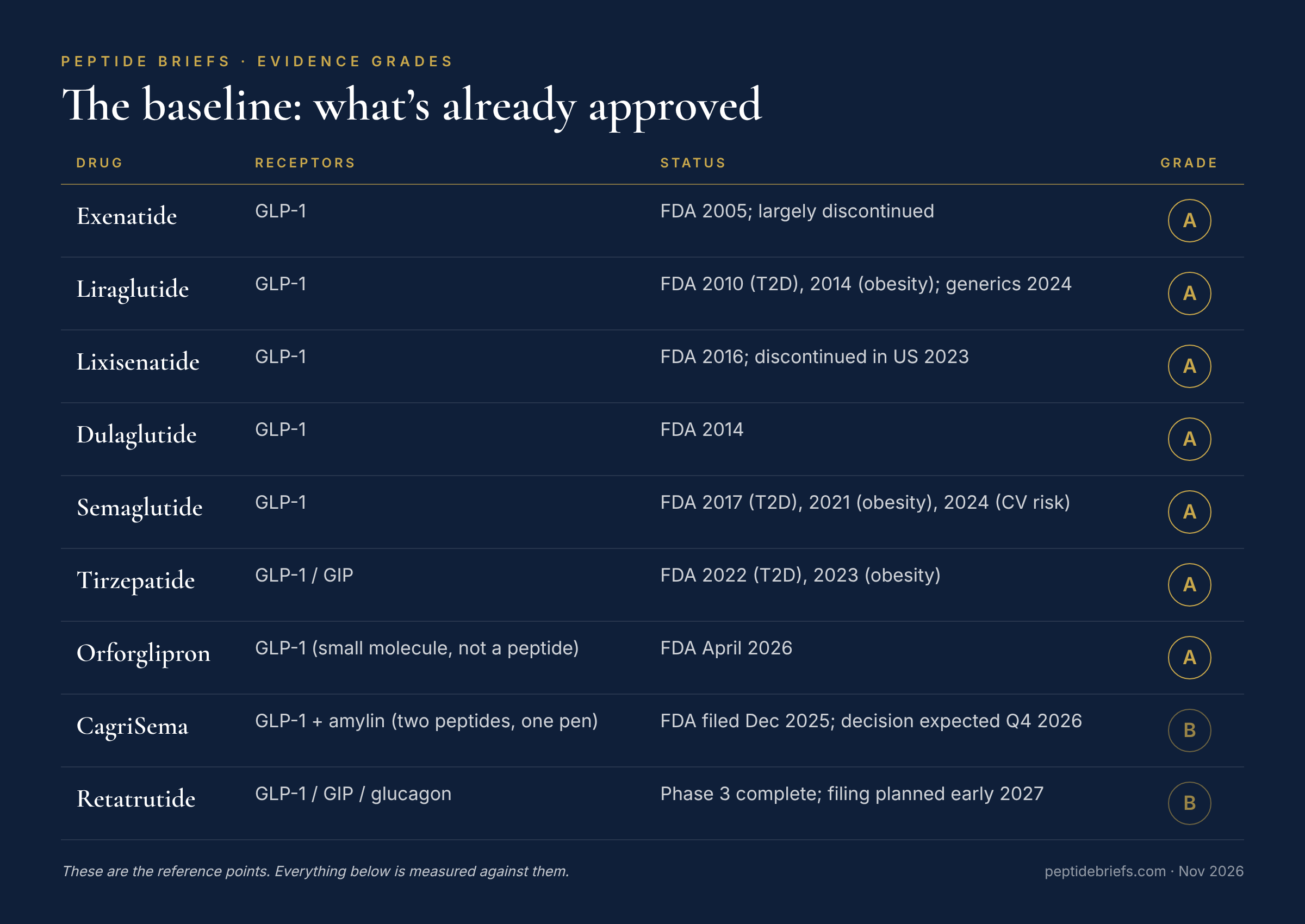
    The Baseline: What’s Already Approved

    DrugReceptorsStatusGrade
    ExenatideGLP-1FDA 2005; largely discontinuedA
    LiraglutideGLP-1FDA 2010 (T2D), 2014 (obesity); generics 2024A
    LixisenatideGLP-1FDA 2016; discontinued in US 2023A
    DulaglutideGLP-1FDA 2014A
    SemaglutideGLP-1FDA 2017 (T2D), 2021 (obesity), 2024 (CV risk)A
    TirzepatideGLP-1/GIPFDA 2022 (T2D), 2023 (obesity)A
    OrforglipronGLP-1 (small molecule, not a peptide)FDA April 2026A
    CagriSemaGLP-1 + amylin (two peptides, one pen)FDA filed Dec 2025, decision expected Q4 2026B
    RetatrutideGLP-1/GIP/glucagonPhase 3 complete, filing planned early 2027B

    The Chinese Pipeline

    China is now the second center of gravity for this drug class, and two of its molecules are approved there. If you have seen a “Chinese retatrutide” referenced online, it is almost certainly one of the first two below.

    UBT251 — the triple agonist Novo bought

    What it is: A once-weekly synthetic peptide that activates GLP-1, GIP and glucagon receptors, the same three targets as retatrutide. Developed by United Bio-Technology (Hengqin), a subsidiary of The United Laboratories (TUL), Zhuhai. In March 2025 Novo Nordisk licensed worldwide rights outside Greater China for $200 million upfront.

    Evidence: Two Chinese phase 2 trials, both reported by press release in 2026 and not yet peer-reviewed. In adults with overweight or obesity (baseline 92 kg, BMI 33), the 6 mg dose produced a mean weight loss of 19.7% at 24 weeks versus 2.0% on placebo. In type 2 diabetes (211 participants), HbA1c fell up to 2.16% versus 1.77% on semaglutide 1 mg, with weight loss up to 9.8% versus 4.8%. Novo is running a global phase 1b/2a in about 330 people, reading out in 2027, and TUL plans two Chinese phase 3s.

    Why people call it “the Chinese retatrutide”: Same mechanism, similar early numbers (retatrutide’s phase 2 showed 24% at 48 weeks; 19.7% at 24 weeks is on a comparable trajectory), and it is Novo’s answer to Lilly’s molecule. On half-life, I can find no published pharmacokinetic data for UBT251 that would support a claim that it lasts longer than retatrutide. Both are dosed weekly. If a vendor is telling you otherwise, ask them for the paper.

    Grade: C. Phase 2, press-release only, no peer review, no regulator.

    Mazdutide — approved in China, dual GLP-1/glucagon

    What it is: A once-weekly GLP-1 and glucagon receptor dual agonist, originally Lilly’s LY3305677, licensed to Innovent Biologics for China. Brand name Xinermei.

    Evidence: The GLORY-2 phase 3 in Chinese adults with obesity reported 16.7% mean weight loss at 9 mg over 60 weeks; the earlier GLORY-1 phase 3 was published in NEJM in 2024 and the program has since appeared in JAMA and Lancet Diabetes & Endocrinology. A US phase 2 reported up to 18.1% at 16 mg over 32 weeks.

    Regulatory: Approved by China’s NMPA for chronic weight management on June 27, 2025 and for type 2 diabetes on September 19, 2025. No FDA or EMA filing.

    Grade: B. Peer-reviewed phase 3 and a completed regulatory review, but not by the FDA or EMA. If you want to call this an A for China, I won’t argue hard. For a US reader it is a B.

    Ecnoglutide — the “biased” GLP-1

    What it is: A long-acting GLP-1 receptor agonist from Sciwind Biosciences (Hangzhou), engineered to preferentially signal through the cAMP pathway rather than β-arrestin, which in theory means less receptor desensitization. Brand names Xianyida (diabetes) and Xianweiying (weight). Pfizer holds China commercialization rights.

    Evidence: Phase 3 in China reported about 15.1% placebo-adjusted weight loss. The biased-agonism claim is mechanistically interesting and clinically unproven; nobody has shown in humans that it translates to better durability or tolerability than semaglutide.

    Regulatory: NMPA approved for type 2 diabetes (January 30, 2026) and for weight management (March 6, 2026). No US filing announced.

    Grade: B, same logic as mazdutide.

    Bofanglutide (GZR18) — the every-two-weeks GLP-1

    What it is: A long-acting GLP-1 receptor agonist from Gan & Lee Pharmaceuticals (Beijing), dosed once every two weeks. This is the one Chinese molecule where “longer half-life” is actually the selling point.

    Evidence: Phase 3 in China with an extension ongoing; Gan & Lee has signed licensing deals with JW Pharmaceutical (Korea, $81 million, April 2026) and Lupin (India). Published data are thinner than for mazdutide or ecnoglutide.

    Grade: C. It is a single GLP-1 agonist, not a triple, so anyone describing it as a longer-acting retatrutide is wrong on mechanism.

    HRS9531 — Hengrui’s dual agonist

    What it is: A GLP-1/GIP dual agonist (tirzepatide’s mechanism) from Jiangsu Hengrui, in phase 3 in China. Kailera Therapeutics licensed it for the rest of the world in 2024.

    Grade: C pending phase 3 publication.


    The Western pipeline you’ve probably skipped

    Survodutide — the one that read out and underwhelmed

    What it is: Boehringer Ingelheim and Zealand Pharma’s once-weekly GLP-1/glucagon dual agonist (BI 456906).

    Evidence: SYNCHRONIZE-1 (NEJM, June 2026; 76 weeks, 1,481 people without diabetes) reported 12.2% and 13.0% at 3.6 and 6.0 mg versus 5.4% placebo on the primary estimand, or up to 16.6% if everyone adhered. SYNCHRONIZE-2 (NEJM, October 2026, type 2 diabetes) reported 8.2% and 9.8% versus 3.9%. A pre-specified substudy showed 63% liver fat reduction and 34% visceral fat reduction, and the earlier phase 2b in MASH showed histological improvement in up to 83% of patients. The cardiovascular outcomes trial completed in June 2026 with results expected before year end.

    The honest read: This is semaglutide-range weight loss with a potentially better liver story. It is not a tirzepatide competitor on the scale.

    Grade: B. Peer-reviewed phase 3, no regulatory review yet.

    MariTide (maridebart cafraglutide) — the monthly one

    What it is: Amgen’s AMG 133, a GLP-1 receptor agonist peptide fused to an antibody that blocks the GIP receptor. Yes, blocks. Tirzepatide activates GIP; MariTide antagonizes it; both lose weight. Nobody has fully explained this. The antibody scaffold gives it a half-life around three weeks, so it is dosed monthly, and Amgen is testing every-eight-weeks maintenance.

    Evidence: Phase 2 (NEJM 2025) showed up to about 20% weight loss at 52 weeks in people without diabetes and about 17% with type 2 diabetes, with the striking feature that weight stayed off for months after the last dose. Phase 3 (MARITIME-1 and -2) is ongoing with an estimated primary completion in January 2027; as of October 2026 no phase 3 results have been reported. The phase 3 titration was slowed after high rates of nausea and vomiting in phase 2.

    Grade: C, and the most interesting C on this list. If anything here deserves the label “longer half-life than retatrutide,” it is this, and it is a peptide-antibody conjugate, not something a peptide synthesizer can make.

    Amycretin — GLP-1 and amylin in one molecule

    What it is: Novo’s single peptide that activates both the GLP-1 receptor and the amylin receptor, available as a weekly injection and a daily pill. Think CagriSema’s two mechanisms fused into one chain.

    Evidence: Phase 1b/2a injectable showed about 22% weight loss at 36 weeks; the oral form showed about 13% at 12 weeks. Phase 3 began in 2026.

    Grade: C. Early, but this is where Novo is putting its chips after the CagriSema head-to-head miss.

    Eloralintide — Lilly’s amylin-only answer

    What it is: A selective amylin receptor agonist (no calcitonin receptor activity, unlike cagrilintide), weekly injection.

    Evidence: Phase 2 showed up to 20% weight loss at 48 weeks as monotherapy, which is remarkable for an amylin drug on its own. The eloralintide-plus-tirzepatide combination (presented at EASD, September 30, 2026) showed up to 23.3% at 48 weeks in obesity with type 2 diabetes versus 14.8% for tirzepatide 15 mg alone. Phase 3 started late 2025.

    Grade: C, likely B within a year.

    Pemvidutide, VK2735, petrelintide, berobenatide

    Briefly: pemvidutide (Altimmune) is a GLP-1/glucagon dual in phase 2 with a MASH focus; VK2735 (Viking) is a GLP-1/GIP dual in phase 3 with both injectable and oral forms; petrelintide (Zealand, partnered with Roche) is another long-acting amylin analogue in phase 2; berobenatide (Pfizer, formerly Metsera’s MET-097i) is an ultra-long-acting GLP-1 dosed monthly, in phase 3, with 12.3% placebo-adjusted weight loss at 28 weeks in phase 2b. All C or D today.

    The Korea pipeline

    CT-G32 — Celltrion’s four-target candidate

    What it is: Celltrion’s injectable candidate that combines GLP-1, GIP, glucagon and amylin activity in one molecule. It’s the first announced design to add amylin to a retatrutide-style triple agonist.

    Evidence: Preclinical only. Celltrion reports that in obese animals at the same dose it produced greater weight loss than retatrutide, with proportionally less lean mass lost, and that primate data support once-weekly dosing. These are company-reported, non-peer-reviewed results, and no human data exist. An IND is expected in early 2027, per company statements.

    Grade: C. Preclinical and company-reported; too early to judge.

    What this means if you are reading vendor listings

    Three patterns to watch for.

    Names that aren’t names. “GLP-3,” “Triple G,” “Reta-L,” “long-acting GLP” are catalog labels, not molecules. Every compound on this page has a development code and, for most, an INN. A vendor who cannot tell you which one they are selling cannot have tested its identity.

    Half-life claims without pharmacokinetics. A peptide’s half-life comes from its lipid tail or antibody scaffold and is measured in a phase 1 trial. Retatrutide’s is about six days; semaglutide’s about seven; cagrilintide’s about seven to eight; MariTide’s about three weeks. Any claim of a “longer half-life” version of a weekly peptide should come with a published number. If the vendor’s answer is a different fatty acid chain, that is a different molecule with no human data at all.

    Approval that isn’t your approval. Mazdutide and ecnoglutide are approved drugs in China. That is a meaningful review. It is not an FDA review, and it does not change the legal status of research-grade material in the US, where the FDA stated in June 2026 that sales of unapproved GLP-class products to consumers are illegal and Lilly filed six lawsuits in August 2026 against sellers of retatrutide, including research-use-only vendors.

    The field is moving fast enough that half of this page will need updating within six months: CagriSema’s FDA decision is due this quarter, retatrutide’s filing is planned for early 2027, MariTide phase 3 reads out around the same time, and SYNCHRONIZE-CVOT is due before year end. I’ll post grade changes as they land.


    Sources

    • United Laboratories / Novo Nordisk, UBT251 phase 2 topline releases, February 24 and March 25, 2026
    • Innovent Biologics, mazdutide NMPA approvals (June 27 and September 19, 2025); Ji L et al., Once-weekly mazdutide in Chinese adults with obesity or overweight, NEJM 2024, doi:10.1056/NEJMoa2411528
    • Sciwind Biosciences, ecnoglutide NMPA approval announcements, January 30 and March 6, 2026
    • Boehringer Ingelheim, SYNCHRONIZE-1 topline (April 28, 2026) and ADA 2026 presentation; SYNCHRONIZE-1 and SYNCHRONIZE-2 in NEJM, June and October 2026
    • Amgen, MariTide phase 2 (NEJM 2025); ClinicalTrials.gov MARITIME-1 and MARITIME-2 records
    • Eli Lilly, eloralintide phase 2 and EASD 2026 presentation (September 30, 2026)
    • Novo Nordisk, REDEFINE 4 company announcement, February 23, 2026
    • FDA statement on unapproved incretin products, June 2026; Eli Lilly press release on retatrutide lawsuits, August 12, 2026
    • Celltrion. Press release on CT-G32 preclinical development, May 29, 2026 (company-authored). celltrion.com
    • Seoul Economic Daily. “Celltrion to Begin Trials of World’s First Quadruple-Acting Obesity Drug,” Nov 4, 2026. en.sedaily.comLeave a comment

    Peptide Briefs is an independent reference and does not sell anything. Its owners co-own a research-peptide vendor; that is disclosed on every page. Nothing here is medical advice.

  • Three of five: what the retatrutide papers say that the press releases didn’t

    TRIUMPH-1 in NEJM, TRIUMPH-2 in The Lancet, same day. The grade stays B. Here’s what moved.

    On September 29, Lilly published two of its retatrutide Phase 3 trials in full on the same day: TRIUMPH-1 in the New England Journal of Medicine and TRIUMPH-2 in The Lancet. With TRANSCEND-T2D-1, published in The Lancet in June, that makes three of the five reported Phase 3 results peer-reviewed. Two remain company topline releases.

    The grade on Peptide Briefs stays B. This post is about why, and about what the papers say that the May and July press releases didn’t.

    Two numbers, both correct

    Lilly’s May headline for TRIUMPH-1 was 28.3% weight loss at 12 mg. The NEJM paper’s primary result is 25.0%. Both appear in Figure 1 of the paper, and the difference is not a correction; it’s two questions. The efficacy estimand asks what happens if every participant stays on drug for 80 weeks. The treatment-regimen estimand, which NEJM reports as primary, counts the people who stopped. Across all three doses the peer-reviewed numbers are 17.6%, 23.7% and 25.0% vs 3.9% on placebo, against topline figures of 19.0%, 25.9% and 28.3%.

    When a vendor or a headline quotes the higher figure, it isn’t wrong. It’s the optimistic one. The same applies to TRIUMPH-2’s 20.8%; the Lancet intention-to-treat number is [insert from paper].

    What TRIUMPH-2 adds

    TRIUMPH-2 is the type 2 diabetes cohort: 1,152 adults, 80 weeks, 4, 9 or 12 mg vs placebo. People with type 2 diabetes reliably lose less on incretin drugs than people without it, and 20.8% at 12 mg is the largest weight loss reported in that population. A1C fell 1.4 to 1.6 points from a 7.7% baseline vs 0.2 on placebo, and up to 40% of participants reached an A1C below 5.7%, the non-diabetic range. Triglycerides fell 39.5%, systolic blood pressure 10.8 mmHg, and hsCRP 58.3% at the top dose.

    What the safety tables add

    Three things the press releases didn’t lead with.

    Dysesthesia. A skin burning or tingling sensation occurred in 12.3% of participants on 9 mg and 12.5% on 12 mg in TRIUMPH-1, against 0.9% on placebo. It isn’t a known GLP-1 or GIP effect; the working assumption is the glucagon component. Lilly reports most cases were mild and resolved on treatment.

    Dropouts by dose don’t line up across trials. In TRIUMPH-1, discontinuation for adverse events rose with dose: 4.1%, 6.5%, 11.2% vs 4.6% placebo. In TRIUMPH-2 the middle dose had the most: 3.8%, 11.6%, 7.7% vs 4.9%. Two trials, two patterns; the honest reading is that we don’t yet know the dose-tolerability curve.

    Orthostatic hypotension. 8.8% at 12 mg vs 0.9% placebo in TRIUMPH-1. Small in absolute terms, ten-fold relative.

    Heart rate, the question most readers have asked, isn’t in the main NEJM tables. It’s in the supplementary appendix, and the page will be updated when we’ve read it rather than summarized from a summary.

    Why B, not A

    A on our scale means the full Phase 3 program is peer-reviewed and a regulator has reviewed the safety file. Three of five is not the program. Lilly says the BLA goes to FDA in Q1 2027; nothing has been reviewed yet. TRIUMPH-5, the head-to-head against tirzepatide, and the 10,000-participant outcomes trial are still running.

    B is not a hedge. It’s the largest weight-loss effect ever recorded in a drug trial, replicated three times in peer-reviewed form, with a safety profile that’s heavier than tirzepatide’s at the top doses and one new adverse event that needs explaining. That’s what B means.