What I could confirm this week in peptide news, and what I couldn’t.
There was a lot of noise in the peptide feed this week. Here is the short version: what I could confirm from a source, what I couldn’t, and what to watch.
- Two compounded GLP-1 recalls over sterility
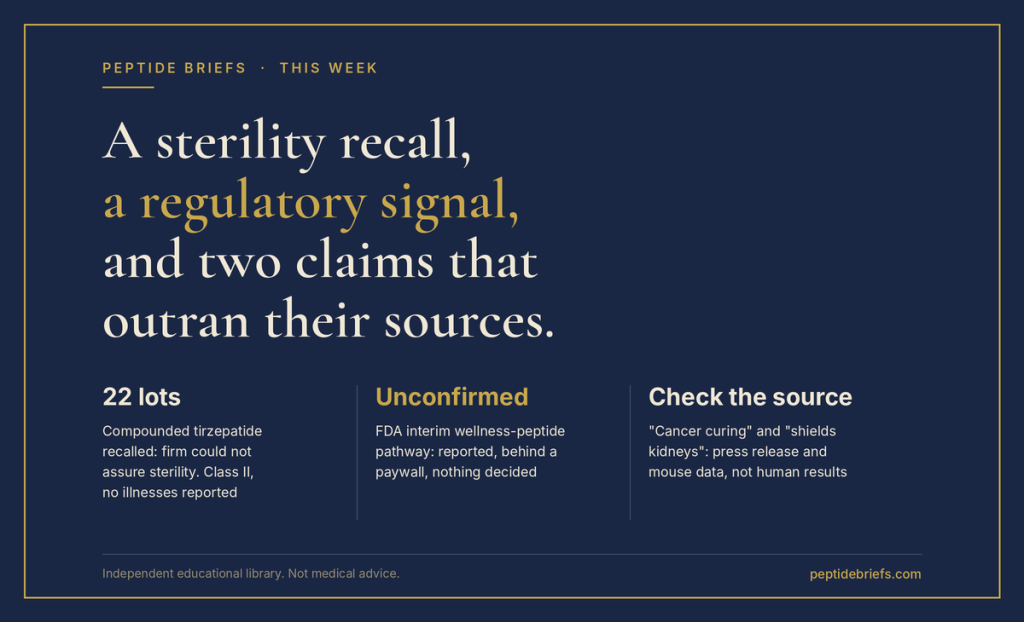
Apothecary Pharma. Apothecary Pharma LLC, a 503B outsourcing facility in Cary, North Carolina, recalled 22 lots of compounded tirzepatide (18 mg/mL, 4 mL multi-dose vials) and one lot of an NAD+ injection. The reason given: the firm “cannot assure the product is sterile.”
What that does and doesn’t mean:
- It is voluntary and firm-initiated, and FDA classified it Class II.
- No illnesses are reported in the coverage I read.
- “Can’t assure sterility” is a documentation finding. It is not a finding that contamination was detected.
- FDA issued a warning letter to the firm after a May 2025 inspection that cited insanitary conditions in sterile drug production. The coverage does not say whether the recall is connected to those findings, so I won’t connect them either.
Carolina Infusion. A widely shared post also described a second recall, by Carolina Infusion, LLC of Ridgeland, South Carolina. FDA’s Enforcement Report lists it. One record I reviewed covers compounded semaglutide 3 mg/mL syringes, Class II, with the reason given as lack of assurance of sterility “related to formulation using bacteriostatic water” and “related to processing equipment used in compounded product.” That wording points at the manufacturing process, not at a contamination finding. The beyond-use dates on the lots in that record have all passed. I only reviewed one record, so I’m not stating how many products or lots the recall covers.
Takeaway: for any injectable, the paperwork is part of the product. If a manufacturer can’t document the process, that is the story, whether or not anyone got sick.
- FDA may be weighing an interim path for “wellness” peptide compounding
The Capitol Forum reported on October 21 that FDA is seeking an interim pathway that would allow compounding of certain unapproved wellness peptides before final rulemaking. The article is paywalled, so I only have the headline and a short summary. I don’t know the scope, which peptides, or any dates.
So: a signal, not a decision. Nothing has changed in what is allowed today. If details become public, I’ll cover them properly.
- Enforcement is moving past the “research use only” label
Eli Lilly filed suit in August against six U.S. companies over unauthorized retatrutide, and says it referred information on more than 200 individuals and entities to authorities. It is also asking payment processors, platforms and shippers to stop unauthorized sales. A law-firm summary of the cases notes that FDA treated one seller’s retatrutide as an unapproved new drug in March, despite research-use-only wording, relying on the company’s website and the claims it made.
The pattern worth noticing is that intended use is judged from conduct, not from the label. Marketing, social posts, and how a seller talks to customers all count. That applies to every seller and every influencer in this space, and it is a good reason to be skeptical of anyone who says “it’s labeled RUO, so anything goes.”
Retatrutide itself is still investigational. Per the same summary, FDA says it cannot be compounded.
- Two claims that outran their sources
SenoMune-0257. A viral post called it a “cancer curing peptide” that “completed pre-clinical studies successfully.” The only coverage I found is a trade-press article built on a company press release from Immorta Bio. It describes a nine-amino-acid, AI-designed peptide intended to train immune cells to remove senescent cells, framed around diseases of aging. It does not call it a cancer treatment, it gives no data on models or results, and human evaluation is described as anticipated before year-end, not started.
A MOTS-c kidney study. Another post said MOTS-c “could be the peptide that shields kidneys from diabetes,” citing a mouse and cell-culture paper. I could not find that paper, so I can’t confirm the details. Even if it holds up exactly as described, mice and lab cells point to where to look. They don’t show what happens in people.
A quick filter for any viral peptide post:
- Mice, cells, or humans?
- Correlation or intervention?
- Is there a DOI? If the poster can’t link it, treat it as a rumor.
What I’m watching
- Any FDA detail on an interim wellness-peptide pathway.
- The retatrutide court case over classification and jurisdiction.
- A DOI for the MOTS-c kidney paper.
This is a news summary and not medical, legal or purchasing advice.
Sources
- Managed Healthcare Executive, October 21, 2026: Apothecary Pharma recall of compounded tirzepatide and NAD+ vials over sterility concerns (managedhealthcareexecutive.com)
- FDA Enforcement Report, Carolina Infusion, LLC (accessdata.fda.gov)
- The Capitol Forum, Health Care Weekly, October 21, 2026 (thecapitolforum.com), paywalled
- Vedder Price, “Lilly’s Retatrutide Lawsuits Spotlight Expanding Enforcement Risk for the Peptide and GLP-1 Industry” (vedder.com)
- RuntimeWire, “Immorta Bio completes preclinical studies for AI-designed senolytic peptide” (runtimewire.com)
Disclosure: I co-own Agape Compounds, a research-use-only peptide company. Peptide Briefs is written independently of it.


Leave a Reply