The week FDA looked the other way, and nine other things that mattered
Originally published on Substack
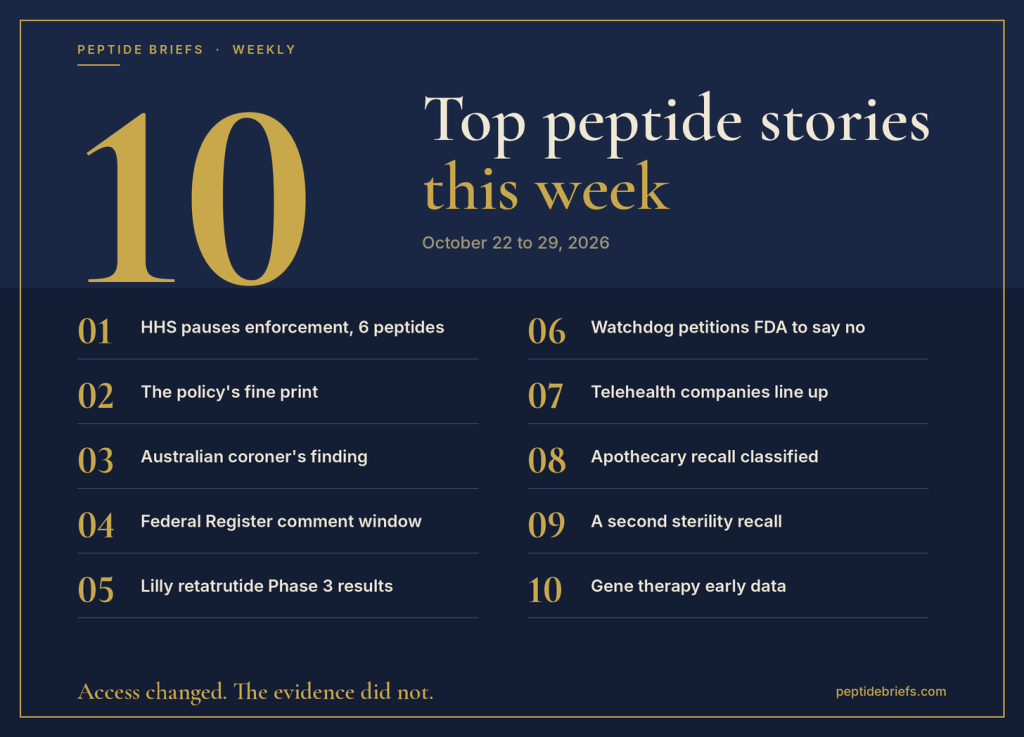
1. HHS issues an enforcement discretion policy for six peptides (Oct 28)
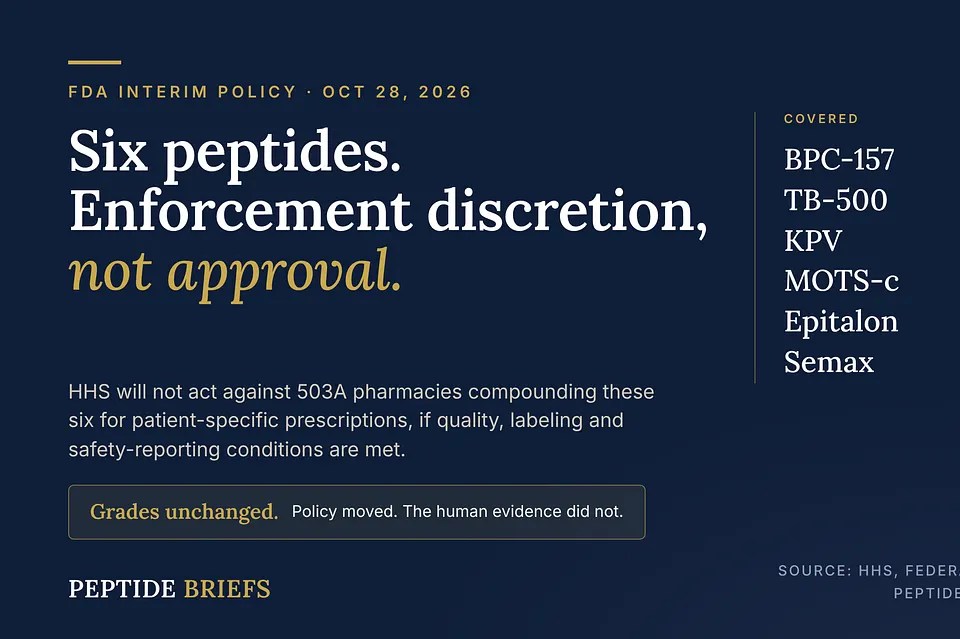
HHS announced it will not pursue enforcement against state licensed pharmacies that compound six peptides: BPC 157, TB 500, KPV, MOTS c, Epitalon and Semax. FDA still has to decide formally whether they belong on the 503A bulks list. This is not an approval. Government scientists reportedly warned the evidence is limited. Our grades do not change: BPC 157 stays at C.
Sources: NCPA (ncpa.org/newsroom/qam/2026/10/29/fda-grants-enforcement-discretion-compounding-six-peptides); Ermer and Suter (ermersuter.com/2026/10/28/midweek-update-346/)
2. The fine print, according to one law firm’s summary
A law firm’s analysis of the policy reports these conditions: it covers 503A pharmacies, not 503B outsourcing facilities; compounding must be patient specific, with no office stock or wholesale; each product may contain only one listed peptide, so blends fall outside it; the ingredient must come from an FDA registered manufacturer that follows current good manufacturing practice and appears on the certificate of analysis; testing must cover identity, purity, potency and impurities; and state pharmacy law must allow it. The same summary says it creates no legal rights, can be revisited, and does not bind states. This is a secondary source. Check the Federal Register notice before relying on any detail.
Source: Lumalex (lumalexlaw.com/2026/10/29/hhs-opens-a-temporary-door-for-peptides/)
3. What happens next: a notice and a comment window
The law firm summary says the notice is scheduled for Federal Register publication on October 30, followed by a two week comment period. It estimates that formal addition to the bulks list could take 12 to 24 months and says FDA’s advisory committee plans to review five more peptides in February 2027. Those are one source’s reading, so confirm the dates when the notice posts.
Source: Lumalex (link above)
4. An Australian coroner links an actor’s death to injected peptides
On October 28, Victorian coroner David Ryan delivered findings on the death of Richard Norton, a 75 year old Australian actor, stuntman and martial arts instructor who died at Melbourne’s Alfred Hospital on March 30, 2025. The coroner found he went into cardiac arrest after injecting two unapproved peptides, CJC 1295 and ipamorelin, and that his death resulted from complications of their use. The coroner also found he had taken more than he was prescribed.
Two details matter here. First, this was not a gray market purchase. A doctor prescribed the peptides, and a licensed compounding pharmacy in Queensland made them. Second, the case is described as believed to be the first confirmed Australian death linked to unapproved peptide use. The coroner recommended that Australia’s Therapeutic Goods Administration review the benefits and safety risks of these peptides and consider further restrictions. The TGA says it is assessing the risks. The Medical Board of Australia earlier found the prescribing doctor’s practice “is or may be unsatisfactory” and imposed a caution and conditions.
What we do not know: what the TGA will do, the exact amounts involved, and whether other deaths exist. The coroner’s wording is that the death was triggered by the injections. News reports also mention other health history, and we are not drawing conclusions beyond the findings.
Why it belongs in this week’s list: it arrived the same day the United States moved the opposite direction on compounding. A prescription and a licensed pharmacy are safeguards, not guarantees. The evidence for these peptides in humans remains limited, and a clinical expert in the Australian case reportedly found insufficient evidence that they are safe, effective or beneficial for human use.
Sources: ABC News Australia (abc.net.au/news/2026-10-29/victoria-peptide-death-coroners-report-richard-norton/107320590); OzArab Media summary (ozarab.media/coroner-urges-review-of-peptide-restrictions-after-richard-nortons-death/)
5. Lilly reports retatrutide topline results against Ozempic (Oct 28)
In the Phase 3 TRANSCEND T2D 2 trial, 1,298 adults with type 2 diabetes were randomized to retatrutide 9 mg, retatrutide 12 mg or Ozempic 2 mg. Lilly reports weight loss of 19.5 percent and 20.9 percent for the two retatrutide doses versus 9.4 percent for Ozempic, and A1C reductions of 2.2 percent versus 1.8 percent. Discontinuation because of side effects was 4.8 percent and 7.9 percent versus 2.7 percent. Caveats: topline data from the sponsor, open label design, and retatrutide is not approved by any regulator. This is a trial of a drug under study, not a reason to trust anything sold online under the same name.
Source: BioPharm International (biopharminternational.com/view/lilly-s-retatrutide-doubles-ozempic-s-weight-loss-in-first-phase-3-head-to-head-trial)
6. A watchdog petitions FDA to say no
The Partnership for Safe Medicines filed a citizen petition asking FDA not to allow compounding of the peptides the advisory committee recommended. It calls them untested and poorly defined, and says it bought five vials from telehealth services as part of its argument. The organization’s page is dated October 26, but the text says the petition was filed October 16. We list both dates because the sources differ.
Source: Partnership for Safe Medicines (safemedicines.org/2026/10/october-26-2026-psm-cp.html)
7. Telehealth companies line up
Time ran a piece titled “The Peptide Rush Has Begun,” and a law firm summary of news coverage says Hims and Hers and Noom are reportedly considering or planning peptide offerings. We could not open the Time article, so treat this as reported, not confirmed. What to watch: what these companies actually launch once the notice is published.
Sources: Time (time.com/article/2026/10/28/peptide-rush-has-begun/); Ermer and Suter (link above)
8. A sterility recall gets its FDA classification
Apothecary Pharma LLC recalled 22 lots of compounded tirzepatide vials on September 24, and FDA classified the recall on October 8. Coverage says no illnesses are tied to this recall and that FDA rated the chance of serious harm as remote. FDA’s March warning letter cited serious deficiencies in sterility protocols. The recall is a reminder that compounded does not mean tested for sterility by default.
Source: Boston Globe (bostonglobe.com/2026/10/21/business/glp-1-alternative-drugs-face-nationwide-recall/)
9. A second sterility recall in the FDA Enforcement Report
Carolina Infusion LLC of Ridgeland, South Carolina appears in the FDA Enforcement Report for compounded semaglutide syringes, with the reason given as a lack of sterility assurance. We have not verified the event number or dates, so we are not repeating them.
Source: FDA Enforcement Report record
10. Adjacent: early human data for a partial reprogramming therapy
A newsletter summary reports early Phase 1 data for Life Biosciences’ ER-100, an experimental gene therapy for optic neuropathies, with no serious safety signals and visual field improvement in 2 of 3 glaucoma participants. Three people is a safety signal, not an efficacy result. We have not read the primary release.
Source: Fight Aging newsletter, October 26 (fightaging.org/archives/2026/10/fight-aging-newsletter-october-26th-2026)
WHAT WE’RE WATCHING NEXT WEEK
The Federal Register notice and comment window; whether the final policy text matches the summaries; any state pharmacy board response; and the full retatrutide data when it is presented at a medical meeting.
ONE THING TO REMEMBER
Access changed this week. The evidence did not. A policy can open a door. Only trials show what is behind it.
Disclosure: I co-own Agape Compounds, a research use only peptide company. Peptide Briefs is written independently of it.