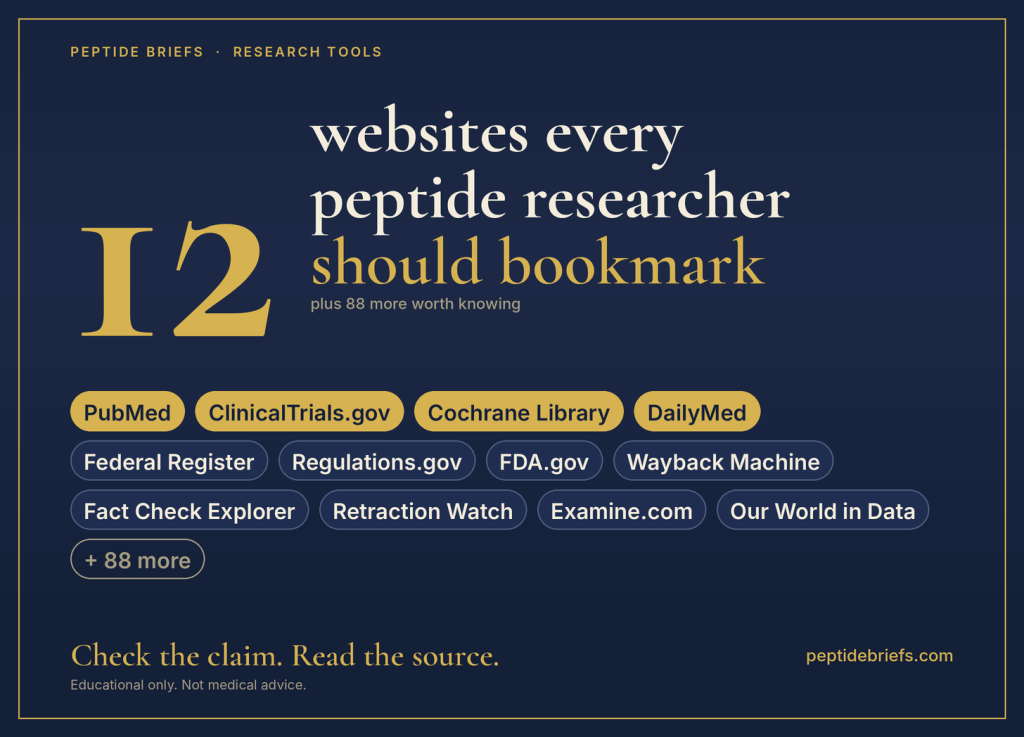
The tools I actually use to check claims, read the evidence and keep up with the rules.
Originally Shared on Substack
Most of us visit the same few websites every day. Meanwhile, some of the most useful tools on the internet sit unused. When I started reading about peptides, I learned fast that the quality of what you find depends on where you look. A good source takes a claim apart. A bad one just repeats it.
Subscribe for free to receive new posts and support my work.
Here are the 12 I would bookmark first, and why. The full list of 100 is below.
The evidence
1. PubMed. The main search engine for biomedical research. Search a compound name and look at what is actually published, then notice how much is animal or cell work.
2. ClinicalTrials.gov. Shows which human trials are registered, running or finished. If a compound has no trials here, that tells you something.
3. Cochrane Library. Systematic reviews that pool many studies. Slow and careful, which is the point.
4. DailyMed. Official labels for approved drugs. Useful for seeing what regulators allow a drug to claim.
The rules
5. Federal Register. Where proposed and final policy appears. Good for reading the notice itself instead of a headline about it.
6. Regulations.gov. Where public comments are filed. You can read what others have said and submit your own.
7. FDA.gov and Drugs@FDA. What is approved, for what, and what has received warnings.
The truth check
8. Wayback Machine. See what a company claimed last month, or last year.
9. Google Fact Check Explorer. Search a claim and see who has already examined it.
10. Retraction Watch. Tracks retracted papers. A study can look strong right up until it is withdrawn.
The quick references
11. Examine.com. Plain language summaries of supplement and nutrition research.
12. Our World in Data. Clear charts built from real datasets, handy when a post throws out a statistic.
A note on what none of these do. Reading a paper is not a prescription, and finding a study is not proof something works for you. Several of these sites exist to help you see how thin the evidence can be. That is a feature.
The full list of 100
Research and evidence: PubMed, ClinicalTrials.gov, Cochrane Library, Google Scholar, Semantic Scholar, Europe PMC, DailyMed, Drugs@FDA, DrugBank, Retraction Watch
Policy and regulation: Federal Register, Regulations.gov, FDA.gov, HHS.gov, Congress.gov, SEC EDGAR, USPTO, FTC.gov, Your State’s Secretary of State Page (Colorado for me), CBP.gov
Verifying things: Wayback Machine, ICANN Lookup, VirusTotal, urlscan.io, Have I Been Pwned, Snopes, Google Fact Check Explorer, TinEye, Archive.today, OpenCorporates
Web and SEO: Google Search Console, Google Analytics, Google Trends, Bing Webmaster Tools, PageSpeed Insights, Ahrefs Webmaster Tools, AnswerThePublic, SimilarWeb, Schema.org, W3C Validator
Store and operations: WooCommerce docs, WordPress.org, Stripe, Klaviyo, Zapier, Cloudflare, Canva, QuickBooks, Shippo, Wise, Omnisend
Writing and publishing: Substack, Hemingway Editor, Grammarly, Notion, Linktree, Beehiiv, Ghost, Typeform, Calendly, Loom
Learning: Khan Academy, Coursera, edX, MIT OpenCourseWare, Wikipedia, Project Gutenberg, Library of Congress, Our World in Data, TED, Wolfram Alpha
Health references: MedlinePlus, Mayo Clinic, CDC, NIH, WHO, Examine.com, Cleveland Clinic, USDA FoodData Central, Cronometer, NHS
News and analysis: Reuters, AP News, Axios, STAT News, Endpoints News, Fierce Biotech, Time, Financial Times, ProPublica, BBC News
My Other Everyday Sites: Weather.gov, Google Flights, Recreation.gov, Colorado Parks and Wildlife, onX Hunt, Rome2Rio, iNaturalist, Kelley Blue Book, CarGurus, Google Maps
Pick five that solve a real problem for you and ignore the rest. You will remember those.
Peptide Briefs is an independent educational library. Nothing here is medical advice.
Disclosure: we co-own a research-peptide vendor. Peptide Briefs is written independently of it and does not link to it.

