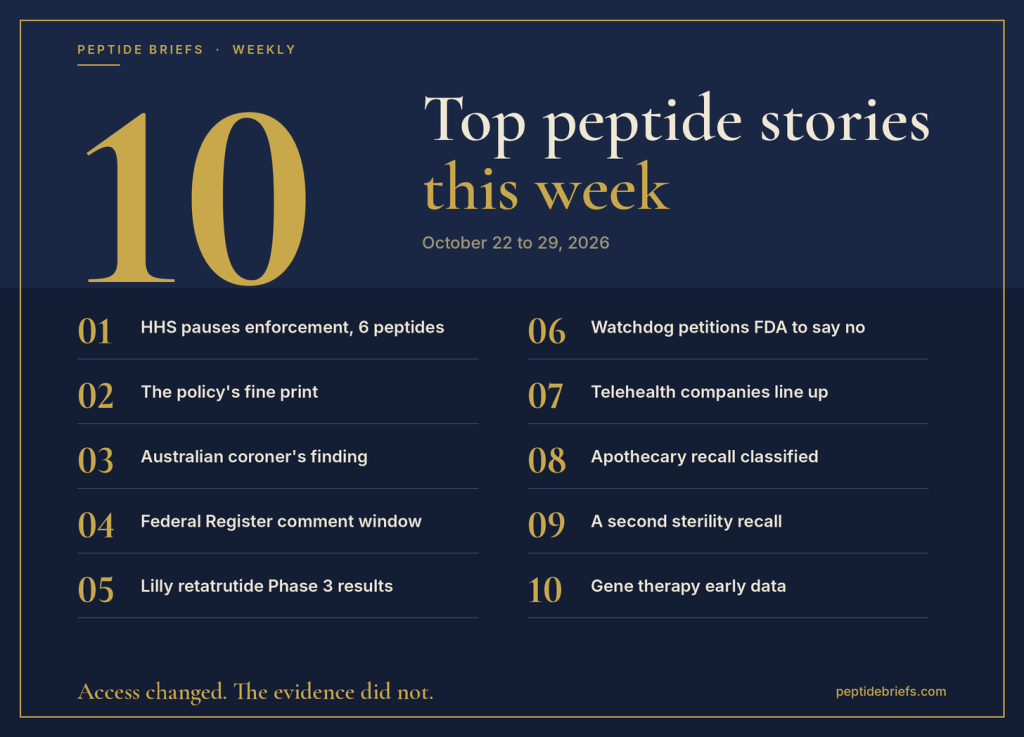
• The Peptide Briefs Top Ten for Oct 22 to Oct 29, 2026

    The Peptide Briefs Top Ten for Oct 22 to Oct 29, 2026

    The week FDA looked the other way, and nine other things that mattered

    Originally published on Substack

    Subscribe

    1. HHS issues an enforcement discretion policy for six peptides (Oct 28)

    HHS announced it will not pursue enforcement against state licensed pharmacies that compound six peptides: BPC 157, TB 500, KPV, MOTS c, Epitalon and Semax. FDA still has to decide formally whether they belong on the 503A bulks list. This is not an approval. Government scientists reportedly warned the evidence is limited. Our grades do not change: BPC 157 stays at C.

    Sources: NCPA (ncpa.org/newsroom/qam/2026/10/29/fda-grants-enforcement-discretion-compounding-six-peptides); Ermer and Suter (ermersuter.com/2026/10/28/midweek-update-346/)

    2. The fine print, according to one law firm’s summary

    A law firm’s analysis of the policy reports these conditions: it covers 503A pharmacies, not 503B outsourcing facilities; compounding must be patient specific, with no office stock or wholesale; each product may contain only one listed peptide, so blends fall outside it; the ingredient must come from an FDA registered manufacturer that follows current good manufacturing practice and appears on the certificate of analysis; testing must cover identity, purity, potency and impurities; and state pharmacy law must allow it. The same summary says it creates no legal rights, can be revisited, and does not bind states. This is a secondary source. Check the Federal Register notice before relying on any detail.

    Source: Lumalex (lumalexlaw.com/2026/10/29/hhs-opens-a-temporary-door-for-peptides/)

    3. What happens next: a notice and a comment window

    The law firm summary says the notice is scheduled for Federal Register publication on October 30, followed by a two week comment period. It estimates that formal addition to the bulks list could take 12 to 24 months and says FDA’s advisory committee plans to review five more peptides in February 2027. Those are one source’s reading, so confirm the dates when the notice posts.

    Source: Lumalex (link above)

    4. An Australian coroner links an actor’s death to injected peptides

    On October 28, Victorian coroner David Ryan delivered findings on the death of Richard Norton, a 75 year old Australian actor, stuntman and martial arts instructor who died at Melbourne’s Alfred Hospital on March 30, 2025. The coroner found he went into cardiac arrest after injecting two unapproved peptides, CJC 1295 and ipamorelin, and that his death resulted from complications of their use. The coroner also found he had taken more than he was prescribed.

    Two details matter here. First, this was not a gray market purchase. A doctor prescribed the peptides, and a licensed compounding pharmacy in Queensland made them. Second, the case is described as believed to be the first confirmed Australian death linked to unapproved peptide use. The coroner recommended that Australia’s Therapeutic Goods Administration review the benefits and safety risks of these peptides and consider further restrictions. The TGA says it is assessing the risks. The Medical Board of Australia earlier found the prescribing doctor’s practice “is or may be unsatisfactory” and imposed a caution and conditions.

    What we do not know: what the TGA will do, the exact amounts involved, and whether other deaths exist. The coroner’s wording is that the death was triggered by the injections. News reports also mention other health history, and we are not drawing conclusions beyond the findings.

    Why it belongs in this week’s list: it arrived the same day the United States moved the opposite direction on compounding. A prescription and a licensed pharmacy are safeguards, not guarantees. The evidence for these peptides in humans remains limited, and a clinical expert in the Australian case reportedly found insufficient evidence that they are safe, effective or beneficial for human use.

    Sources: ABC News Australia (abc.net.au/news/2026-10-29/victoria-peptide-death-coroners-report-richard-norton/107320590); OzArab Media summary (ozarab.media/coroner-urges-review-of-peptide-restrictions-after-richard-nortons-death/)

    5. Lilly reports retatrutide topline results against Ozempic (Oct 28)

    In the Phase 3 TRANSCEND T2D 2 trial, 1,298 adults with type 2 diabetes were randomized to retatrutide 9 mg, retatrutide 12 mg or Ozempic 2 mg. Lilly reports weight loss of 19.5 percent and 20.9 percent for the two retatrutide doses versus 9.4 percent for Ozempic, and A1C reductions of 2.2 percent versus 1.8 percent. Discontinuation because of side effects was 4.8 percent and 7.9 percent versus 2.7 percent. Caveats: topline data from the sponsor, open label design, and retatrutide is not approved by any regulator. This is a trial of a drug under study, not a reason to trust anything sold online under the same name.

    Source: BioPharm International (biopharminternational.com/view/lilly-s-retatrutide-doubles-ozempic-s-weight-loss-in-first-phase-3-head-to-head-trial)

    6. A watchdog petitions FDA to say no

    The Partnership for Safe Medicines filed a citizen petition asking FDA not to allow compounding of the peptides the advisory committee recommended. It calls them untested and poorly defined, and says it bought five vials from telehealth services as part of its argument. The organization’s page is dated October 26, but the text says the petition was filed October 16. We list both dates because the sources differ.

    Source: Partnership for Safe Medicines (safemedicines.org/2026/10/october-26-2026-psm-cp.html)

    7. Telehealth companies line up

    Time ran a piece titled “The Peptide Rush Has Begun,” and a law firm summary of news coverage says Hims and Hers and Noom are reportedly considering or planning peptide offerings. We could not open the Time article, so treat this as reported, not confirmed. What to watch: what these companies actually launch once the notice is published.

    Sources: Time (time.com/article/2026/10/28/peptide-rush-has-begun/); Ermer and Suter (link above)

    8. A sterility recall gets its FDA classification

    Apothecary Pharma LLC recalled 22 lots of compounded tirzepatide vials on September 24, and FDA classified the recall on October 8. Coverage says no illnesses are tied to this recall and that FDA rated the chance of serious harm as remote. FDA’s March warning letter cited serious deficiencies in sterility protocols. The recall is a reminder that compounded does not mean tested for sterility by default.

    Source: Boston Globe (bostonglobe.com/2026/10/21/business/glp-1-alternative-drugs-face-nationwide-recall/)

    9. A second sterility recall in the FDA Enforcement Report

    Carolina Infusion LLC of Ridgeland, South Carolina appears in the FDA Enforcement Report for compounded semaglutide syringes, with the reason given as a lack of sterility assurance. We have not verified the event number or dates, so we are not repeating them.

    Source: FDA Enforcement Report record

    10. Adjacent: early human data for a partial reprogramming therapy

    A newsletter summary reports early Phase 1 data for Life Biosciences’ ER-100, an experimental gene therapy for optic neuropathies, with no serious safety signals and visual field improvement in 2 of 3 glaucoma participants. Three people is a safety signal, not an efficacy result. We have not read the primary release.

    Source: Fight Aging newsletter, October 26 (fightaging.org/archives/2026/10/fight-aging-newsletter-october-26th-2026)

    WHAT WE’RE WATCHING NEXT WEEK

    The Federal Register notice and comment window; whether the final policy text matches the summaries; any state pharmacy board response; and the full retatrutide data when it is presented at a medical meeting.

    ONE THING TO REMEMBER

    Access changed this week. The evidence did not. A policy can open a door. Only trials show what is behind it.

    Disclosure: I co-own Agape Compounds, a research use only peptide company. Peptide Briefs is written independently of it.
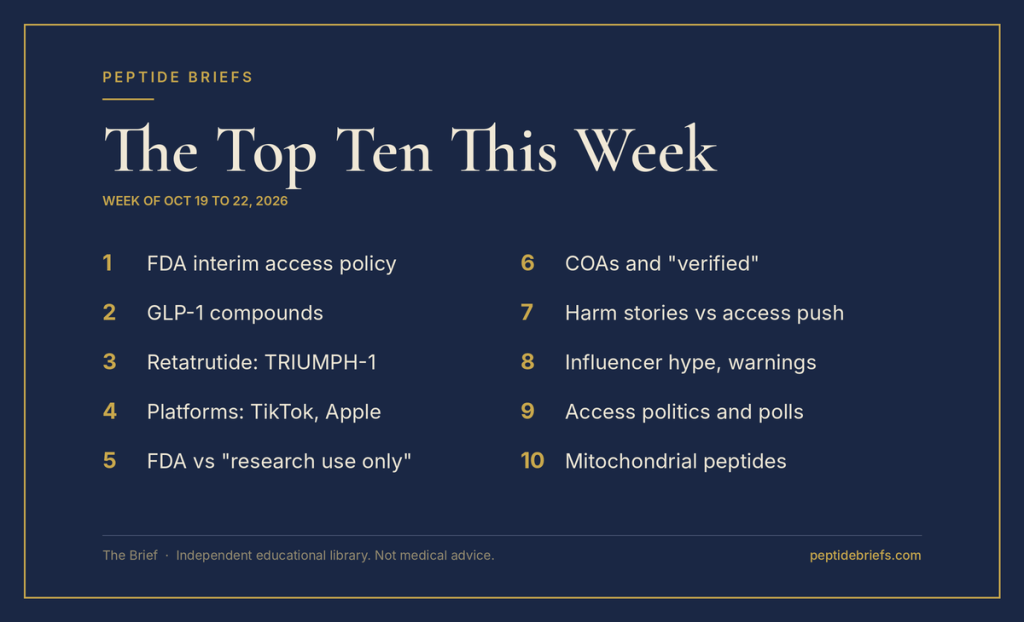

  • The Peptide Briefs Top Ten: Week of Oct 19, 2026

    The Peptide Briefs Top Ten: Week of Oct 19, 2026

    What the internet argued about this week, and what each topic really means.

    Every week, ten peptide topics take over the feeds, the news and the comment sections. This is the list, in order, with one line on why each matters.

    How it’s built: news coverage, Reddit and Substack discussion, and public posts on X, ordered by editorial judgment. It is not a measured ranking. I can’t measure X directly, and every claim below is attributed to its source.

    1. FDA’s interim access policy. Sent to the White House on Oct 14. The text isn’t public. Enforcement discretion is not approval, and the evidence grades haven’t moved.
    2. GLP-1 compounds. They account for most online peptide conversation, by a wide margin.
    3. Retatrutide. Lilly’s TRIUMPH-1 topline results are driving interest. The data aren’t yet peer-reviewed, and the drug isn’t approved.
    4. Platforms writing the rules. TikTok is reported to block searches for some peptide names. A screenshot of an Apple letter shows it objecting to reconstitution calculators. Neither is confirmed by the company.
    5. FDA versus “research use only.” August warning letters made the point that a disclaimer doesn’t outweigh the rest of a site’s marketing.
    6. COAs and “verified.” Everyone says the word. Few define it. Does it mean the lab confirmed the report, or the seller uploaded a PDF?
    7. Harm stories versus the access push. Media reports of people hurt by peptides are running alongside the political push for wider access.
    8. Influencer hype and expert warnings. Doctors in several countries are pushing back on social-media promotion.
    9. Access politics and polls. Sponsor-funded polling shows support for pharmacy access. Read it with the sponsor in mind.
    10. Mitochondrial peptides. MOTS-c, SS-31 and Humanin keep coming up, often with a level in the body mistaken for an outcome.

    WHAT MOVED THIS WEEK
    This is the first edition, so there is nothing to compare yet. Next week this section will show what moved up and down.

    YOUR TURN
    Which topic would you move to #1? Reply and tell me.

    Get the Top Ten every Thursday: subscribe on Substack

    I co-own a research-peptide vendor, and Peptide Briefs is editorially independent of it. Nothing here is medical advice.

  • The FDA’s Six: What the Human Evidence Actually Shows

    On July 23-24, 2026, something unusual happened at the FDA’s White Oak campus. The Pharmacy Compounding Advisory Committee, a panel that exists to give the agency outside expert advice, voted against FDA staff’s own written recommendations six times in a row. Reporters in the room described an audible gasp when the first tally was read.

    The result: BPC-157, TB-500, Semax, KPV, MOTS-c, and Epitalon all received committee recommendations for inclusion on the FDA’s 503A Bulks List, the mechanism that lets licensed compounding pharmacies legally prepare patient-specific prescriptions. A seventh compound, Emideltide (DSIP), was voted down.

    This is not FDA approval. It’s not even a final decision. It’s a non-binding recommendation, and as of this writing, two months later, the FDA hasn’t acted on it. Formal rulemaking, if it happens, typically takes 8-12 months.

    But the vote raises a question worth answering properly: what does the actual human evidence say about these six compounds? Not the mechanism papers, not the mouse studies people cite as if they settle the matter. The human data specifically. Here’s the honest picture, compound by compound.

    BPC-157

    Grade: D. Plausible mechanism, essentially no human evidence.

    BPC-157 has zero completed human randomized controlled trials. That’s the single fact that matters most here, and it’s worth sitting with before anything else.

    The closest thing to human-scale data is a recent retrospective count of 1,039 documented users, tracked from nadir to follow-up. That’s a real number, but it measures something different than most people assume: it tells you how many people used the compound, not whether it worked. A usage count and an efficacy result are two different questions, and conflating them is the most common error in how this compound gets discussed.

    The clinical history is also more instructive than most coverage lets on. The original research trail goes back to PLIVA, the Croatian pharmaceutical company that worked with discoverer Predrag Sikiric. PLIVA registered early-stage trials around 2000 that were never published. The research was sold to GSX in 2006, and GSX abandoned it. A separate trial in Tijuana in 2015 was also canceled with no data released. Multiple companies with real resources picked this compound up and walked away. That’s a different story than “suppressed because it works,” but it’s also not nothing.

    TB-500

    Grade: D. Same evidence category as BPC-157.

    TB-500 (a synthetic fragment of Thymosin Beta-4) has an extensive preclinical literature on tissue repair, cell migration, and wound healing. None of it has translated into a completed human clinical trial for the injectable research compound as it’s commonly sold.

    The mechanistic story is genuinely interesting; it’s thought to coordinate the movement of cells involved in tissue repair, which is why it shows up so often in sports medicine and regenerative medicine discussions. But “mechanistically interesting” and “shown to work in humans” remain two separate claims, and only the first one currently has support.

    Semax

    Grade: D, with an asterisk worth understanding.

    Semax has a real research history, just not one that shows up cleanly in a PubMed search. A meaningful share of the literature on Semax (and several other Russian-developed compounds, including some of the older bromantane and actovegin research) exists in Russian-language journals that were never translated or indexed in the databases most Western researchers default to.

    This matters because “no human trials” and “no human trials I can find in English” are different claims, and the discourse around Semax tends to treat them as identical. To be direct about the limits of this caveat: this is a well-documented pattern in the space, and it’s a real gap in how evidence gets surfaced, but it isn’t a claim we’ve personally verified paper-by-paper. Treat it as an important qualifier, not a settled fact that resolves the evidence question in Semax’s favor.

    KPV

    Grade: D. The strongest mechanism of the six, and still zero completed human trials.

    KPV is a three-amino-acid fragment of alpha-MSH, and its mechanism is unusually well-characterized for a compound this size. It enters intestinal and immune cells through the PepT1 transporter, the same carrier that handles dipeptides and tripeptides from digested dietary protein, and once inside, it interferes with the importin-alpha3/p65RelA complex, blocking NF-kB nuclear translocation and suppressing downstream inflammatory cytokines (TNF-alpha, IL-1, IL-6).

    The animal data is genuinely strong: DSS and TNBS mouse colitis models (Dalmasso 2008, Kannengiesser 2008) show meaningful reductions in inflammatory markers. The problem is the translation step. DSS/TNBS mouse colitis models have historically translated to human outcomes at only 10-15%, a sobering number for any compound whose entire efficacy case currently rests on mouse data. Zero completed human RCTs exist for KPV in any indication.

    MOTS-c

    Grade: D. The clearest correlation-vs-causation trap of the six.

    MOTS-c is a 16-amino-acid peptide encoded directly in mitochondrial DNA, discovered in 2015. The animal data (primarily mice) shows real effects on insulin sensitivity, inflammatory markers, and glucose homeostasis.

    The human data that exists is purely observational: exercise increases circulating MOTS-c levels in skeletal muscle and blood. That’s a real finding, but it’s a correlation between exercise and a biomarker, not a controlled trial testing whether giving someone exogenous MOTS-c produces a treatment effect. No published human interventional trial has tested that question. The gap between “your body makes more of this when you exercise” and “taking more of this replicates exercise’s benefits” is exactly the kind of gap that’s easy to paper over with hopeful language, and worth naming directly instead.

    Epitalon

    Grade: D. Same literature-access problem as Semax.

    Epitalon carries a near-legendary reputation in longevity circles, and its research history runs into the same issue as Semax: a real body of work exists, much of it Russian in origin, and much of it sits outside what’s easily searchable in English-language databases. The same caveat applies here as it did for Semax: this is a documented pattern worth naming, not a fully verified claim that resolves the evidence gap.

    The pattern across all six

    Every one of these compounds has a plausible, often well-characterized mechanism. Every one has real preclinical (mostly animal) data supporting that mechanism. And every one is missing the thing that actually determines whether a compound works in people: a completed human clinical trial.

    That’s not a condemnation of any of them. Plenty of compounds with this exact profile eventually clear that bar. It’s just the honest state of the evidence right now, and it’s worth being precise about it independent of the regulatory news cycle.

    Here’s the distinction that matters most going forward: a 503A compounding recommendation, if the FDA eventually adopts it, changes the legal pathway for these compounds. It does not change the evidence. Those are two separate axes, and it’s worth not letting a genuinely significant regulatory story get mistaken for a medical one.

    We’ll keep grading these as the literature moves. If any of the six clears a real human trial, that’s the post that follows this one.

  • The Retatrutide Court Case: What’s Actually at Stake

    Troy Snyder, Sept 2026

    If you’ve been tracking Retatrutide’s evidence record with us — the TRIUMPH trials, the June Lancet publication, the EASD data landing September 30 — there’s a separate story developing this week that has nothing to do with clinical data and everything to do with whether any of it matters in the way you’d expect.

    On September 21, the DOJ filed a letter in Eli Lilly v. FDA (7th Circuit, No. 26-1301), a case that’s been quietly working through the courts and is about to get a lot louder. Oral arguments are Thursday, September 24, 9:30am, Chicago.

    What the case is actually about

    Strip away the legal language and it comes down to one question: is Retatrutide a peptide drug, or is it a protein/biologic?

    That sounds like a technicality. It isn’t. The two classifications sit inside completely different regulatory frameworks, and which one Reta lands in determines the entire competitive landscape around it going forward.

    • Lilly’s position: Retatrutide should be classified as a protein/biologic.
    • FDA’s position: It’s a peptide drug and doesn’t meet the agency’s own definition of a protein.

    The DOJ’s letter this week is procedural but consequential — it’s pointing the appeals court toward a recent Seventh Circuit precedent (Franco v. Chobani, 2026) holding that when an agency’s interpretation of its own scientific definitions is at issue, that interpretation can still carry significant weight with courts, even post-Chevron. In plain terms: DOJ is telling the judges not to second-guess FDA’s classification lightly.

    Why the classification actually matters

    If Reta gets classified as a biologic:

    • Follow-on/generic-equivalent products go through the biosimilar pathway instead of the standard generic route — a slower, more expensive approval process historically reserved for large, complex molecules.
    • 503A/503B compounding pharmacies lose their normal drug-compounding exemptions for biologics, which changes who can legally produce Reta-adjacent formulations and under what rules.

    If Reta stays classified as a peptide drug:

    • It remains inside the traditional drug framework, where standard generic pathways apply.
    • 503A/503B compounding exemptions can still apply, provided other regulatory requirements are met.

    Neither outcome is good or bad in the abstract but they’re genuinely different worlds for anyone tracking availability, pricing, and the broader compounding/RUO ecosystem that sits adjacent to this compound’s supply chain.

    What this means for the grey market

    The 503A/503B compounding question isn’t just a pharmacy-industry detail, it’s the actual bridge between this court case and the broader research-peptide ecosystem, RUO sourcing included.

    If Reta moves into the biosimilar framework, compounding pharmacies lose the exemptions that currently let them produce Reta-adjacent formulations more freely. That tends to push demand in one of two directions, and it’s genuinely unclear which wins out:

    • Tighter compounding rules could push more demand toward RUO/research-only channels as the compounding pathway narrows, the same pattern seen with other GLP-1 compounds when compounding pharmacies faced restrictions.
    • Or it could do the opposite: a high-profile classification fight tends to put the entire peptide category under a brighter regulatory spotlight, RUO sourcing included, not just the specific compound in litigation. Increased scrutiny on one part of the ecosystem has historically spilled over into stricter enforcement, platform bans, and payment-processor caution across the board — something we’ve experienced directly this month.

    We’re not going to speculate on which direction wins, because neither outcome is something we’d base a customer-facing claim on before it actually happens. What we can say plainly: this case is worth watching regardless of whether you buy compounded, RUO, or anything else in this space. The ruling reshapes incentives for the whole supply chain, not just Lilly’s own product line.

    What we’re watching for

    We’ll be straight about where we sit on this: we don’t have a legal opinion on how the classification question should be decided, that’s genuinely a matter for the courts to work out, and we’re not lawyers. But we do have a rooting interest, and we’re not going to pretend otherwise. If Reta stays classified as a peptide drug, the compounding and RUO ecosystem this whole site operates in keeps more room to breathe. If Lilly wins, that room narrows. That’s not a legal argument for either side, it’s just an honest disclosure of where our interest lies, same as we disclose our ownership stake in Agape on multiple pages of this site.

    Oral arguments are Thursday. A ruling likely won’t land immediately; appellate decisions in cases like this often take weeks to months after arguments, but the reasoning that comes out of Thursday’s session will be the first real signal of which way this is heading.

    We’ll cover the outcome in Grade Changes once there’s something concrete to report. For now, this is a “know it’s coming” post, not a “here’s the answer” post — and we’d rather tell you that plainly than manufacture certainty we don’t have.

    — Troy

    Peptide Briefs is an independent research library. This piece covers regulatory proceedings, not clinical evidence — Retatrutide’s evidence grade (B) is unaffected by this case and is tracked separately.

  • What a 60%-Off Sale Actually Tells You About a Peptide Supplier

    Troy Snyder, September 2026

    If you’ve spent any time in peptide research circles this month, you’ve seen it: sitewide discounts stacking past 50%, automatic markdowns on top of promo codes, giveaways for anyone who checks out with the right code. One vendor pairs a 45% automatic discount with another 15% off code and calls it “no end date.” Another runs Buy-One-Get-One on top of a percentage code that, stacked correctly, works out to over 60% off per vial.

    It’s tempting to read that as a good deal. It’s worth reading it as a question instead: how does a business built around third-party testing, verified sourcing, and cold-chain shipping sustain a discount that deep, indefinitely, and still stay in business?

    There are really only three ways the math works.

    One: the margin was never that thin to begin with. If a sitewide “sale” price still covers costs at 60% off, the pre-sale price wasn’t reflecting real costs — it was reflecting what the market would bear before the next promo. That’s not illegal. It’s just worth knowing that “sale price” and “fair price” aren’t the same claim.

    Two: something in the process is getting cut to make the discount work. Third-party testing costs money per batch ($200 to $500 per vial depending on the peptide and tests). Verified cold-chain shipping costs money per order. A cryptographically signed Certificate of Analysis, one you can actually verify yourself, not just a PDF with a lab’s letterhead on it costs more than a basic identity check. When the discount is deep enough and permanent enough, ask which of those got quietly thinned out to protect the margin.

    Three: it’s a customer-acquisition strategy, not a pricing strategy. Giveaways, referral drawings, “round two” prize drawings for anyone who already bought these are list-building and retention plays. Nothing wrong with that on its own. But it means the price you’re looking at was never really about the product. It was about winning your business away from whoever you were buying from before, permanently discounted forever, funded by volume rather than margin.

    None of this means every vendor running a deep discount is cutting corners. Some genuinely have better supplier costs and are passing it through, which we are always trying to find and pass on to our customers. That’s the honest version of price competition, and it’s real. The problem is you can’t tell the difference from the discount percentage alone. A 60% off badge tells you nothing about purity. It tells you the marketing team is good at their job.

    So what should you actually check, instead of chasing the number?

    • Is the COA batch-specific, or generic? A Certificate of Analysis tied to the exact lot number on your product is worth infinitely more than a “representative” COA posted once and reused across restocks.
    • Can you verify the signature independently? A cryptographically signed COA (verifiable through the testing lab’s own portal, not just trust-the-PDF) means the document can’t be quietly edited after the fact. Most suppliers don’t offer this because most testing labs don’t offer it standard. It costs more.
    • What method did the testing actually use? UV-Vis identity testing is common and it’s honest as far as it goes, but it can’t distinguish some closely related compounds from each other. HPLC and LC-MS can. If a vendor doesn’t say which method was used, that’s the question to ask before you ask about price.
    • Does the discount depend on you never checking again? The vendors worth trusting are the ones who’d still pass this test at full price. If the pitch only works because you’re excited about the percentage, the pitch is doing the work the product should be doing.

    We built Peptide Briefs on the opposite bet: that researchers would rather know exactly where the evidence stands, including the compounds we grade a C, including the batches that failed identity testing and got discarded rather than shipped, than be sold on a discount that changes weekly. That’s also why every Agape Compounds batch carries a signed, independently verifiable COA rather than a static PDF. We’d rather be the supplier you checked and trusted than the one you almost forgot to check because the price looked good.

    The next time a sitewide discount crosses 50%, don’t ask “how do I stack this.” Ask what it would honestly cost to run this business, then ask why this price doesn’t reflect that.

    — Troy

    Peptide Briefs is an independent research library. We test, grade, and document. We don’t chase the discount war.

  • 5 Red Flags That Separate a Legitimate Peptide Supplier from a Sketchy One

    5 Red Flags That Separate a Legitimate Peptide Supplier from a Sketchy One

    If you have spent any time shopping for research peptides, you already know the feeling: the packaging looks sharp, the website is polished, the prices are either suspiciously low or suspiciously high, and underneath all of it sits one unanswerable question.

    Is this supplier actually legitimate?

    It is a fair question to ask, and an uncomfortable one to ask out loud. Most buyers in this category are not looking for a bargain. They are looking for consistency: the same compound, the same purity, the same documentation, order after order. The trouble is that the signals which separate a careful supplier from a careless one are rarely advertised. You have to know where to look.

    Below are five red flags worth checking before you place an order, and what good practice looks like when a supplier is doing it right. None of this is about a single company. It is a checklist you can apply anywhere, including to us.

    Red flag 1: No certificate of analysis, or one you have to beg for

    A certificate of analysis (COA) is the single most useful document in this market. It records what was actually tested in a given batch: identity, purity, and the analytical method used to establish them, usually high-performance liquid chromatography (HPLC) or mass spectrometry (MS).

    The red flag is not a missing PDF on the homepage. It is a COA that only appears after three emails, that arrives with the batch number blanked out, or that lists purity to two decimal places with no method, no laboratory name, and no date.

    What good practice looks like: the COA is available before purchase, it matches the batch number printed on the vial you receive, and it names the testing method and the date of analysis. If a supplier cannot tell you which batch a document belongs to, the document tells you very little.

    Red flag 2: Purity claims with no method behind them

    “99% pure” is a marketing sentence until someone tells you 99% of what, measured how.

    Peptide purity is a real, measurable quantity, but it is also easy to state loosely. A supplier who advertises a purity figure without naming the analytical method, the testing laboratory, or the batch is asking you to take the number on faith. That is the opposite of how analytical chemistry works.

    What good practice looks like: purity figures are tied to a specific batch, a specific method, and a specific date. Where a supplier publishes third-party testing, even better. Documentation is not a marketing asset. It is a record, and records have dates.

    Red flag 3: Pressure pricing and manufactured urgency

    Countdown timers. “Only 4 left” on a compound that is synthesized to order. A discount that expires in twenty minutes and reappears tomorrow.

    Urgency is a retail technique, not a laboratory one. In a category where the product is a measured chemical and the buyers are frequently researchers, manufactured scarcity is a tell. It suggests the seller is optimizing for a fast transaction rather than a repeat relationship, and repeat relationships are the only kind that matter in this market.

    There is a second, subtler version of this flag: prices that swing wildly between visits. Real supply costs move slowly. If a listing price is different every week with no explanation, the seller may be testing what the traffic will bear rather than pricing a product.

    What good practice looks like: stable, plainly stated pricing, transparent shipping terms, and no theatrics.

    Red flag 4: No real contact information

    A supplier who cannot be reached before a sale is unlikely to be reachable after one.

    Check for a physical business address, a working phone line or a monitored email address, and terms that name the legal entity behind the storefront. A contact form that routes into a void, a support email that bounces, or terms of service copied verbatim from an unrelated site are all signs that the operation is thin.

    What good practice looks like: verifiable contact details, a named entity, clear terms, and a human response within a reasonable window. Support quality before purchase is the best available preview of support quality after.

    Red flag 5: Inconsistency between batches

    This is the most important flag, and the hardest to spot from the outside.

    A compound that arrives as a fine white powder one month and a clumped, discolored mass the next is not necessarily contaminated, but it does mean something changed. Batch-to-batch consistency is the entire point of buying from a serious supplier instead of a marketplace listing. When the product, the documentation, or the packaging shifts without explanation, the supplier is telling you how much process control sits behind the label.

    What good practice looks like: batch numbers that change while everything else stays constant, matching documentation for each batch, and honest disclosure when a batch is reformulated, restocked, or delayed.

    What to do with this list

    Run the five checks in order. Ask for the COA before you buy and confirm the batch number matches the vial you receive. Ask which method established the purity figure. Ignore the timer. Send a question to support and see who answers and how quickly. Compare your last three orders from the same supplier and look for drift.

    Then ask the same questions of whoever you buy from next, including us. A supplier who is confident in their process will not mind the questions. That confidence is the product, and it is the only one worth paying for.

    One note on scope, since it matters for reading everything above correctly: research peptides are sold for laboratory and research use, not for human consumption, and no part of this article is medical advice or a claim about any compound’s effects in people. What we are describing here is procurement hygiene: how to tell whether the vial in your hand matches the paperwork that came with it.

    At Agape Compounds, every order ships with a full certificate of analysis, purity figures tied to the batch you receive, discreet and secure shipping, and a support team that answers questions before a sale rather than after. Rooted in faith, driven by science. Vet us like you would vet anyone else.