Find Part One Here
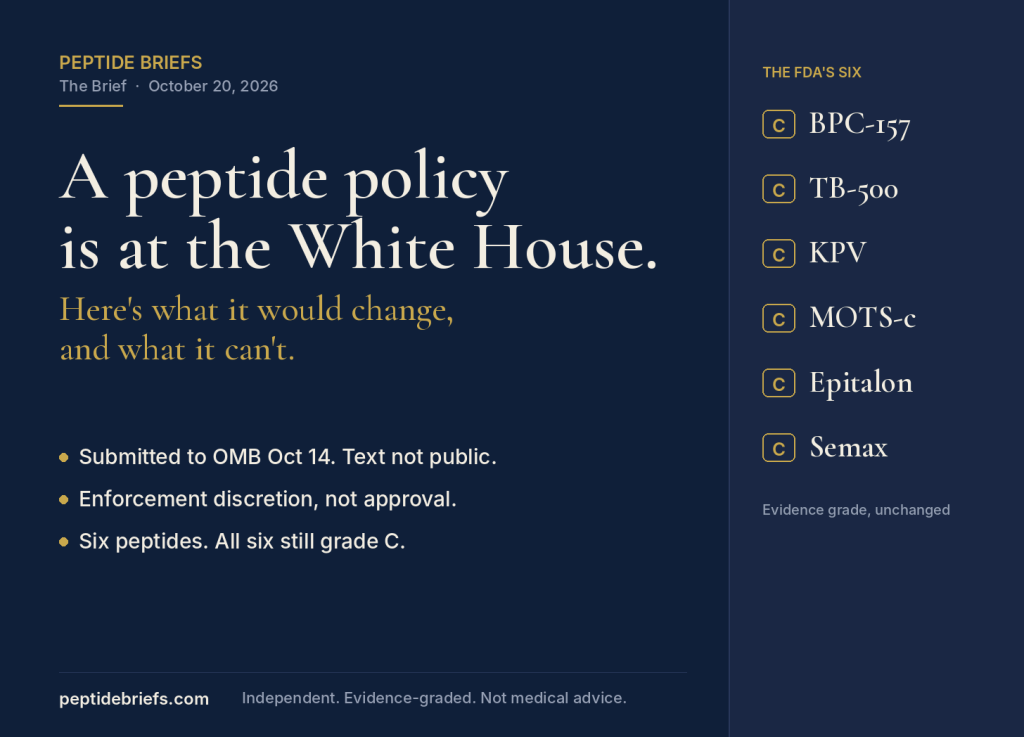
On October 14, HHS and the FDA sent a document called “Interim Access Policy for Compounding Using Certain Peptides” to the White House Office of Management and Budget for review. It is listed as pending. Reuters reported the submission the next day, and within 48 hours several headlines had the FDA “fast-tracking” peptides.
It isn’t. Here is what actually happened, what the document most likely says, and what it cannot do.
Where this came from:
In September we covered what the human evidence shows for the six peptides an FDA advisory committee voted toward the compounding list in July: BPC-157, KPV, TB-500, MOTS-c, Epitalon and Semax. Short version: all six sit at C on our scale. Cell and animal data, little or no controlled human data, and in several cases no published human trial at all.
The votes were close and they went against the agency’s own scientists. FDA staff had recommended against all seven peptides under review on June 29, citing poorly characterized substances, limited human data and immune-reaction risk. BPC-157, KPV and TB-500 each passed 8 to 6 with one abstention. Emideltide (DSIP) failed 6 to 7. Roughly half the reconstituted committee was reported to have ties to peptide clinics or businesses.
A committee vote does not put anything on the 503A bulks list. That takes a proposed rule, a comment period and a final rule. The last time FDA did this for a batch of ten substances, the proposed rule came in 2016 and the final rule in 2019.
What the October 14 document most likely is
Nobody outside government has read it. But the title says “interim” and “access,” and the FDA already runs an interim policy for nominated bulk substances. Under that policy, a substance in Category 1 can be compounded by a state-licensed 503A pharmacy while the agency keeps evaluating it, because the FDA says it does not intend to enforce against that use. Category 2 substances, where BPC-157 and friends sat from 2023 until April of this year, get no such discretion.
So the most likely shape is this: the six move into Category 1, with conditions. A prescriber writes a prescription for one patient. A licensed pharmacy compounds it from bulk material that meets whatever sourcing and testing standards the policy names. The FDA agrees not to pursue that pharmacy for it, for now.
What it would not do
- It would not approve anything. Enforcement discretion is the agency saying what it will not prosecute. The peptides would remain unapproved drugs with the same evidence base they have today.
- It would not be permanent. A guidance document can be narrowed or withdrawn without a comment period. The compounded semaglutide and tirzepatide discretion periods ended the same way.
- It would not cover products sold as research chemicals, dietary supplements or through 503B outsourcing facilities. The channel it opens is prescription-only, through a pharmacy.
- It would not bind state pharmacy or medical boards, which can still say no.
- It could be limited by route. Some committee members tied their yes votes to specific routes of administration, and the policy could follow them.
That third point deserves a second look, because it is the one the headlines skip.
The other half of the story
While the access story got the attention, enforcement went the other way. On August 24 the FDA sent five warning letters to online peptide vendors. The agency’s reasoning is worth knowing exactly: a “research use only” label did not outweigh evidence the products were intended for people, and the evidence it pointed to was bacteriostatic water sold for mixing and dosing calculators offered alongside the vials.
On September 18 a warning letter went to a compounder whose GLP-1 products with added B12 or niacinamide were, in the FDA’s view, essentially copies of approved drugs. The same letter questioned prescriptions generated from preselected menu options on telehealth platforms. And in August the developer of retatrutide filed six lawsuits against sellers and reported more than 200 referrals to regulators.
Read those two threads together. The administration is building a narrow, licensed, prescription path for six C-grade peptides, and at the same time the agency is telling the gray market that the label on the vial is not a defense if the rest of the website says otherwise.
What happens next
Date
What
Now
OMB review of the interim policy; no deadline, no public text
Before end of Feb 2027
Second advisory committee meeting on GHK-Cu, LL-37, Dihexa, Melanotan II and PEG-MGF; date not set
2027
A proposed rule for the bulks list, if FDA accepts the July votes
Late 2027 to 2028
A final rule, on the 2016-to-2019 precedent
Jan 2029
Whatever survives the 2028 election
If the policy comes out, the things to read first are the conditions: which lab standards the bulk material has to meet, whether the FDA-registered facility and certificate-of-analysis language applies, and whether any route is excluded. Those conditions will say more about where this is going than the headline.
What it means for the grades
Nothing. A grade here is a statement about evidence, and no evidence changed this month. Access and evidence are different questions, and a policy that opens the first does not answer the second. If a controlled human trial of any of the six publishes, you will read about it here, and the grade will move then.
The six pages, for reference: BPC-157, TB-500, KPV, MOTS-c, Epitalon, Semax.
Disclosure: I co-own a research-peptide vendor. That is stated on every page here, and this library does not link to it.
Peptide Briefs is an independent reference. Nothing here is medical advice or a recommendation to use any compound.
Also published on Substack

