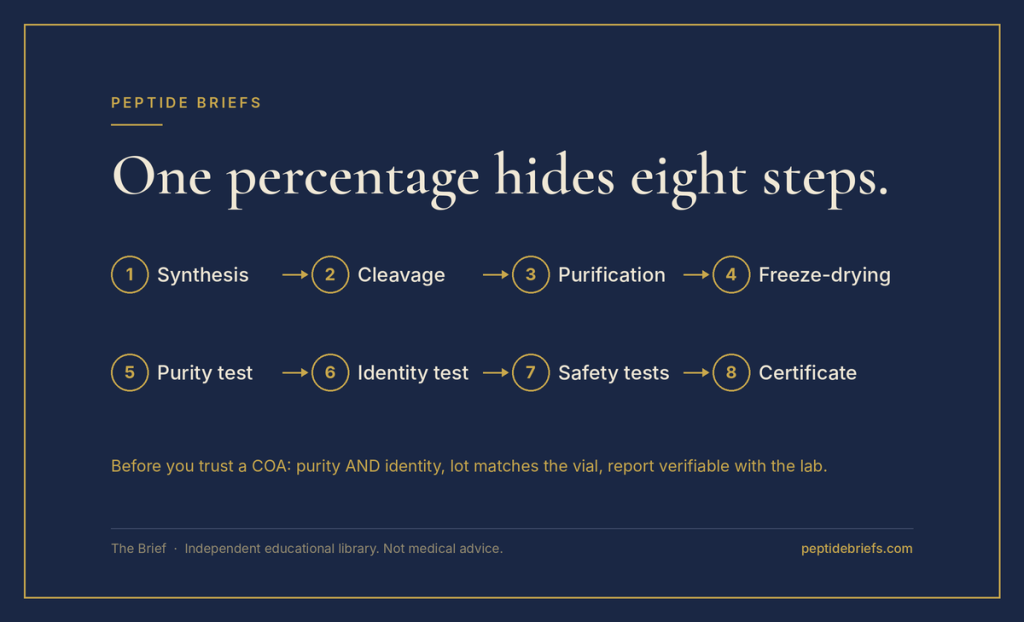
Eight steps, and where each one can go wrong.
A label says “99% pure.” It doesn’t say what happened before that number. Here is the path of one lot from chemistry to certificate, with the question to ask at each step.
This is about manufacturing and testing. It is research-use-only information, not guidance for use in people.
A note on where this comes from. I spent two years living in China, where I observed the peptide industry up close: I met vendors and manufacturers and visited their labs. I’m not a chemist, and this post doesn’t pretend to be a lab manual. It’s what I learned about how a lot moves from synthesis to certificate, and about which questions separate a real certificate from a PDF.
SYNTHESIS
Amino acids are joined one at a time on a resin bead. No step is perfect.
Make Simple: at 99% efficiency per step, a 30-amino-acid peptide comes out roughly three-quarters full-length. The rest is near-miss sequences.
Ask: how was the batch made, and how was the crude product cleaned up?
CLEAVAGE
The chain is chemically cut from the resin. What comes off is a mixture: the target, truncated pieces, deleted sequences, leftover reagents.
PURIFICATION
Preparative HPLC separates the target from the junk. Which fractions get kept is a judgment call, and it sets the final purity.
FREEZE-DRYING
The purified peptide is freeze-dried into powder. That powder is not 100% peptide. It also holds water and counterions such as TFA or acetate.
Make Simple: “net peptide content” tells you how much of the powder is actually peptide.
Ask: is net peptide content reported?
PURITY TEST
Analytical HPLC reports the share of the signal that belongs to the main peak.
Make Simple: purity tells you how clean. It does not tell you what it is.
IDENTITY TEST
Mass spectrometry checks the molecular weight. Without it, a clean peak could still be the wrong molecule.
Ask: is identity confirmed, and by what method?
SAFETY TESTS
Endotoxin and microbial testing are separate from purity. A certificate that lists only HPLC doesn’t cover them.
THE CERTIFICATE
A COA is a claim about one lot.
Check: the lot number matches the vial. The report number can be verified with the lab itself, not just a PDF. The methods are listed. An independent lab ran it. The lab’s accreditation status is stated honestly.THE JOURNEY IN ONE LINE
Synthesis → cleavage → purification → freeze-drying → purity → identity → safety → certificate
THE BIG TAKEAWAY
A single percentage hides seven other steps. Before you trust a COA, ask:
- Does it show purity AND identity?
- Is net peptide content reported?
- Were endotoxin and microbial tests run?
- Does the lot match the vial?
- Can the report number be verified with the lab?
Which of these do you see missing most often?
This post describes general peptide manufacturing and analytical practice. It makes no claim about any specific product or supplier.
Also published on Substack.

