Originally publshed on Substack
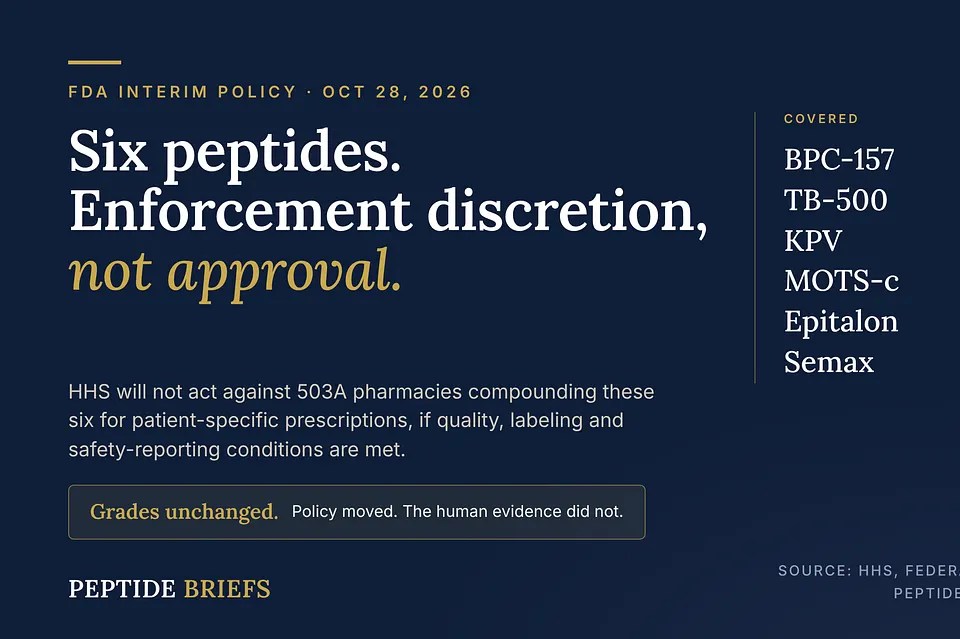
Today the Department of Health and Human Services published an interim policy in the Federal Register covering six peptides: BPC-157, TB-500, KPV, MOTS-c, Epitalon and Semax. Under it, FDA says it will not take enforcement action against licensed 503A pharmacies and physicians who compound these peptides for individual patients, provided they meet conditions on ingredient quality, manufacturing standards, labeling, safety reporting and patient-specific prescriptions. Several clinicians are reporting an effective date of Friday, October 30.
This is the end of a road that started in September 2023, when FDA moved these compounds into Category 2 of its interim bulks policy, effectively blocking pharmacies from compounding them. In April 2026 they were removed from Category 2. In July an FDA advisory committee voted narrowly, 8 to 6 on most of them, to recommend adding all six to the 503A bulks list, over the objection of the agency’s own scientific reviewers. On October 14 HHS sent this interim policy to the White House. It cleared review on October 27 and was published today.
What it is
Enforcement discretion. FDA is telling compounding pharmacies it will not pursue them for making these six, as long as the conditions are met. That gives clinics and telehealth providers a workable federal basis to prescribe them for the first time in three years.
What it is not
Approval. HHS said explicitly that the policy does not constitute FDA approval of the peptides or of any compounded product made from them. Compounded drugs are not reviewed for safety, efficacy or quality before they reach patients. HHS also said it may reconsider the policy if safety signals or product-quality problems emerge, which is a reminder that this can be withdrawn as easily as it was granted.
It also does not bind the states. State boards of pharmacy regulate compounding on the ground, and at least one industry figure has already said some states may not follow the federal move.
And it does not touch research-use products. A vial sold as research-use-only is outside a compounding policy entirely. Nothing in today’s announcement changes the legal status of that market in either direction.
What the evidence says
Here is the part that matters most to this library. FDA’s reviewers found no human safety studies for KPV, TB-500, MOTS-c or Epitalon, and found the BPC-157 trials too small and too short to establish safety or efficacy for any proposed use. An independent systematic review published this month in Acta Orthopaedica Belgica searched every major database through June for human BPC-157 data and came to a similar conclusion.
So the grades here do not move. BPC-157 stays at C. TB-500 stays at C. The others hold where they are. A policy decision about who may dispense a compound is not evidence about whether it works, and this library grades evidence.
What to watch
The policy text itself, which should show exactly which conditions pharmacies must meet and whether specific indications are named. Any state board responses. The citizen petition filed last week asking FDA to block compounding of these peptides. And, further out, whether FDA ever starts the formal rulemaking that would put any of the six on the bulks list permanently. The advisory committee’s recommendation was non-binding, and as of today no proposed rule exists.
Disclosure: I co-own a research-peptide vendor. That is disclosed on every page of this publication and does not affect how compounds are graded here.
Sources
Reuters, Oct 28, 2026: US health department to allow temporary sale of some unapproved peptides
AJMC, Jul 31, 2026: FDA Panel Backs 6 Peptides for Compounding
Holland & Knight, Oct 2026: Peptides at a Crossroads
reginfo.gov, RIN 0910-ZD94, Interim Access Policy for Compounding Using Certain Peptides

