• WHAT ACTUALLY HAPPENS TO A PEPTIDE BEFORE IT REACHES THE VIAL

    WHAT ACTUALLY HAPPENS TO A PEPTIDE BEFORE IT REACHES THE VIAL

    Eight steps, and where each one can go wrong.

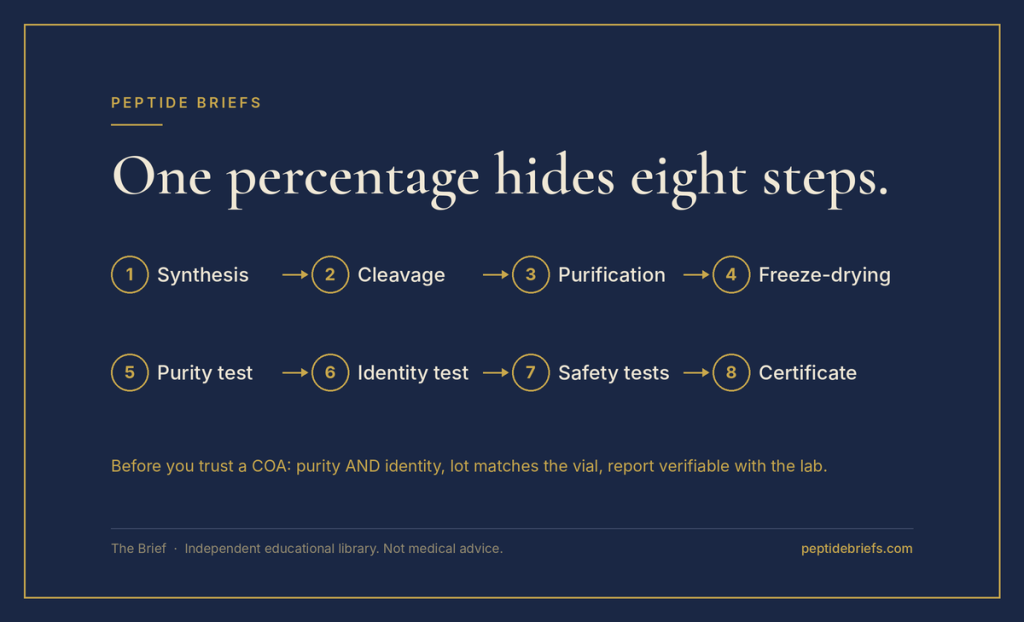
    A label says “99% pure.” It doesn’t say what happened before that number. Here is the path of one lot from chemistry to certificate, with the question to ask at each step.

    This is about manufacturing and testing. It is research-use-only information, not guidance for use in people.

    A note on where this comes from. I spent two years living in China, where I observed the peptide industry up close: I met vendors and manufacturers and visited their labs. I’m not a chemist, and this post doesn’t pretend to be a lab manual. It’s what I learned about how a lot moves from synthesis to certificate, and about which questions separate a real certificate from a PDF.

    SYNTHESIS
    Amino acids are joined one at a time on a resin bead. No step is perfect.
    Make Simple: at 99% efficiency per step, a 30-amino-acid peptide comes out roughly three-quarters full-length. The rest is near-miss sequences.
    Ask: how was the batch made, and how was the crude product cleaned up?

    CLEAVAGE
    The chain is chemically cut from the resin. What comes off is a mixture: the target, truncated pieces, deleted sequences, leftover reagents.

    PURIFICATION
    Preparative HPLC separates the target from the junk. Which fractions get kept is a judgment call, and it sets the final purity.

    FREEZE-DRYING
    The purified peptide is freeze-dried into powder. That powder is not 100% peptide. It also holds water and counterions such as TFA or acetate.
    Make Simple: “net peptide content” tells you how much of the powder is actually peptide.
    Ask: is net peptide content reported?

    PURITY TEST
    Analytical HPLC reports the share of the signal that belongs to the main peak.
    Make Simple: purity tells you how clean. It does not tell you what it is.

    IDENTITY TEST
    Mass spectrometry checks the molecular weight. Without it, a clean peak could still be the wrong molecule.
    Ask: is identity confirmed, and by what method?

    SAFETY TESTS
    Endotoxin and microbial testing are separate from purity. A certificate that lists only HPLC doesn’t cover them.

    THE CERTIFICATE
    A COA is a claim about one lot.
    Check: the lot number matches the vial. The report number can be verified with the lab itself, not just a PDF. The methods are listed. An independent lab ran it. The lab’s accreditation status is stated honestly.THE JOURNEY IN ONE LINE
    Synthesis → cleavage → purification → freeze-drying → purity → identity → safety → certificate

    THE BIG TAKEAWAY
    A single percentage hides seven other steps. Before you trust a COA, ask:

    1. Does it show purity AND identity?
    2. Is net peptide content reported?
    3. Were endotoxin and microbial tests run?
    4. Does the lot match the vial?
    5. Can the report number be verified with the lab?

    Which of these do you see missing most often?

    This post describes general peptide manufacturing and analytical practice. It makes no claim about any specific product or supplier.

    Also published on Substack.
  • What a $150,000 Group Buy Teaches About Reading a COA

    What a $150,000 Group Buy Teaches About Reading a COA

    In July, a grey-market peptide “group buy” collapsed and its members were out roughly $150,000. TitrateLab traced the money on-chain and published the details; Rick Gold at OHM Peptides separately described the same trick a month later. I’d point you to both pieces rather than retell them. What interests me is the part that had nothing to do with blockchains.

    The certificates of analysis never held up.

    Some resolved, on the testing lab’s own website, to entirely different companies. Others failed lookup altogether. The vendor’s name had been pasted onto reports that belonged to someone else. Every buyer who lost money had a PDF that looked right, and the PDF was real. Only the name at the top was fake.

    This is worth sitting with, because it inverts the usual advice. “Check the COA” is not enough. A fraudulent seller who is any good at this will hand you a genuine COA. The question is whether the COA is theirs.

    Three checks that would have caught it

    Look up the report ID on the lab’s site, not the vendor’s. Janoshik, and most serious labs, let you enter a report number and see the original. If the vendor name on the lab’s copy doesn’t match the vendor selling to you, stop.

    Match the lot number on the vial to the report. A COA for lot 2407-A tells you nothing about the vial marked 2409-C in your hand. Vendors reuse a good report across batches more often than anyone admits.

    Call the lab. This sounds excessive until you’ve done it once. A real third-party lab will confirm that a report number exists and who commissioned it. A vendor who discourages you from calling has told you what you need to know.

    What “verified by customers” means

    When the promoter in the TitrateLab piece was asked about testing, the answer was that it had been done “by customers.” That phrase should be a full stop. Customer testing is unverifiable by definition: you’re taking a stranger’s word for a stranger’s lab work. It’s the COA equivalent of “trust me.”

    The uncomfortable part

    I co-own a research-peptide vendor, disclosed on every page of this site. Earlier this year I sourced retatrutide through a contact I’d met and vetted in person, with a clean-looking COA. Two lots failed identity testing at an independent lab. The certificate had looked fine. I hadn’t asked the right questions either.

    That’s why the checklist exists. It’s one page, eight questions, and it’s the sequence I now run on every batch before it’s listed anywhere. It won’t stop a determined fraud. It will stop the lazy ones, which is most of them.

    [Download the Counterfeit Peptide Red Flag Checklist]

    Sources: TitrateLab, “The $150,000 rugpull we warned everybody about,” July 2026. Rick Gold / OHM Peptides, X, August 27, 2026. Research use only; nothing here is advice on use.