• Peptide Briefs Weekly Top 10: Week of Nov 6, 2026

    Peptide Briefs Weekly Top 10: Week of Nov 6, 2026

    Originally pusblished on Substack

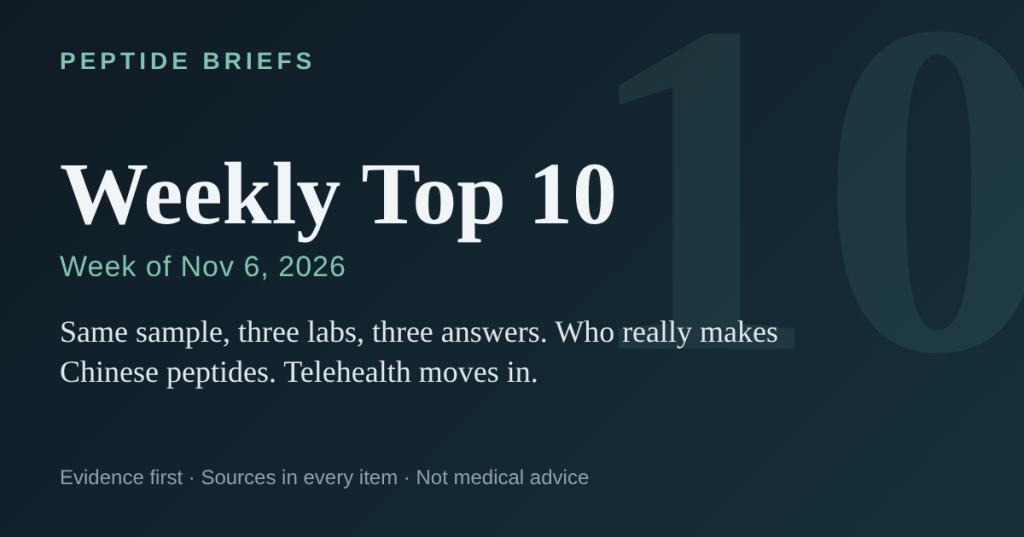
    This week’s new material: labs returning very different numbers on what was reported as the same product, a telehealth company staging a peptide line, warnings of shipping delays ahead of the Shenzhen summit, and tighter customs scrutiny. The HHS peptide policy we covered last week is a follow-up, further down. Ten items follow, with what the evidence does and does not show. Nothing here is medical advice or a recommendation to use any compound.

    SUBSCRIBE

    1. Same sample, different labs, very different numbers

    Krysia, who writes a Substack that digs into third-party peptide testing, documented several cases this week where labs disagreed on the same product. The credit for surfacing these goes to her work and to the labs willing to publish their results. These are anecdotal, vendor-submitted samples, not controlled comparisons, and separate vials can differ. In one case, described as apparently the same batch of a 10 mg retatrutide product, one lab reported 3.98 mg at 36.44% purity, a second reported about 7.7 mg at about 67.3% (two runs, 67.301% and 67.319%), and a third reported 11.26 mg at 98.183%. Janoshik said the simplest explanation for its gap with the second lab was “sample difference”; the first lab declined to discuss. In another case, two labs tested separate vials from the same 10 mg eloralintide kit: one reported 99.74% purity and 10.09 mg, the other 67.8% and 12.1 mg. The second lab stands by its result, citing an extra chromatogram peak that barely registered at 220 nm but showed strongly at 280 nm, which it says it has not yet identified; it says it ruled out two candidate explanations, and no response from the first lab was available. Methods also differ in what “purity” means: one lab does not report blend purity at all because overlapping peaks can hide impurities, another reports combined peak area and says it is “not absolute mass purity,” and one lab found the TB-500 fragment co-eluted with another component. The takeaway: “99%” on a certificate usually means 99% of detected peak area at one wavelength, not 99% of the vial, and a single certificate cannot settle quality. A separate site reports several popular labs are not accredited (ISO/IEC 17025) for peptide assays; it has vendor ties, so verify before citing.

    Sources: Krysia (Substack) and her follow-up notes, ChemVerify (commercial ties)

    2. Telehealth moves in: Hims & Hers stages a peptide line

    On its Aug 10 earnings call, Hims & Hers said it planned to sell compounded peptides by the end of 2026 in phases: sermorelin, glutathione and an existing product first, and the six committee-recommended peptides only after FDA action. The day after HHS acted, its Oct 29 release described a “Peptides+” preview with a waitlist, listing sermorelin, glutathione, B12, NAD+ and L-carnitine, with BPC-157 and TB-500 to follow “when allowable.” The release gives no launch date or pricing, says treatment would come through independent providers and licensed pharmacies, and itself notes that published studies are limited. Becker’s reports the company is running stability testing on BPC-157 at a California facility. As of this week, this is a waitlist and a plan, not a launch.

    Sources: Hims & Hers release (company, promotional), Becker’s Hospital Review

    3. Shenzhen summit: shipping delays are warned, but no export restriction is confirmed

    The APEC Economic Leaders’ Meeting is scheduled for Nov 18 to 19 in Shenzhen. A peptide sourcing vendor’s advisory says freight partners expect “enhanced security measures and stricter cargo inspections” in Shenzhen-area logistics hubs before and during the summit, with delays it calls impossible to predict. That advisory does not mention any government restriction on peptide exports, and I found no confirmed Chinese government export restriction on peptides. Separate social posts relay vendor warnings of a longer shipping disruption starting in late September; I could not verify those. Treat this as a logistics warning, not a policy change.

    Sources: APEC China 2026 (Wikipedia), vendor advisory (commercial source)

    4. Customs and enforcement are tightening on peptide shipments

    On Nov 5, NL Times (citing RTL Nieuws and BNR) reported that Dutch Customs stopped “hundreds of shipments” containing peptides through September, mostly by courier, while RTL identified 203 illegal online pharmacies, more than half under six months old, with products mainly supplied from China. Earlier this year, U.S. Customs and Border Protection reported a Cincinnati interdiction of roughly 5,000 mis-manifested peptide shipments from China, per a secondary summary of the CBP release (exact dates should be confirmed against the primary release). Neither report describes Chinese export controls.

    Sources: NL Times, ChemVerify (secondary, commercial ties)

    5. A large preprint finds wide variability in marketed research peptides

    A preprint by Mendias and Awan (Apr 24, 2026; not peer reviewed) analyzed public third-party testing data from Finnrick Analytics: 14 peptides, 6,285 analyzed samples from 203 companies, tested between December 2024 and April 2026. Depending on the acceptance standard, 41.6% to 71.1% of samples failed basic criteria. Median measured content was 101.8% of label claim, but TB-500 had the lowest median purity (97.29%) and the highest identity failure rate (10.0%), and quality varied more between vendors than between peptides. Endotoxin data existed for under 4% of samples, and 15% of those showed measurable endotoxin. The authors caution the data are voluntary submissions, not a representative sample, and the failure rates are likely a lower bound.

    Source: Preprints.org 202604.1748

    6. A new orthopaedic review: preclinical promise, thin human data

    A narrative review in the Journal of the American Academy of Orthopaedic Surgeons (online Oct 27) covers BPC-157, thymosin beta-4 and TB-500, searching PubMed, EMBASE and Scopus through June 2026. BPC-157 has the largest musculoskeletal preclinical literature, mostly in small animals, while the human musculoskeletal evidence is one small, retrospective, uncontrolled case series. Thymosin beta-4’s musculoskeletal evidence is in vitro and rodent only, and TB-500 is a seven-amino-acid fragment often confused with full-length thymosin beta-4, with no validated equivalence. The authors flag identity, purity, sterility and consistency concerns for commercial products and conclude routine clinical use cannot currently be recommended.

    Source: PubMed 42937313

    7. Follow-up: the HHS interim policy on six peptides, one week on

    As covered last week, the Department of Health and Human Services filed an interim policy on Oct 28 (scheduled for Federal Register publication Oct 30) covering BPC-157, epitalon, KPV, MOTS-c, Semax and TB-500. HHS says it does not intend to take enforcement action against state-licensed pharmacies, federal facilities or licensed physicians that compound these six while FDA works on its 503A bulks list. The policy is interim and non-final, signed by the HHS Secretary rather than issued by FDA, and HHS says it may revisit it if a safety signal or quality problem appears.

    Sources: AJMC, Foley & Lardner

    8. What the policy requires, and what it is not

    Per a law-firm summary, enforcement discretion applies only if conditions are met: the bulk substance comes from an FDA-registered facility with a valid certificate of analysis, the original manufacturer is FDA-registered and CGMP-compliant, adverse events go to MedWatch, the product has a single active ingredient, and labeling states “This is a compounded drug product. Not for resale.” The policy does not add the peptides to the 503A bulks list and is not FDA approval of any compounded product. A formal listing would need notice-and-comment rulemaking, which can take months to years. FDA does not review compounded products for safety, effectiveness or quality before marketing.

    Sources: Foley & Lardner, BioXconomy

    9. The policy departs from FDA staff advice, and a petition pushes back

    In July, FDA’s Pharmacy Compounding Advisory Committee narrowly recommended six of seven nominated peptides after the panel was reshaped; some members reportedly had industry ties. FDA’s career scientists recommended against, citing poorly characterized structures, limited safety data, contamination risk, possible immune reactions from peptide aggregation and little data on combinations. HHS says circumstances changed and calls CDER’s concerns “inferential/mechanistic rather than based on observed harm,” but as of BioXconomy’s reporting the evidence HHS cited had not been published. The Partnership for Safe Medicines petitioned FDA (reported Oct 26) to disregard the vote. Written comments on the HHS policy are due two weeks after publication, which one law-firm summary puts at Nov 13.

    Sources: pharmaphorum, BioXconomy, AJMC, PeptideLaws

    10. Approved peptide drugs keep moving: NICE expands Imcivree, GLP-1 pipeline advances

    Rhythm Pharmaceuticals announced Nov 4 that NICE issued positive guidance for Imcivree (setmelanotide) for adults with genetically confirmed Bardet-Biedl syndrome in England, Wales and Northern Ireland, expanding a May 2024 recommendation for ages 6 to 17; children 2 to 5 are already funded through NHS England. This comes from a company press release that says it is intended for investors, cites no trial numbers and does not quote NICE, so check NICE’s own document. It is a regulated drug for a rare genetic condition, a contrast with the unapproved research peptides above. On incretins, per an industry aggregator (check primary sources), retatrutide’s TRIUMPH-2 showed 20.8% weight loss at 80 weeks on 12 mg versus 4.0% on placebo, with Lilly targeting a filing in Q1 2027; survodutide’s SYNCHRONIZE-2 reported 13.1% versus 3.1% at 76 weeks; orforglipron has a positive CHMP opinion with the European Commission decision pending.

    Sources: Rhythm Pharmaceuticals release (company), Life Science Daily

    Dates to watch: Nov 13 (HHS comment deadline, per one law-firm summary), Nov 14 to 17 (ObesityWeek), Nov 18 (NICE orforglipron appraisal expected), Nov 18 to 19 (APEC Shenzhen). No published date: FDA’s CagriSema decision and any bulks-list rulemaking.


    Evidence note: Items 2 to 4 and 7 to 9 are policy, business and logistics reporting; item 1 is anecdotal, not evidence about whether these compounds work. Item 6 is the only peer-reviewed abstract verified this week; item 5 is a preprint. Company press releases are labeled as promotional.

    Credits: item 1 draws on Krysia’s Substack reporting and the lab results she compiled (Janoshik, Freedom Diagnostics, Chromate, BT Labs, Vanguard, Testides, Amino Metrics). Item 5 is the work of Mendias and Awan using public data from Finnrick Analytics. Item 6 is the JAAOS review authors’ work. Item 2 draws on Hims & Hers’ own release and Becker’s Hospital Review. Item 4 draws on NL Times (reporting by RTL Nieuws and BNR). Items 7 to 9 draw on AJMC, Foley & Lardner, BioXconomy, pharmaphorum and PeptideLaws.
  • The Peptide Briefs Top Ten for Oct 22 to Oct 29, 2026

    The Peptide Briefs Top Ten for Oct 22 to Oct 29, 2026

    The week FDA looked the other way, and nine other things that mattered

    Originally published on Substack

    Subscribe

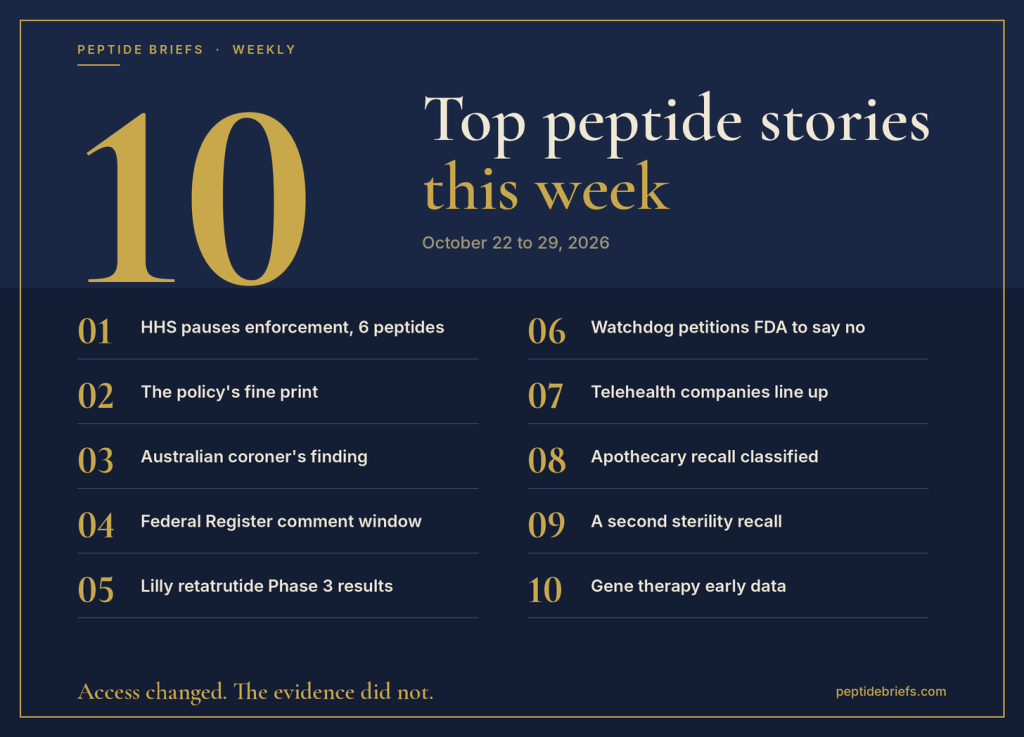
    1. HHS issues an enforcement discretion policy for six peptides (Oct 28)

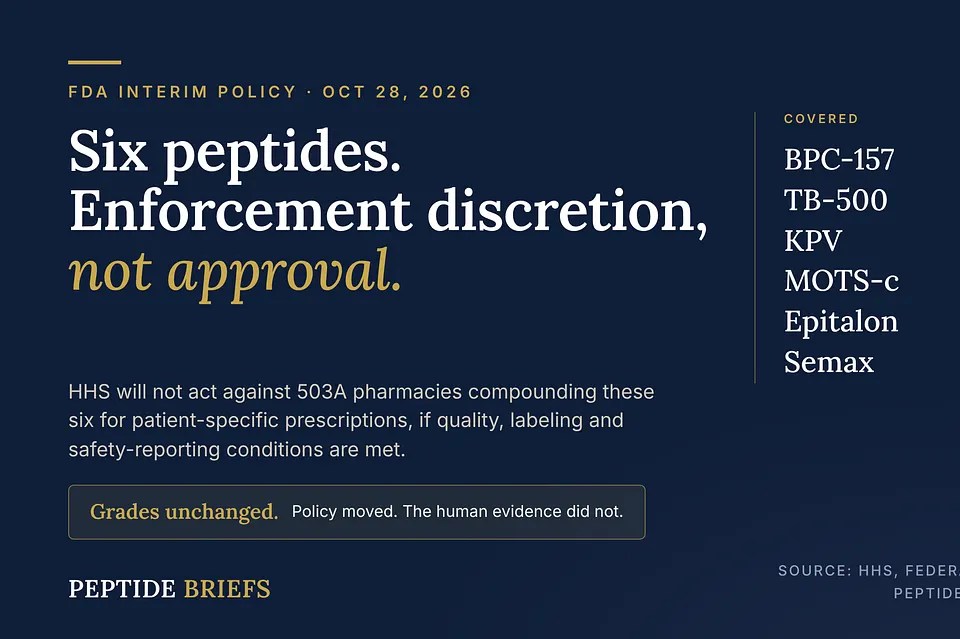
    HHS announced it will not pursue enforcement against state licensed pharmacies that compound six peptides: BPC 157, TB 500, KPV, MOTS c, Epitalon and Semax. FDA still has to decide formally whether they belong on the 503A bulks list. This is not an approval. Government scientists reportedly warned the evidence is limited. Our grades do not change: BPC 157 stays at C.

    Sources: NCPA (ncpa.org/newsroom/qam/2026/10/29/fda-grants-enforcement-discretion-compounding-six-peptides); Ermer and Suter (ermersuter.com/2026/10/28/midweek-update-346/)

    2. The fine print, according to one law firm’s summary

    A law firm’s analysis of the policy reports these conditions: it covers 503A pharmacies, not 503B outsourcing facilities; compounding must be patient specific, with no office stock or wholesale; each product may contain only one listed peptide, so blends fall outside it; the ingredient must come from an FDA registered manufacturer that follows current good manufacturing practice and appears on the certificate of analysis; testing must cover identity, purity, potency and impurities; and state pharmacy law must allow it. The same summary says it creates no legal rights, can be revisited, and does not bind states. This is a secondary source. Check the Federal Register notice before relying on any detail.

    Source: Lumalex (lumalexlaw.com/2026/10/29/hhs-opens-a-temporary-door-for-peptides/)

    3. What happens next: a notice and a comment window

    The law firm summary says the notice is scheduled for Federal Register publication on October 30, followed by a two week comment period. It estimates that formal addition to the bulks list could take 12 to 24 months and says FDA’s advisory committee plans to review five more peptides in February 2027. Those are one source’s reading, so confirm the dates when the notice posts.

    Source: Lumalex (link above)

    4. An Australian coroner links an actor’s death to injected peptides

    On October 28, Victorian coroner David Ryan delivered findings on the death of Richard Norton, a 75 year old Australian actor, stuntman and martial arts instructor who died at Melbourne’s Alfred Hospital on March 30, 2025. The coroner found he went into cardiac arrest after injecting two unapproved peptides, CJC 1295 and ipamorelin, and that his death resulted from complications of their use. The coroner also found he had taken more than he was prescribed.

    Two details matter here. First, this was not a gray market purchase. A doctor prescribed the peptides, and a licensed compounding pharmacy in Queensland made them. Second, the case is described as believed to be the first confirmed Australian death linked to unapproved peptide use. The coroner recommended that Australia’s Therapeutic Goods Administration review the benefits and safety risks of these peptides and consider further restrictions. The TGA says it is assessing the risks. The Medical Board of Australia earlier found the prescribing doctor’s practice “is or may be unsatisfactory” and imposed a caution and conditions.

    What we do not know: what the TGA will do, the exact amounts involved, and whether other deaths exist. The coroner’s wording is that the death was triggered by the injections. News reports also mention other health history, and we are not drawing conclusions beyond the findings.

    Why it belongs in this week’s list: it arrived the same day the United States moved the opposite direction on compounding. A prescription and a licensed pharmacy are safeguards, not guarantees. The evidence for these peptides in humans remains limited, and a clinical expert in the Australian case reportedly found insufficient evidence that they are safe, effective or beneficial for human use.

    Sources: ABC News Australia (abc.net.au/news/2026-10-29/victoria-peptide-death-coroners-report-richard-norton/107320590); OzArab Media summary (ozarab.media/coroner-urges-review-of-peptide-restrictions-after-richard-nortons-death/)

    5. Lilly reports retatrutide topline results against Ozempic (Oct 28)

    In the Phase 3 TRANSCEND T2D 2 trial, 1,298 adults with type 2 diabetes were randomized to retatrutide 9 mg, retatrutide 12 mg or Ozempic 2 mg. Lilly reports weight loss of 19.5 percent and 20.9 percent for the two retatrutide doses versus 9.4 percent for Ozempic, and A1C reductions of 2.2 percent versus 1.8 percent. Discontinuation because of side effects was 4.8 percent and 7.9 percent versus 2.7 percent. Caveats: topline data from the sponsor, open label design, and retatrutide is not approved by any regulator. This is a trial of a drug under study, not a reason to trust anything sold online under the same name.

    Source: BioPharm International (biopharminternational.com/view/lilly-s-retatrutide-doubles-ozempic-s-weight-loss-in-first-phase-3-head-to-head-trial)

    6. A watchdog petitions FDA to say no

    The Partnership for Safe Medicines filed a citizen petition asking FDA not to allow compounding of the peptides the advisory committee recommended. It calls them untested and poorly defined, and says it bought five vials from telehealth services as part of its argument. The organization’s page is dated October 26, but the text says the petition was filed October 16. We list both dates because the sources differ.

    Source: Partnership for Safe Medicines (safemedicines.org/2026/10/october-26-2026-psm-cp.html)

    7. Telehealth companies line up

    Time ran a piece titled “The Peptide Rush Has Begun,” and a law firm summary of news coverage says Hims and Hers and Noom are reportedly considering or planning peptide offerings. We could not open the Time article, so treat this as reported, not confirmed. What to watch: what these companies actually launch once the notice is published.

    Sources: Time (time.com/article/2026/10/28/peptide-rush-has-begun/); Ermer and Suter (link above)

    8. A sterility recall gets its FDA classification

    Apothecary Pharma LLC recalled 22 lots of compounded tirzepatide vials on September 24, and FDA classified the recall on October 8. Coverage says no illnesses are tied to this recall and that FDA rated the chance of serious harm as remote. FDA’s March warning letter cited serious deficiencies in sterility protocols. The recall is a reminder that compounded does not mean tested for sterility by default.

    Source: Boston Globe (bostonglobe.com/2026/10/21/business/glp-1-alternative-drugs-face-nationwide-recall/)

    9. A second sterility recall in the FDA Enforcement Report

    Carolina Infusion LLC of Ridgeland, South Carolina appears in the FDA Enforcement Report for compounded semaglutide syringes, with the reason given as a lack of sterility assurance. We have not verified the event number or dates, so we are not repeating them.

    Source: FDA Enforcement Report record

    10. Adjacent: early human data for a partial reprogramming therapy

    A newsletter summary reports early Phase 1 data for Life Biosciences’ ER-100, an experimental gene therapy for optic neuropathies, with no serious safety signals and visual field improvement in 2 of 3 glaucoma participants. Three people is a safety signal, not an efficacy result. We have not read the primary release.

    Source: Fight Aging newsletter, October 26 (fightaging.org/archives/2026/10/fight-aging-newsletter-october-26th-2026)

    WHAT WE’RE WATCHING NEXT WEEK

    The Federal Register notice and comment window; whether the final policy text matches the summaries; any state pharmacy board response; and the full retatrutide data when it is presented at a medical meeting.

    ONE THING TO REMEMBER

    Access changed this week. The evidence did not. A policy can open a door. Only trials show what is behind it.

    Disclosure: I co-own Agape Compounds, a research use only peptide company. Peptide Briefs is written independently of it.

  • The FDA’s Six, Part 3: HHS Cleared the Six. Here Is What That Does and Does Not Mean

    The FDA’s Six, Part 3: HHS Cleared the Six. Here Is What That Does and Does Not Mean

    Originally publshed on Substack

    Today the Department of Health and Human Services published an interim policy in the Federal Register covering six peptides: BPC-157, TB-500, KPV, MOTS-c, Epitalon and Semax. Under it, FDA says it will not take enforcement action against licensed 503A pharmacies and physicians who compound these peptides for individual patients, provided they meet conditions on ingredient quality, manufacturing standards, labeling, safety reporting and patient-specific prescriptions. Several clinicians are reporting an effective date of Friday, October 30.

    Subscribe

    This is the end of a road that started in September 2023, when FDA moved these compounds into Category 2 of its interim bulks policy, effectively blocking pharmacies from compounding them. In April 2026 they were removed from Category 2. In July an FDA advisory committee voted narrowly, 8 to 6 on most of them, to recommend adding all six to the 503A bulks list, over the objection of the agency’s own scientific reviewers. On October 14 HHS sent this interim policy to the White House. It cleared review on October 27 and was published today.

    What it is

    Enforcement discretion. FDA is telling compounding pharmacies it will not pursue them for making these six, as long as the conditions are met. That gives clinics and telehealth providers a workable federal basis to prescribe them for the first time in three years.

    What it is not

    Approval. HHS said explicitly that the policy does not constitute FDA approval of the peptides or of any compounded product made from them. Compounded drugs are not reviewed for safety, efficacy or quality before they reach patients. HHS also said it may reconsider the policy if safety signals or product-quality problems emerge, which is a reminder that this can be withdrawn as easily as it was granted.

    It also does not bind the states. State boards of pharmacy regulate compounding on the ground, and at least one industry figure has already said some states may not follow the federal move.

    And it does not touch research-use products. A vial sold as research-use-only is outside a compounding policy entirely. Nothing in today’s announcement changes the legal status of that market in either direction.

    What the evidence says

    Here is the part that matters most to this library. FDA’s reviewers found no human safety studies for KPV, TB-500, MOTS-c or Epitalon, and found the BPC-157 trials too small and too short to establish safety or efficacy for any proposed use. An independent systematic review published this month in Acta Orthopaedica Belgica searched every major database through June for human BPC-157 data and came to a similar conclusion.

    So the grades here do not move. BPC-157 stays at C. TB-500 stays at C. The others hold where they are. A policy decision about who may dispense a compound is not evidence about whether it works, and this library grades evidence.

    What to watch

    The policy text itself, which should show exactly which conditions pharmacies must meet and whether specific indications are named. Any state board responses. The citizen petition filed last week asking FDA to block compounding of these peptides. And, further out, whether FDA ever starts the formal rulemaking that would put any of the six on the bulks list permanently. The advisory committee’s recommendation was non-binding, and as of today no proposed rule exists.

    Disclosure: I co-own a research-peptide vendor. That is disclosed on every page of this publication and does not affect how compounds are graded here.

    Sources
    Reuters, Oct 28, 2026: US health department to allow temporary sale of some unapproved peptides
    AJMC, Jul 31, 2026: FDA Panel Backs 6 Peptides for Compounding
    Holland & Knight, Oct 2026: Peptides at a Crossroads
    reginfo.gov, RIN 0910-ZD94, Interim Access Policy for Compounding Using Certain Peptides

  • The Peptide Briefs Top Ten: Week of Oct 19, 2026

    The Peptide Briefs Top Ten: Week of Oct 19, 2026

    What the internet argued about this week, and what each topic really means.

    Every week, ten peptide topics take over the feeds, the news and the comment sections. This is the list, in order, with one line on why each matters.

    How it’s built: news coverage, Reddit and Substack discussion, and public posts on X, ordered by editorial judgment. It is not a measured ranking. I can’t measure X directly, and every claim below is attributed to its source.

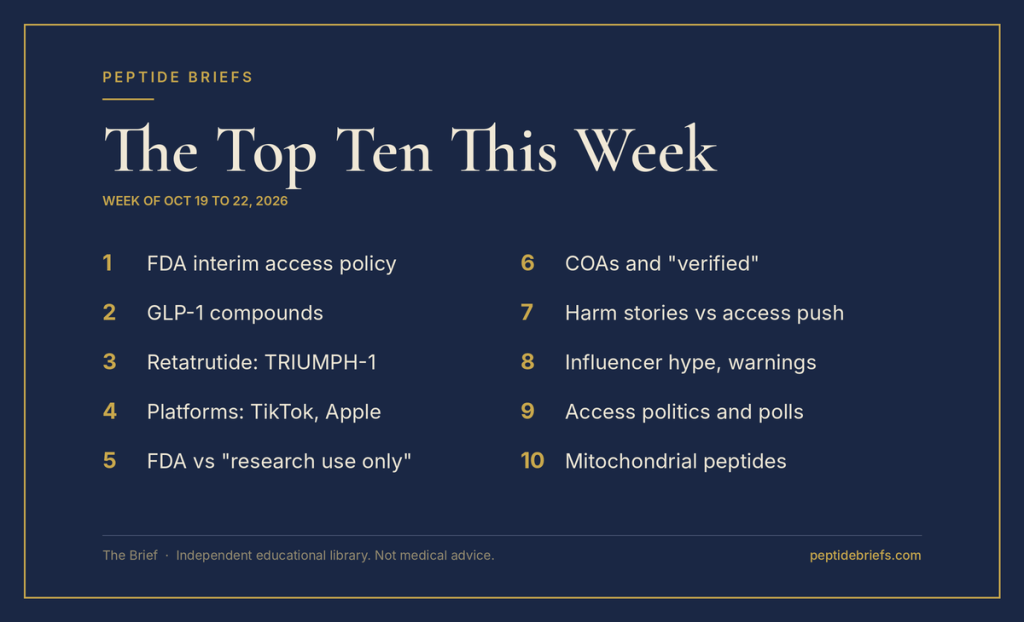
    1. FDA’s interim access policy. Sent to the White House on Oct 14. The text isn’t public. Enforcement discretion is not approval, and the evidence grades haven’t moved.
    2. GLP-1 compounds. They account for most online peptide conversation, by a wide margin.
    3. Retatrutide. Lilly’s TRIUMPH-1 topline results are driving interest. The data aren’t yet peer-reviewed, and the drug isn’t approved.
    4. Platforms writing the rules. TikTok is reported to block searches for some peptide names. A screenshot of an Apple letter shows it objecting to reconstitution calculators. Neither is confirmed by the company.
    5. FDA versus “research use only.” August warning letters made the point that a disclaimer doesn’t outweigh the rest of a site’s marketing.
    6. COAs and “verified.” Everyone says the word. Few define it. Does it mean the lab confirmed the report, or the seller uploaded a PDF?
    7. Harm stories versus the access push. Media reports of people hurt by peptides are running alongside the political push for wider access.
    8. Influencer hype and expert warnings. Doctors in several countries are pushing back on social-media promotion.
    9. Access politics and polls. Sponsor-funded polling shows support for pharmacy access. Read it with the sponsor in mind.
    10. Mitochondrial peptides. MOTS-c, SS-31 and Humanin keep coming up, often with a level in the body mistaken for an outcome.

    WHAT MOVED THIS WEEK
    This is the first edition, so there is nothing to compare yet. Next week this section will show what moved up and down.

    YOUR TURN
    Which topic would you move to #1? Reply and tell me.

    Get the Top Ten every Thursday: subscribe on Substack

    I co-own a research-peptide vendor, and Peptide Briefs is editorially independent of it. Nothing here is medical advice.

  • The FDA’s Six, Part Two: a peptide policy is sitting at the White House. Here’s what it would and wouldn’t change.

    The FDA’s Six, Part Two: a peptide policy is sitting at the White House. Here’s what it would and wouldn’t change.

    Find Part One Here

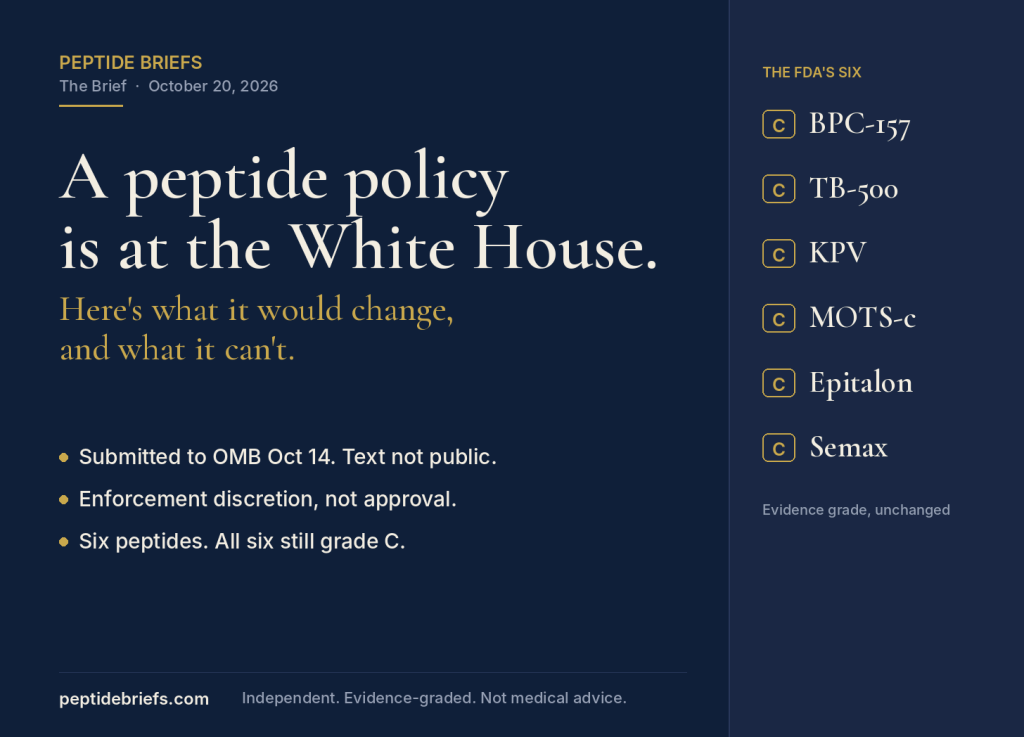
    On October 14, HHS and the FDA sent a document called “Interim Access Policy for Compounding Using Certain Peptides” to the White House Office of Management and Budget for review. It is listed as pending. Reuters reported the submission the next day, and within 48 hours several headlines had the FDA “fast-tracking” peptides.

    It isn’t. Here is what actually happened, what the document most likely says, and what it cannot do.

    Where this came from:

    In September we covered what the human evidence shows for the six peptides an FDA advisory committee voted toward the compounding list in July: BPC-157, KPV, TB-500, MOTS-c, Epitalon and Semax. Short version: all six sit at C on our scale. Cell and animal data, little or no controlled human data, and in several cases no published human trial at all.

    The votes were close and they went against the agency’s own scientists. FDA staff had recommended against all seven peptides under review on June 29, citing poorly characterized substances, limited human data and immune-reaction risk. BPC-157, KPV and TB-500 each passed 8 to 6 with one abstention. Emideltide (DSIP) failed 6 to 7. Roughly half the reconstituted committee was reported to have ties to peptide clinics or businesses.

    A committee vote does not put anything on the 503A bulks list. That takes a proposed rule, a comment period and a final rule. The last time FDA did this for a batch of ten substances, the proposed rule came in 2016 and the final rule in 2019.

    What the October 14 document most likely is

    Nobody outside government has read it. But the title says “interim” and “access,” and the FDA already runs an interim policy for nominated bulk substances. Under that policy, a substance in Category 1 can be compounded by a state-licensed 503A pharmacy while the agency keeps evaluating it, because the FDA says it does not intend to enforce against that use. Category 2 substances, where BPC-157 and friends sat from 2023 until April of this year, get no such discretion.

    So the most likely shape is this: the six move into Category 1, with conditions. A prescriber writes a prescription for one patient. A licensed pharmacy compounds it from bulk material that meets whatever sourcing and testing standards the policy names. The FDA agrees not to pursue that pharmacy for it, for now.

    What it would not do

    1. It would not approve anything. Enforcement discretion is the agency saying what it will not prosecute. The peptides would remain unapproved drugs with the same evidence base they have today.
    2. It would not be permanent. A guidance document can be narrowed or withdrawn without a comment period. The compounded semaglutide and tirzepatide discretion periods ended the same way.
    3. It would not cover products sold as research chemicals, dietary supplements or through 503B outsourcing facilities. The channel it opens is prescription-only, through a pharmacy.
    4. It would not bind state pharmacy or medical boards, which can still say no.
    5. It could be limited by route. Some committee members tied their yes votes to specific routes of administration, and the policy could follow them.

    That third point deserves a second look, because it is the one the headlines skip.

    The other half of the story

    While the access story got the attention, enforcement went the other way. On August 24 the FDA sent five warning letters to online peptide vendors. The agency’s reasoning is worth knowing exactly: a “research use only” label did not outweigh evidence the products were intended for people, and the evidence it pointed to was bacteriostatic water sold for mixing and dosing calculators offered alongside the vials.

    On September 18 a warning letter went to a compounder whose GLP-1 products with added B12 or niacinamide were, in the FDA’s view, essentially copies of approved drugs. The same letter questioned prescriptions generated from preselected menu options on telehealth platforms. And in August the developer of retatrutide filed six lawsuits against sellers and reported more than 200 referrals to regulators.

    Read those two threads together. The administration is building a narrow, licensed, prescription path for six C-grade peptides, and at the same time the agency is telling the gray market that the label on the vial is not a defense if the rest of the website says otherwise.

    What happens next

    Date

    What

    Now

    OMB review of the interim policy; no deadline, no public text

    Before end of Feb 2027

    Second advisory committee meeting on GHK-Cu, LL-37, Dihexa, Melanotan II and PEG-MGF; date not set

    2027

    A proposed rule for the bulks list, if FDA accepts the July votes

    Late 2027 to 2028

    A final rule, on the 2016-to-2019 precedent

    Jan 2029

    Whatever survives the 2028 election

    If the policy comes out, the things to read first are the conditions: which lab standards the bulk material has to meet, whether the FDA-registered facility and certificate-of-analysis language applies, and whether any route is excluded. Those conditions will say more about where this is going than the headline.

    What it means for the grades

    Nothing. A grade here is a statement about evidence, and no evidence changed this month. Access and evidence are different questions, and a policy that opens the first does not answer the second. If a controlled human trial of any of the six publishes, you will read about it here, and the grade will move then.

    The six pages, for reference: BPC-157, TB-500, KPV, MOTS-c, Epitalon, Semax.

    Disclosure: I co-own a research-peptide vendor. That is stated on every page here, and this library does not link to it.

    Peptide Briefs is an independent reference. Nothing here is medical advice or a recommendation to use any compound.

    Also published on Substack

  • The FDA’s Six: What the Human Evidence Actually Shows

    On July 23-24, 2026, something unusual happened at the FDA’s White Oak campus. The Pharmacy Compounding Advisory Committee, a panel that exists to give the agency outside expert advice, voted against FDA staff’s own written recommendations six times in a row. Reporters in the room described an audible gasp when the first tally was read.

    The result: BPC-157, TB-500, Semax, KPV, MOTS-c, and Epitalon all received committee recommendations for inclusion on the FDA’s 503A Bulks List, the mechanism that lets licensed compounding pharmacies legally prepare patient-specific prescriptions. A seventh compound, Emideltide (DSIP), was voted down.

    This is not FDA approval. It’s not even a final decision. It’s a non-binding recommendation, and as of this writing, two months later, the FDA hasn’t acted on it. Formal rulemaking, if it happens, typically takes 8-12 months.

    But the vote raises a question worth answering properly: what does the actual human evidence say about these six compounds? Not the mechanism papers, not the mouse studies people cite as if they settle the matter. The human data specifically. Here’s the honest picture, compound by compound.

    BPC-157

    Grade: D. Plausible mechanism, essentially no human evidence.

    BPC-157 has zero completed human randomized controlled trials. That’s the single fact that matters most here, and it’s worth sitting with before anything else.

    The closest thing to human-scale data is a recent retrospective count of 1,039 documented users, tracked from nadir to follow-up. That’s a real number, but it measures something different than most people assume: it tells you how many people used the compound, not whether it worked. A usage count and an efficacy result are two different questions, and conflating them is the most common error in how this compound gets discussed.

    The clinical history is also more instructive than most coverage lets on. The original research trail goes back to PLIVA, the Croatian pharmaceutical company that worked with discoverer Predrag Sikiric. PLIVA registered early-stage trials around 2000 that were never published. The research was sold to GSX in 2006, and GSX abandoned it. A separate trial in Tijuana in 2015 was also canceled with no data released. Multiple companies with real resources picked this compound up and walked away. That’s a different story than “suppressed because it works,” but it’s also not nothing.

    TB-500

    Grade: D. Same evidence category as BPC-157.

    TB-500 (a synthetic fragment of Thymosin Beta-4) has an extensive preclinical literature on tissue repair, cell migration, and wound healing. None of it has translated into a completed human clinical trial for the injectable research compound as it’s commonly sold.

    The mechanistic story is genuinely interesting; it’s thought to coordinate the movement of cells involved in tissue repair, which is why it shows up so often in sports medicine and regenerative medicine discussions. But “mechanistically interesting” and “shown to work in humans” remain two separate claims, and only the first one currently has support.

    Semax

    Grade: D, with an asterisk worth understanding.

    Semax has a real research history, just not one that shows up cleanly in a PubMed search. A meaningful share of the literature on Semax (and several other Russian-developed compounds, including some of the older bromantane and actovegin research) exists in Russian-language journals that were never translated or indexed in the databases most Western researchers default to.

    This matters because “no human trials” and “no human trials I can find in English” are different claims, and the discourse around Semax tends to treat them as identical. To be direct about the limits of this caveat: this is a well-documented pattern in the space, and it’s a real gap in how evidence gets surfaced, but it isn’t a claim we’ve personally verified paper-by-paper. Treat it as an important qualifier, not a settled fact that resolves the evidence question in Semax’s favor.

    KPV

    Grade: D. The strongest mechanism of the six, and still zero completed human trials.

    KPV is a three-amino-acid fragment of alpha-MSH, and its mechanism is unusually well-characterized for a compound this size. It enters intestinal and immune cells through the PepT1 transporter, the same carrier that handles dipeptides and tripeptides from digested dietary protein, and once inside, it interferes with the importin-alpha3/p65RelA complex, blocking NF-kB nuclear translocation and suppressing downstream inflammatory cytokines (TNF-alpha, IL-1, IL-6).

    The animal data is genuinely strong: DSS and TNBS mouse colitis models (Dalmasso 2008, Kannengiesser 2008) show meaningful reductions in inflammatory markers. The problem is the translation step. DSS/TNBS mouse colitis models have historically translated to human outcomes at only 10-15%, a sobering number for any compound whose entire efficacy case currently rests on mouse data. Zero completed human RCTs exist for KPV in any indication.

    MOTS-c

    Grade: D. The clearest correlation-vs-causation trap of the six.

    MOTS-c is a 16-amino-acid peptide encoded directly in mitochondrial DNA, discovered in 2015. The animal data (primarily mice) shows real effects on insulin sensitivity, inflammatory markers, and glucose homeostasis.

    The human data that exists is purely observational: exercise increases circulating MOTS-c levels in skeletal muscle and blood. That’s a real finding, but it’s a correlation between exercise and a biomarker, not a controlled trial testing whether giving someone exogenous MOTS-c produces a treatment effect. No published human interventional trial has tested that question. The gap between “your body makes more of this when you exercise” and “taking more of this replicates exercise’s benefits” is exactly the kind of gap that’s easy to paper over with hopeful language, and worth naming directly instead.

    Epitalon

    Grade: D. Same literature-access problem as Semax.

    Epitalon carries a near-legendary reputation in longevity circles, and its research history runs into the same issue as Semax: a real body of work exists, much of it Russian in origin, and much of it sits outside what’s easily searchable in English-language databases. The same caveat applies here as it did for Semax: this is a documented pattern worth naming, not a fully verified claim that resolves the evidence gap.

    The pattern across all six

    Every one of these compounds has a plausible, often well-characterized mechanism. Every one has real preclinical (mostly animal) data supporting that mechanism. And every one is missing the thing that actually determines whether a compound works in people: a completed human clinical trial.

    That’s not a condemnation of any of them. Plenty of compounds with this exact profile eventually clear that bar. It’s just the honest state of the evidence right now, and it’s worth being precise about it independent of the regulatory news cycle.

    Here’s the distinction that matters most going forward: a 503A compounding recommendation, if the FDA eventually adopts it, changes the legal pathway for these compounds. It does not change the evidence. Those are two separate axes, and it’s worth not letting a genuinely significant regulatory story get mistaken for a medical one.

    We’ll keep grading these as the literature moves. If any of the six clears a real human trial, that’s the post that follows this one.

  • Behind the Science: How We Verify Every Batch

    “Trust us” isn’t a testing methodology. So here’s exactly what happens before any compound reaches you — not a summary, the actual panel.

    The testing panel

    Every batch goes through independent third-party testing at Purity Analytics, a Georgia-based lab, covering:

    • HPLC (High-Performance Liquid Chromatography) — measures purity, confirming what percentage of the vial is actually the compound it claims to be
    • Mass spectrometry — confirms molecular identity, verifying the compound is what it says it is, not just how pure it is
    • Heavy metals (ICP-MS) — screens for contamination from the manufacturing process
    • TAMC/TYMC — total aerobic microbial count and total yeast/mold count, catching biological contamination
    • Endotoxin testing (LAL) — screens for bacterial endotoxins, especially critical for injectable research compounds

    Why the signature matters more than the number

    A COA is only as trustworthy as its origin. Ours are cryptographically signed using PKCS#7/Sectigo digital signatures — the same underlying technology banks use to verify document authenticity. That means the document itself can prove it hasn’t been altered since the lab issued it, and you can verify that signature yourself in Adobe Acrobat, not just take our description of it on faith.

    Every COA is also independently checkable at verify.purityanalytics.com — you don’t need to trust our website’s claim that testing happened; you can go straight to the lab’s own verification system.

    The honest part

    This process isn’t unique to us, it’s what any legitimate research supplier should be doing. What we think is actually worth pointing out: it’s rare to see suppliers publish the full panel rather than a vague “tested for purity” claim. See our [Research Index] for the published literature these compounds are studied against, and check any batch’s COA yourself before you use it.

    This content is provided for research and informational purposes only. Agape Compounds products are not intended for human or animal consumption.