• The FDA’s Six, Part 3: HHS Cleared the Six. Here Is What That Does and Does Not Mean

    The FDA’s Six, Part 3: HHS Cleared the Six. Here Is What That Does and Does Not Mean

    Originally publshed on Substack

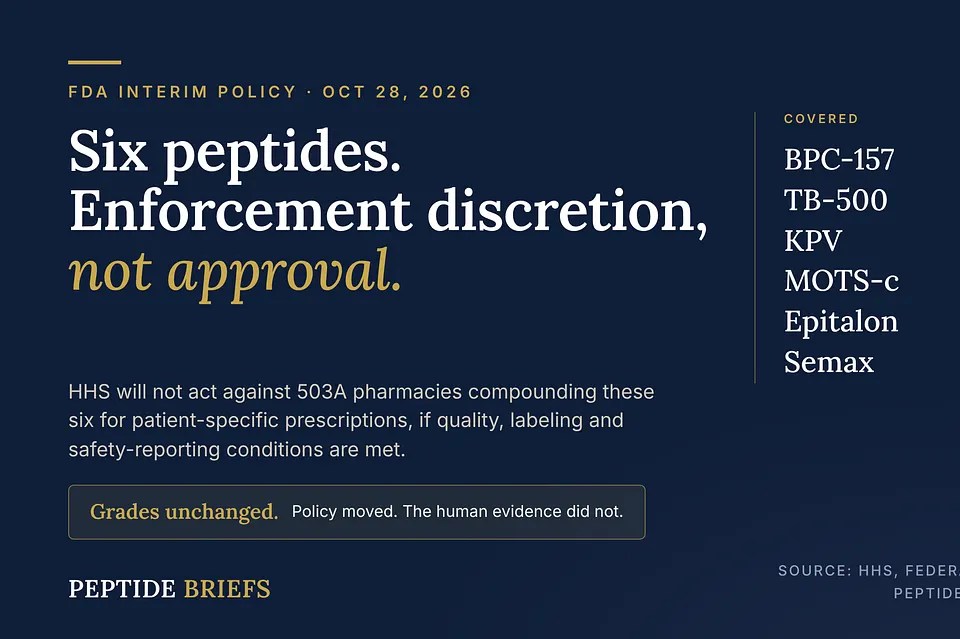
    Today the Department of Health and Human Services published an interim policy in the Federal Register covering six peptides: BPC-157, TB-500, KPV, MOTS-c, Epitalon and Semax. Under it, FDA says it will not take enforcement action against licensed 503A pharmacies and physicians who compound these peptides for individual patients, provided they meet conditions on ingredient quality, manufacturing standards, labeling, safety reporting and patient-specific prescriptions. Several clinicians are reporting an effective date of Friday, October 30.

    Subscribe

    This is the end of a road that started in September 2023, when FDA moved these compounds into Category 2 of its interim bulks policy, effectively blocking pharmacies from compounding them. In April 2026 they were removed from Category 2. In July an FDA advisory committee voted narrowly, 8 to 6 on most of them, to recommend adding all six to the 503A bulks list, over the objection of the agency’s own scientific reviewers. On October 14 HHS sent this interim policy to the White House. It cleared review on October 27 and was published today.

    What it is

    Enforcement discretion. FDA is telling compounding pharmacies it will not pursue them for making these six, as long as the conditions are met. That gives clinics and telehealth providers a workable federal basis to prescribe them for the first time in three years.

    What it is not

    Approval. HHS said explicitly that the policy does not constitute FDA approval of the peptides or of any compounded product made from them. Compounded drugs are not reviewed for safety, efficacy or quality before they reach patients. HHS also said it may reconsider the policy if safety signals or product-quality problems emerge, which is a reminder that this can be withdrawn as easily as it was granted.

    It also does not bind the states. State boards of pharmacy regulate compounding on the ground, and at least one industry figure has already said some states may not follow the federal move.

    And it does not touch research-use products. A vial sold as research-use-only is outside a compounding policy entirely. Nothing in today’s announcement changes the legal status of that market in either direction.

    What the evidence says

    Here is the part that matters most to this library. FDA’s reviewers found no human safety studies for KPV, TB-500, MOTS-c or Epitalon, and found the BPC-157 trials too small and too short to establish safety or efficacy for any proposed use. An independent systematic review published this month in Acta Orthopaedica Belgica searched every major database through June for human BPC-157 data and came to a similar conclusion.

    So the grades here do not move. BPC-157 stays at C. TB-500 stays at C. The others hold where they are. A policy decision about who may dispense a compound is not evidence about whether it works, and this library grades evidence.

    What to watch

    The policy text itself, which should show exactly which conditions pharmacies must meet and whether specific indications are named. Any state board responses. The citizen petition filed last week asking FDA to block compounding of these peptides. And, further out, whether FDA ever starts the formal rulemaking that would put any of the six on the bulks list permanently. The advisory committee’s recommendation was non-binding, and as of today no proposed rule exists.

    Disclosure: I co-own a research-peptide vendor. That is disclosed on every page of this publication and does not affect how compounds are graded here.

    Sources
    Reuters, Oct 28, 2026: US health department to allow temporary sale of some unapproved peptides
    AJMC, Jul 31, 2026: FDA Panel Backs 6 Peptides for Compounding
    Holland & Knight, Oct 2026: Peptides at a Crossroads
    reginfo.gov, RIN 0910-ZD94, Interim Access Policy for Compounding Using Certain Peptides

  • The FDA’s Six: What the Human Evidence Actually Shows

    On July 23-24, 2026, something unusual happened at the FDA’s White Oak campus. The Pharmacy Compounding Advisory Committee, a panel that exists to give the agency outside expert advice, voted against FDA staff’s own written recommendations six times in a row. Reporters in the room described an audible gasp when the first tally was read.

    The result: BPC-157, TB-500, Semax, KPV, MOTS-c, and Epitalon all received committee recommendations for inclusion on the FDA’s 503A Bulks List, the mechanism that lets licensed compounding pharmacies legally prepare patient-specific prescriptions. A seventh compound, Emideltide (DSIP), was voted down.

    This is not FDA approval. It’s not even a final decision. It’s a non-binding recommendation, and as of this writing, two months later, the FDA hasn’t acted on it. Formal rulemaking, if it happens, typically takes 8-12 months.

    But the vote raises a question worth answering properly: what does the actual human evidence say about these six compounds? Not the mechanism papers, not the mouse studies people cite as if they settle the matter. The human data specifically. Here’s the honest picture, compound by compound.

    BPC-157

    Grade: D. Plausible mechanism, essentially no human evidence.

    BPC-157 has zero completed human randomized controlled trials. That’s the single fact that matters most here, and it’s worth sitting with before anything else.

    The closest thing to human-scale data is a recent retrospective count of 1,039 documented users, tracked from nadir to follow-up. That’s a real number, but it measures something different than most people assume: it tells you how many people used the compound, not whether it worked. A usage count and an efficacy result are two different questions, and conflating them is the most common error in how this compound gets discussed.

    The clinical history is also more instructive than most coverage lets on. The original research trail goes back to PLIVA, the Croatian pharmaceutical company that worked with discoverer Predrag Sikiric. PLIVA registered early-stage trials around 2000 that were never published. The research was sold to GSX in 2006, and GSX abandoned it. A separate trial in Tijuana in 2015 was also canceled with no data released. Multiple companies with real resources picked this compound up and walked away. That’s a different story than “suppressed because it works,” but it’s also not nothing.

    TB-500

    Grade: D. Same evidence category as BPC-157.

    TB-500 (a synthetic fragment of Thymosin Beta-4) has an extensive preclinical literature on tissue repair, cell migration, and wound healing. None of it has translated into a completed human clinical trial for the injectable research compound as it’s commonly sold.

    The mechanistic story is genuinely interesting; it’s thought to coordinate the movement of cells involved in tissue repair, which is why it shows up so often in sports medicine and regenerative medicine discussions. But “mechanistically interesting” and “shown to work in humans” remain two separate claims, and only the first one currently has support.

    Semax

    Grade: D, with an asterisk worth understanding.

    Semax has a real research history, just not one that shows up cleanly in a PubMed search. A meaningful share of the literature on Semax (and several other Russian-developed compounds, including some of the older bromantane and actovegin research) exists in Russian-language journals that were never translated or indexed in the databases most Western researchers default to.

    This matters because “no human trials” and “no human trials I can find in English” are different claims, and the discourse around Semax tends to treat them as identical. To be direct about the limits of this caveat: this is a well-documented pattern in the space, and it’s a real gap in how evidence gets surfaced, but it isn’t a claim we’ve personally verified paper-by-paper. Treat it as an important qualifier, not a settled fact that resolves the evidence question in Semax’s favor.

    KPV

    Grade: D. The strongest mechanism of the six, and still zero completed human trials.

    KPV is a three-amino-acid fragment of alpha-MSH, and its mechanism is unusually well-characterized for a compound this size. It enters intestinal and immune cells through the PepT1 transporter, the same carrier that handles dipeptides and tripeptides from digested dietary protein, and once inside, it interferes with the importin-alpha3/p65RelA complex, blocking NF-kB nuclear translocation and suppressing downstream inflammatory cytokines (TNF-alpha, IL-1, IL-6).

    The animal data is genuinely strong: DSS and TNBS mouse colitis models (Dalmasso 2008, Kannengiesser 2008) show meaningful reductions in inflammatory markers. The problem is the translation step. DSS/TNBS mouse colitis models have historically translated to human outcomes at only 10-15%, a sobering number for any compound whose entire efficacy case currently rests on mouse data. Zero completed human RCTs exist for KPV in any indication.

    MOTS-c

    Grade: D. The clearest correlation-vs-causation trap of the six.

    MOTS-c is a 16-amino-acid peptide encoded directly in mitochondrial DNA, discovered in 2015. The animal data (primarily mice) shows real effects on insulin sensitivity, inflammatory markers, and glucose homeostasis.

    The human data that exists is purely observational: exercise increases circulating MOTS-c levels in skeletal muscle and blood. That’s a real finding, but it’s a correlation between exercise and a biomarker, not a controlled trial testing whether giving someone exogenous MOTS-c produces a treatment effect. No published human interventional trial has tested that question. The gap between “your body makes more of this when you exercise” and “taking more of this replicates exercise’s benefits” is exactly the kind of gap that’s easy to paper over with hopeful language, and worth naming directly instead.

    Epitalon

    Grade: D. Same literature-access problem as Semax.

    Epitalon carries a near-legendary reputation in longevity circles, and its research history runs into the same issue as Semax: a real body of work exists, much of it Russian in origin, and much of it sits outside what’s easily searchable in English-language databases. The same caveat applies here as it did for Semax: this is a documented pattern worth naming, not a fully verified claim that resolves the evidence gap.

    The pattern across all six

    Every one of these compounds has a plausible, often well-characterized mechanism. Every one has real preclinical (mostly animal) data supporting that mechanism. And every one is missing the thing that actually determines whether a compound works in people: a completed human clinical trial.

    That’s not a condemnation of any of them. Plenty of compounds with this exact profile eventually clear that bar. It’s just the honest state of the evidence right now, and it’s worth being precise about it independent of the regulatory news cycle.

    Here’s the distinction that matters most going forward: a 503A compounding recommendation, if the FDA eventually adopts it, changes the legal pathway for these compounds. It does not change the evidence. Those are two separate axes, and it’s worth not letting a genuinely significant regulatory story get mistaken for a medical one.

    We’ll keep grading these as the literature moves. If any of the six clears a real human trial, that’s the post that follows this one.