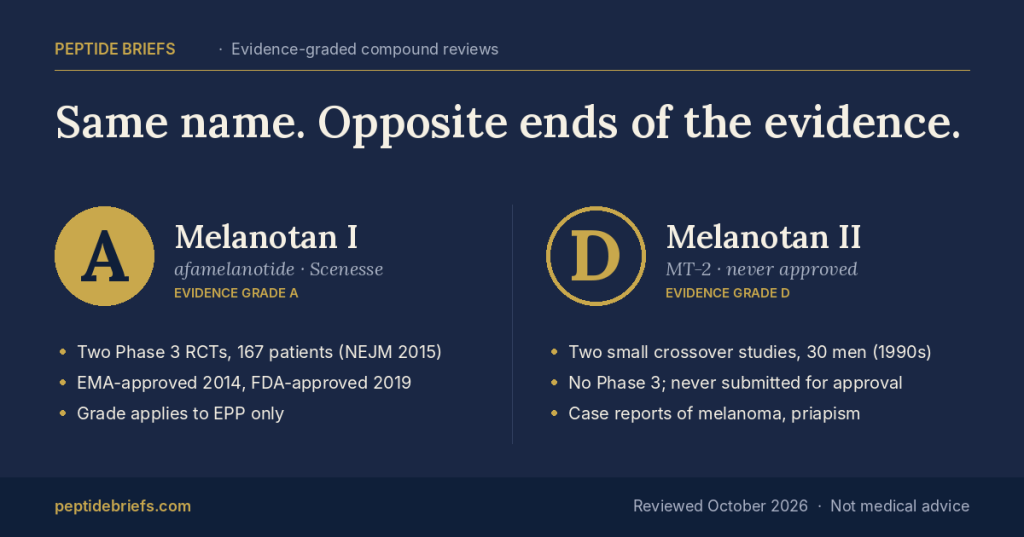
Melanotan I (afamelanotide) — Evidence grade: A (for erythropoietic protoporphyria) — reviewed October 2026
Melanotan II — Evidence grade: D — reviewed October 2026
Controlled human trials: MT-I, two Phase 3 RCTs (167 patients combined); MT-II, two small placebo-controlled crossover studies (10 and 20 men) plus a 3-person pilot
Animal studies: extensive for both (1980s–90s melanocortin pharmacology)
Also known as: MT-I, afamelanotide, Scenesse, CUV1647; MT-II, MT-2, “the Barbie drug”
Sequence: MT-I is a linear 13-residue α-MSH analog (Nle4, D-Phe7); MT-II is a cyclic heptapeptide with a lactam bridge
Why one is an A and the other a D
Both compounds came out of the University of Arizona in the 1980s as analogs of α-melanocyte-stimulating hormone, designed to drive pigmentation without UV. They then went in different directions. Melanotan I was licensed, reformulated as an implant, and taken through two randomized, double-blind, placebo-controlled Phase 3 trials in a rare disease, published in the New England Journal of Medicine, followed by EMA approval in 2014 and FDA approval in 2019. That is the full chain the A requires: pivotal peer-reviewed data plus a regulatory safety review.
Melanotan II stopped at pilot stage. Its human evidence is three decades old, totals a few dozen subjects, was never submitted for approval, and the compound has since accumulated published safety signals from case reports. A D means the literature is not merely thin; it points the wrong way.
What they are
Melanotan I (afamelanotide) is a linear analog of α-MSH that is relatively selective for the MC1 receptor on melanocytes. It is marketed as a subcutaneous implant for adults with erythropoietic protoporphyria (EPP), a genetic photodermatosis causing severe pain on sun exposure.
Melanotan II is a shorter, cyclized analog that activates MC1, MC3, MC4 and MC5 receptors with similar affinity. The non-selectivity explains why its effects were never limited to skin: MC4R activity in the hypothalamus produced the unexpected erection and libido findings that later spun off into bremelanotide (Vyleesi), a different, FDA-approved compound.
Proposed mechanism
Both stimulate MC1R on melanocytes, raising cAMP, upregulating tyrosinase, and shifting pigment production toward eumelanin. In EPP the rationale is photoprotection: more eumelanin absorbs and scatters light before it reaches protoporphyrin-loaded tissue. Afamelanotide also appears to have anti-oxidative and anti-inflammatory effects on skin cells in vitro, which may contribute independent of pigment.
Human evidence
Melanotan I. Langendonk and colleagues ran two multicenter, randomized, double-blind, placebo-controlled trials of afamelanotide implants in EPP, one in Europe (74 patients) and one in the United States (93 patients). The primary endpoint was duration of pain-free sun exposure. In the U.S. trial, median pain-free exposure was 69.4 hours on afamelanotide versus 40.8 hours on placebo; in the European trial the gap was 6.0 versus 0.8 hours. Phototoxic reactions were roughly halved in the European trial but not reduced in the U.S. trial, and quality-of-life scores improved on every measured dimension. Side effects were mild, mostly nausea and headache. Longer-term safety has since been followed in post-marketing registries required by both regulators. mdedge
Melanotan II. The human record is small and old. A 1996 pilot in Life Sciences gave MT-II to three healthy men and recorded dose-dependent tanning alongside nausea, flushing and spontaneous erections. That side effect redirected the program. A 1998 double-blind crossover study in the Journal of Urology reported erections in 8 of 10 men with psychogenic erectile dysfunction versus 0 of 10 on placebo; a pooled report in 2000 covered 20 men with psychogenic or organic ED and found erections in 17 of 20, with nausea and yawning frequently reported and severe nausea in a meaningful minority. No tanning trial in a clinical population was ever completed, and no Phase 3 trials were conducted; the compound was never submitted for FDA approval. Melanotan II (MT-II): A Non-Selective Melanocortin Agonist — Research, Safety, and Regulatory Status +3
Regulatory status
Afamelanotide (Scenesse): EMA-approved December 2014, FDA-approved October 2019, both for adult EPP only.
Melanotan II: not approved for any indication in any jurisdiction; the UK MHRA issued a public warning in 2009 and the FDA has sent warning letters to domestic distributors. In July 2026 the Skin Cancer Foundation issued its own warning, citing case reports of melanoma following use, rapid changes in moles that can mask skin-cancer detection, and reports of systemic toxicity and muscle damage, while noting that case reports cannot establish causation. superpowerskincancer
Gaps and caveats
- The A for afamelanotide is an A for EPP. There is no controlled evidence for cosmetic tanning, and the approval does not transfer to any other indication.
- The two Phase 3 trials disagreed on phototoxic-reaction counts, so the clearest signal is time-in-sun and quality of life, not reaction frequency.
- For MT-II, the strongest human data concern erectile function, not pigmentation, and even those total 30 subjects across two studies.
- The MT-II safety literature is case reports, which prove possibility, not rate. The honest reading is “unknown risk with a known direction,” not “proven harm.”
- Product-quality data matter here: gray-market MT-II vials tested by Breindahl and colleagues contained between 4.32 and 8.84 mg of peptide against a 10 mg label. Identity and purity testing is the only way to know what is actually in a vial. superpower
Key references (verify each on PubMed before pasting; DOIs/PMIDs where confirmed)
- Langendonk JG et al. Afamelanotide for erythropoietic protoporphyria. N Engl J Med. 2015;373(1):48-59. doi:10.1056/NEJMoa1411481
- Dorr RT et al. Evaluation of melanotan-II, a superpotent cyclic melanotropic peptide, in a pilot phase I clinical study. Life Sci. 1996;58(20):1777-1784.
- Wessells H et al. Synthetic melanotropic peptide initiates erections in men with psychogenic erectile dysfunction. J Urol. 1998;160(2):389-393.
- Wessells H et al. Melanocortin receptor agonists, penile erection, and sexual motivation: human studies with Melanotan II. Int J Impot Res. 2000;12 Suppl 4:S74-S79. PMID 11035391
- Breindahl T et al. Identification and characterization by LC-UV/MS of melanotan II in seized internet products. Drug Test Anal. 2015 (confirm volume/pages).
- Skin Cancer Foundation. Warning regarding Melanotan II. July 7, 2026.
- FDA label, Scenesse (afamelanotide) implant, 2019.

